
Direct answer: Yes — but not in the way the scariest headlines suggest. In 2015, the World Health Organization's cancer agency classified processed meat (bacon, sausages, ham, hot dogs, salami) as carcinogenic to humans, and unprocessed red meat (beef, pork, lamb, veal) as probably carcinogenic. The evidence is strongest for colorectal cancer, it grows with the amount eaten, and it is much stronger for processed meat than for a plain steak. But the famous "same category as tobacco" line is a trap: the category measures how sure scientists are that something can cause cancer, not how dangerous it is. Smoking multiplies lung cancer risk many times over; a daily 50-gram portion of processed meat raises colorectal cancer risk by about 18% in relative terms — which, on a typical lifetime risk of about 4.5%, moves it to roughly 5.3%. That is a real increase, worth taking seriously across a whole population, and a small one for any single person. The honest verdict: processed meat every day is a bad habit to keep; a moderate amount of unprocessed red meat is a much smaller, still unresolved risk; and anyone who tells you steak is as deadly as cigarettes, or completely risk-free, is ignoring the numbers.
In October 2015, a two-page summary in The Lancet Oncology detonated the internet's dinner table. The International Agency for Research on Cancer (IARC), part of the World Health Organization, had spent eight days in Lyon, France, with 22 experts from 10 countries reviewing more than 800 studies. Its verdict: processed meat is carcinogenic to humans, and red meat is probably carcinogenic. Within hours, headlines around the world reduced that careful, dose-dependent finding to a single scream: "Bacon is as bad as smoking." Butchers reported angry customers, vegetarians declared victory, carnivore fans declared war, and the actual science — which is genuinely interesting and genuinely unsettled in places — got buried under the shouting.
Eleven years later, the shouting has not stopped; it has organised itself. On one side, plant-based advocates and public-health agencies point to a consistent link with bowel cancer and say the case is closed. On the other, meat-industry groups, carnivore influencers and a growing band of sceptical nutrition researchers say the evidence is weak, confounded and exaggerated, and that guidelines have run ahead of the data. Both sides can point to real studies. Both sides also routinely misread the other side's best argument. This article separates the three questions that get tangled into one: what did the WHO actually say, how big is the risk in numbers a normal person can understand, and where does the evidence genuinely wobble?
First, the definitions: "red" and "processed" are not the same thing
Most of the confusion starts here, because the two categories behave very differently in the data. IARC defined red meat as unprocessed mammalian muscle meat — beef, veal, pork, lamb, mutton, horse and goat. Processed meat is meat transformed through salting, curing, fermentation, smoking or other processes to enhance flavour or improve preservation: hot dogs, ham, sausages, corned beef, beef jerky, canned meat, and meat-based preparations and sauces. A fresh steak and a packet of salami are therefore not the same exposure, and the evidence treats them differently: sufficient evidence for processed meat causing colorectal cancer, limited evidence for red meat.
That distinction matters for every practical decision in this article. If you eat a steak twice a week and never touch processed meat, your profile is not the same as someone eating bacon every morning, a ham sandwich at lunch and sausages for dinner. Studies that lump the two together, or headlines that say "meat causes cancer" without specifying which meat, are hiding the most useful fact in the whole debate.
What the WHO actually said — and the category trap
IARC's classification system ranks agents by the strength of the evidence that they can cause cancer, not by the size of the risk. Group 1 means there is sufficient evidence that the agent causes cancer in humans. Group 2A means it probably causes cancer, based on limited human evidence plus strong mechanistic evidence. Processed meat went into Group 1; red meat into Group 2A.
Here is the trap, and it is worth spelling out because it explains a decade of bad arguments. Tobacco smoking is also Group 1. So is asbestos, and so is sunlight. Group 1 does not mean "as dangerous as tobacco." It means "we are confident it can cause cancer at all." IARC itself said this explicitly at the time, noting that it does not compare the level of cancer risk within a category, and that eating meat is not as dangerous as smoking. The agency's own spokesperson put the individual risk plainly: for an individual, the risk of developing colorectal cancer because of processed meat consumption remains small, but it increases with the amount eaten.
So when a post says "the WHO put bacon in the same category as cigarettes," it is technically true and substantively misleading. And when a meat-industry response says "the WHO only meant hazard, not risk, so ignore it," that is equally misleading in the other direction: IARC's job is hazard identification, but it also published a dose-response estimate, and that estimate is where the real argument lives.
The numbers, honestly: relative risk versus absolute risk
The headline figure from the IARC evaluation is that each 50-gram portion of processed meat eaten daily increases the risk of colorectal cancer by about 18%, and each 100-gram portion of red meat eaten daily increases it by about 17%. A 50-gram portion is roughly one hot dog, two slices of bacon, or a few slices of ham. A 100-gram portion of red meat is a small steak, about the size of a deck of cards.
Those percentages are relative risks: they describe the increase compared with people who eat the least, not the chance itself. To understand what they mean for you, you need the baseline. The lifetime risk of colorectal cancer in the general population is about 4.5% — roughly 1 in 22 people. Raise that by 18% and you get about 5.3%. In other words, out of 1,000 people, about 45 would be expected to develop colorectal cancer over a lifetime without the daily processed meat, and about 53 with it — roughly 8 extra cases per 1,000 people. That is the same arithmetic behind the "7 fewer cancers per 1,000 people" figure that surfaced in coverage of later reviews: small per person, large across a country.
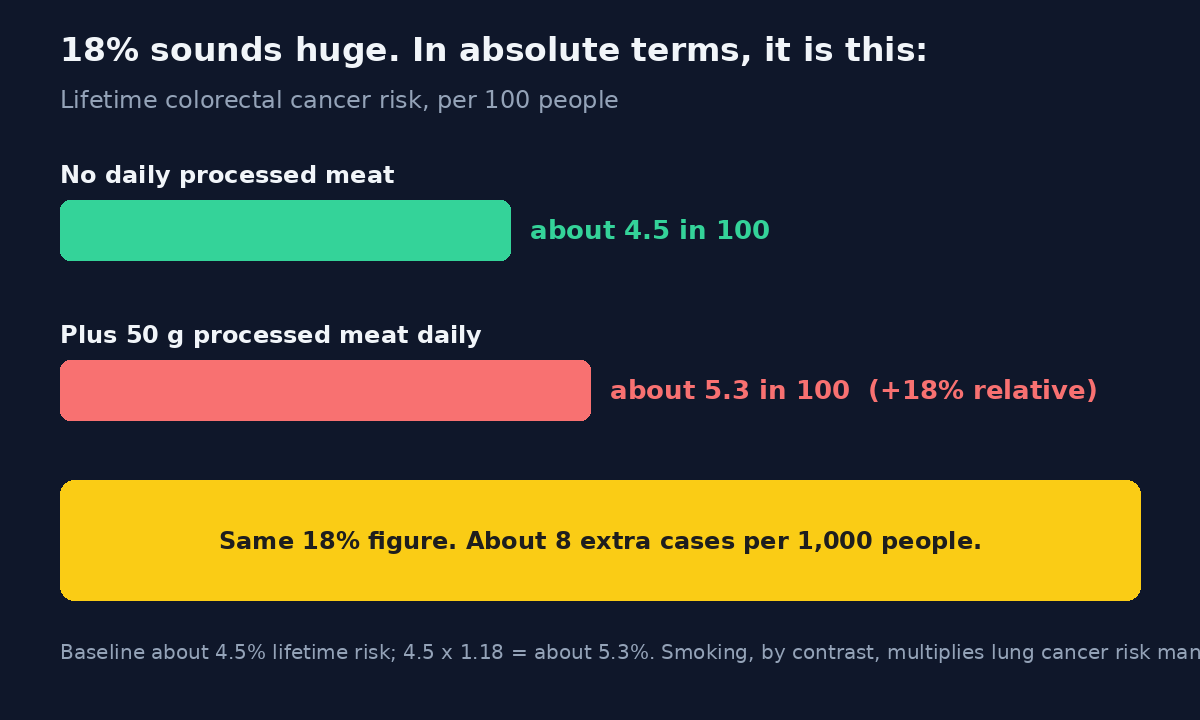
Now compare that with smoking, because the comparison is the whole controversy in miniature. Smoking raises lung cancer risk by roughly 15 to 30 times, not by 18%. Nobody who understands the numbers thinks a bacon sandwich is comparable. But the population picture cuts the other way too: because so many people eat processed meat every day, even a small per-person increase adds up to a large number of cases. The Global Burden of Disease project estimate cited by IARC put cancer deaths attributable to diets high in processed meat at about 34,000 per year worldwide. Against roughly 1 million deaths a year from tobacco smoking and hundreds of thousands from alcohol, processed meat is a minor cause of cancer deaths globally — and still tens of thousands of real cases.
Both statements are true at once: the risk is small for you, and meaningful for public health. Most of the online fight happens because each camp picks one half of that sentence and pretends the other half does not exist.
How meat could cause cancer: the mechanisms
The case for a causal link is not just statistical. There are plausible mechanisms, and they are stronger for processed meat than for fresh red meat — which matches the pattern in the human data.
First, nitrates and nitrites. Processed meats are commonly preserved with nitrites, which in the gut can form N-nitroso compounds, several of which are known carcinogens that can damage DNA in the colon lining. High-temperature cooking adds a second route: frying, grilling and barbecuing meat produces heterocyclic amines and polycyclic aromatic hydrocarbons, compounds formed when meat is cooked at high heat until charred, which are also carcinogenic in laboratory studies.
Second, haem iron. Red meat is rich in haem iron, which can promote the formation of those same N-nitroso compounds in the gut and drive lipid peroxidation — a kind of oxidative damage to cell membranes and DNA. This is one reason the risk signal is stronger for red meat than for white meat: chicken and fish contain far less haem iron.
Third, the gut environment. Processed meat consumption is associated with changes in the gut microbiome and chronic low-grade inflammation, both of which are implicated in colorectal tumour development. None of these mechanisms alone proves the case, but together they make the epidemiological association harder to dismiss as a pure statistical accident. The sceptics' best reply is not that mechanisms do not exist, but that laboratory mechanisms at high doses do not automatically translate into large human risks at ordinary intakes — a fair point, and one we return to below.
The case for the prosecution, stated fairly
The strongest version of the case against heavy meat eating runs like this. The association has been found repeatedly, in many countries, in prospective cohort studies that follow large groups of people for years and record diet before cancer appears — the strongest observational design available for diet. The IARC working group reviewed more than 800 studies and concluded that chance, bias and confounding were unlikely explanations for the processed-meat link. Later large cohorts have kept finding it: a 2019 study in The BMJ following more than 81,000 US health professionals over 16 years found that increasing unprocessed red meat intake by at least three and a half servings a week was associated with a 9% higher risk of dying during the following eight years, and 13% higher for processed meat. The World Cancer Research Fund's continuous update project reached the same dose estimates as IARC — 17% per 100 grams of red meat, 18% per 50 grams of processed meat — and major guidelines, including the World Cancer Research Fund's advice to limit red meat to 350–500 grams per week and eat little if any processed meat, rest on that consistency.
The prosecution also has a dose-response argument: risk rises with amount eaten, which is what you expect from a real cause and not from a one-off statistical fluke. And it has a substitution argument: in the BMJ study and others, replacing red meat with whole grains, vegetables, poultry or fish was associated with lower mortality. If the association were purely about unhealthy people eating more meat, swapping one food for another would not show that pattern so consistently.
The case for the defence, stated fairly
The defence is stronger than the "bacon is fine, science is corrupt" version that circulates online. Its serious form has four parts.
One: the evidence is observational, and observational nutrition research is genuinely fragile. Almost no one is randomised to eat bacon for twenty years, so studies rely on food questionnaires — people misremembering what they ate months ago — and on statistical adjustment for everything else that differs between heavy meat eaters and light ones: smoking, drinking, exercise, weight, income, vegetable intake, screening. Heavy processed-meat eaters, on average, smoke more, move less and eat fewer vegetables. Adjustments try to correct for that, but they cannot correct perfectly for things measured badly or not at all. A 2015–2025 scoping review published in 2026 found exactly this heterogeneity: positive associations in some studies, no significant overall association in others, with results varying by meat type, cooking method, anatomical site and population. That inconsistency is real, and it is concentrated in red meat more than in processed meat.
Two: the absolute effects are small, and the certainty is low. In 2019, the NutriRECS consortium published a series of systematic reviews in the Annals of Internal Medicine and a guideline recommending that adults continue their current red and processed meat consumption. The panel did not dispute that risk might be slightly higher; it judged the evidence low-certainty and the absolute benefit of cutting back — roughly 8% lower lifetime risk of heart disease, cancer and early death from cutting three servings a week, in one summary of the findings — too small to justify a strong recommendation. The reaction was ferocious: Harvard, the American Cancer Society and other institutions called the guideline irresponsible, and some scientists wrote to the journal asking for the papers to be held. But the panel's underlying point — that "low-certainty, small effect" is a different thing from "proven major cause" — is a legitimate reading of the same data, and the ferocity of the reaction arguably proved the panel's point about how politicised nutrition science has become.
Three: newer methods give weaker answers for unprocessed red meat. A 2022 burden-of-proof analysis in Nature Medicine, which grades evidence across many risk factors on a common scale, found only weak or no evidence linking unprocessed red meat consumption with six major health outcomes. Sceptics cite this as a correction to the 2015 verdict; defenders reply that burden-of-proof grading penalises nutrition research for the very observational design that is unavoidable in diet studies, and that "weak" on that scale does not mean "zero."
Four: context and substitution matter. A steak eaten as part of a diet rich in vegetables, whole grains and fibre, by a non-smoker who exercises, is not the same exposure as a processed-meat-heavy diet alongside smoking and obesity — yet headline risk figures rarely carry that context. The defence argues that guidelines aimed at populations get misread as personal death sentences, and that the moral panic drives people toward ultra-processed meat substitutes or restrictive diets that carry their own problems.

Where the two camps actually agree (and what is still genuinely unresolved)
Strip away the slogans, and the camps agree on more than either admits. Both accept that processed meat is the bigger problem. Both accept that dose matters: nobody in the serious literature claims a single steak gives you cancer, or that a lifetime of daily bacon is harmless. Both accept that colorectal cancer has many causes — smoking, alcohol, obesity, inactivity, family history and screening matter at least as much, and for most individuals far more, than any single food.
What is genuinely unresolved is the size of the red-meat effect specifically — as opposed to processed meat — and whether it survives full adjustment for the rest of the diet and lifestyle. The processed-meat link has survived every major review since 2015; the unprocessed red-meat link is consistent in direction but modest in size, variable across studies, and graded as limited evidence by IARC itself. That is why the honest verdict splits: confident about cutting daily processed meat, cautious about condemning moderate fresh red meat.
There is a second unresolved question that gets less attention: cooking and cut. Charred, well-done and smoked meats carry more of the suspect compounds than gently cooked meat; fatty processed meats carry more than lean ones; and the evidence for other cancers beyond colorectal — pancreatic, prostate, stomach — is weaker and more contested than the colorectal finding. A debate that treats "meat" as one uniform thing will keep generating heat, because it is answering a question the data never asked.
At a glance: claim vs evidence
| Claim you will hear | What the evidence actually says |
|---|---|
| Bacon is as dangerous as smoking | False as a risk comparison. Both are Group 1, but the group measures certainty, not size. Smoking multiplies lung cancer risk many-fold; daily processed meat raises colorectal risk by about 18% in relative terms. |
| The WHO says all meat causes cancer | No. Processed meat: carcinogenic (Group 1). Unprocessed red meat: probably carcinogenic (Group 2A), based on limited human evidence. |
| One steak gives you cancer | No. Risk is dose-dependent and cumulative. A single meal is not the unit of risk; a pattern over years is. |
| Daily processed meat raises bowel cancer risk by 18% | Yes, in relative terms per 50 grams a day. In absolute terms, roughly 4.5% lifetime risk becomes roughly 5.3%. |
| Red meat is completely safe | Not established. The red-meat link is smaller and less certain than processed meat, but it has not been refuted, and guidelines still advise limiting it. |
| The 2019 Annals reviews proved meat is safe | No. They judged the evidence low-certainty and the absolute benefit of cutting back small, and recommended continuing current intake — a judgement about recommendations, not a proof of safety. |
| Cutting meat out eliminates bowel cancer risk | No. Most colorectal cancers occur in people for other reasons, and screening, smoking, alcohol, weight and family history matter greatly. |
| White meat and fish carry the same risk | No. The signal is specific to red and processed meat, partly because of haem iron and processing compounds. |
| Grilling and charring make it worse | Plausible and supported mechanistically: high-heat cooking creates heterocyclic amines and polycyclic aromatic hydrocarbons. |
Popular opinions: how divided people actually are
The arguments below are paraphrased from the recurring positions in forums, social media threads and comment sections — not quoted posts, and no usernames are invented or cited. They show the real shape of the divide, which is not "science versus ignorance" but different readings of the same numbers.
"My grandfather ate bacon every day and lived to 94." The most common defence, and the most human. Its weakness is the same as every anecdote about risk: a small increase in risk is invisible in any one life, and the grandfather who lived to 94 is remembered precisely because he beat the odds. Verdict: a true story that proves nothing about averages — and averages are what the 18% figure describes.
"They put bacon in the same group as cigarettes — that tells you everything." This camp is right that the grouping sounds alarming, and wrong about what the grouping means. IARC groups by certainty, not danger, and its own statements say meat is not as dangerous as smoking. Verdict: a true fact used to support a false comparison.
"The studies are all food questionnaires — nobody actually knows what anyone ate." Partly true and genuinely important: dietary recall is noisy, and heavy meat eaters differ from light ones in many ways. Its weakness is overreach: noisy measurement usually dilutes a real association rather than inventing one, and the processed-meat signal has survived across countries, decades and study designs. Verdict: a real limitation, strongest against the red-meat claim, weakest as a dismissal of the whole field.
"Carnivore fixed my health, so the guidelines are a lie." Carnivore and low-carb diets do help some people lose weight and control blood sugar in the short term, usually because they cut ultra-processed food and total calories. The weakness is the leap from personal improvement to population safety: short-term weight loss does not answer a twenty-year cancer question, and there are no long-term trials of all-meat diets. Verdict: a real personal result, not a refutation of epidemiology.
"If you care about cancer, stop smoking and get screened — meat is a distraction." This is the most defensible sceptical position. Smoking, alcohol, obesity and missed screening each move colorectal and overall cancer risk far more than a weekly steak. Its weakness is the false choice: you can quit smoking, get screened, and also eat less processed meat. Verdict: correct about priorities, wrong if used to claim the meat link is zero.
"I just eat less processed meat and keep the steak — that is the sane middle." This is where the evidence actually points: the processed-meat case is strong, the fresh red-meat case is modest and uncertain, and a moderate pattern fits both. Its weakness is only that it makes a boring social media post. Verdict: the position the numbers support, and the one neither camp wants to share.
Notice the pattern, familiar from every food fight: each side reads the same 18% as proof of its own position. One side hears "18% more cancer" and stops listening. The other hears "only 18%" and stops listening. The number itself is neither a death sentence nor a clean bill of health. It is a small, real, dose-dependent increase, concentrated in processed meat, sitting inside a much larger picture of cancer risk.
How to decide for yourself
A practical approach that follows the evidence, rather than a camp, looks like this. Treat daily processed meat as the habit to break first: bacon every morning, ham sandwiches every lunch, sausages most nights is the pattern the data actually indicts. Keep unprocessed red meat moderate — the World Cancer Research Fund's range of 350–500 grams of cooked red meat per week is a reasonable ceiling, not a target — and favour lean cuts cooked without heavy charring. Fill the gap with the foods that show up on the other side of every substitution study: vegetables, beans, whole grains, poultry and fish. And keep the priorities in order: if you smoke, quitting matters more than any dietary change in this article; if you are over 45, or have a family history of colorectal cancer, screening matters more than steak frequency; and if you have symptoms such as persistent blood in your stool, unexplained weight loss or a lasting change in bowel habit, see a clinician rather than adjusting your diet and hoping.
Red meat is not poison, and it is not innocent. It is a food with a real nutritional upside — iron, zinc, vitamin B12, complete protein — and a real, modest, dose-dependent downside, concentrated in its processed forms. The 2015 warning was not a hoax and it was not an apocalypse. It was a measurement: a small risk, multiplied across billions of meals, that is worth knowing about and easy to reduce without giving up steak altogether. The camps will keep fighting over the slogan. The numbers, read properly, point somewhere quieter: less processed meat, moderate fresh meat, and a lot less shouting at the dinner table.
Frequently asked questions
Does red meat cause cancer?
Processed meat is classified as carcinogenic to humans, with the strongest evidence for colorectal cancer. Unprocessed red meat is classified as probably carcinogenic, based on limited human evidence plus strong mechanistic evidence. The risk rises with the amount eaten and is much larger for processed meat than for fresh red meat.
Is bacon really as bad as smoking?
No. Both are in IARC Group 1, but that group measures how certain scientists are that something can cause cancer, not how large the risk is. Smoking multiplies lung cancer risk many times over; a daily 50-gram portion of processed meat raises colorectal cancer risk by about 18% in relative terms, moving a typical lifetime risk from about 4.5% to about 5.3%.
How much red meat is safe to eat?
No intake has been proven risk-free, and guidelines do not promise one. The World Cancer Research Fund advises limiting red meat to 350–500 grams of cooked weight per week and eating little if any processed meat. That range is a ceiling for moderation, not a recommended daily amount.
Does cooking method matter?
Yes, plausibly. High-temperature cooking, grilling, frying and charring produce heterocyclic amines and polycyclic aromatic hydrocarbons, and smoking and curing add nitroso compounds. Gentler cooking, avoiding heavy charring, and choosing fresh over processed meat all reduce the suspect exposures, though they do not eliminate the underlying association.
What did the 2019 Annals of Internal Medicine reviews actually conclude?
The NutriRECS panel reviewed the same broad evidence, judged it low-certainty, judged the absolute benefit of cutting back to be small, and recommended that adults continue their current red and processed meat consumption. Major health organisations strongly disagreed with that recommendation. The reviews did not prove meat is safe; they disagreed about whether the evidence justified a strong recommendation to cut back.
Should I stop eating red meat completely?
The evidence does not require it. The strongest case is against daily processed meat, not against an occasional steak. If you keep red meat moderate, limit processed meat, eat plenty of vegetables and fibre, do not smoke, and take up colorectal screening when eligible, you have addressed the largest risks in this picture. Anyone with a family history of colorectal cancer or worrying symptoms should speak to a clinician about their personal risk.
Sources and further reading
- IARC Monographs Working Group, "Carcinogenicity of consumption of red and processed meat", The Lancet Oncology, 2015 — processed meat classified carcinogenic to humans (Group 1), red meat probably carcinogenic (Group 2A); 50 grams of processed meat a day associated with an 18% higher colorectal cancer risk, 100 grams of red meat a day with 17%.
- World Cancer Research Fund, Continuous Update Project on colorectal cancer — dose estimates and the advice to limit red meat to 350–500 grams per week and eat little if any processed meat.
- Global Burden of Disease estimate cited by IARC — about 34,000 cancer deaths per year worldwide attributable to diets high in processed meat.
- Zheng Y et al., "Association of changes in red meat consumption with total and cause-specific mortality among US women and men", The BMJ, 2019 — 81,000-plus US health professionals followed for 16 years; increasing unprocessed red meat by at least three and a half servings a week associated with 9% higher mortality over the next eight years, 13% for processed meat.
- Johnston BC et al., "Unprocessed red meat and processed meat consumption: dietary guideline recommendations from the NutriRECS Consortium", Annals of Internal Medicine, 2019 — weak recommendation to continue current consumption, based on low-certainty evidence; small absolute effects.
- Lesley et al., burden-of-proof analysis of unprocessed red meat and health outcomes, Nature Medicine, 2022 — weak or no evidence ratings for unprocessed red meat across six outcomes, as reported in subsequent coverage.
- Scoping review of red and processed meat and colorectal cancer risk, 2015–2025 literature, published 2026 — heterogeneous associations varying by meat type, cooking method, site and population.
This article is for general information only and is not medical advice. If you have a family history of colorectal cancer, or symptoms such as blood in your stool, unexplained weight loss or a lasting change in bowel habit, speak to a clinician.
Found this answer useful? This post is part of a series that takes questions many people search for but nobody has answered properly, and gives the real, detailed answer. Earlier in the series: whether fluoride in tap water is safe, whether seed oils are toxic, whether organic food is actually healthier, the MSG food fight and whether expired poison becomes safe. If you have a question you want answered this way, reach out through asadwebs.com.
Be the first to share a useful question or thought.