
Direct answer: No. An expiry date on a poison is the last day the maker guarantees the product's stated properties. It is not the day the product stops being dangerous. Expired poison can be weaker, just as strong, or — for a few chemicals — more dangerous than when it was new. Treat every expired poison as still dangerous, and dispose of it properly. Never consume it, and never test it on yourself, another person, or an animal to "find out."
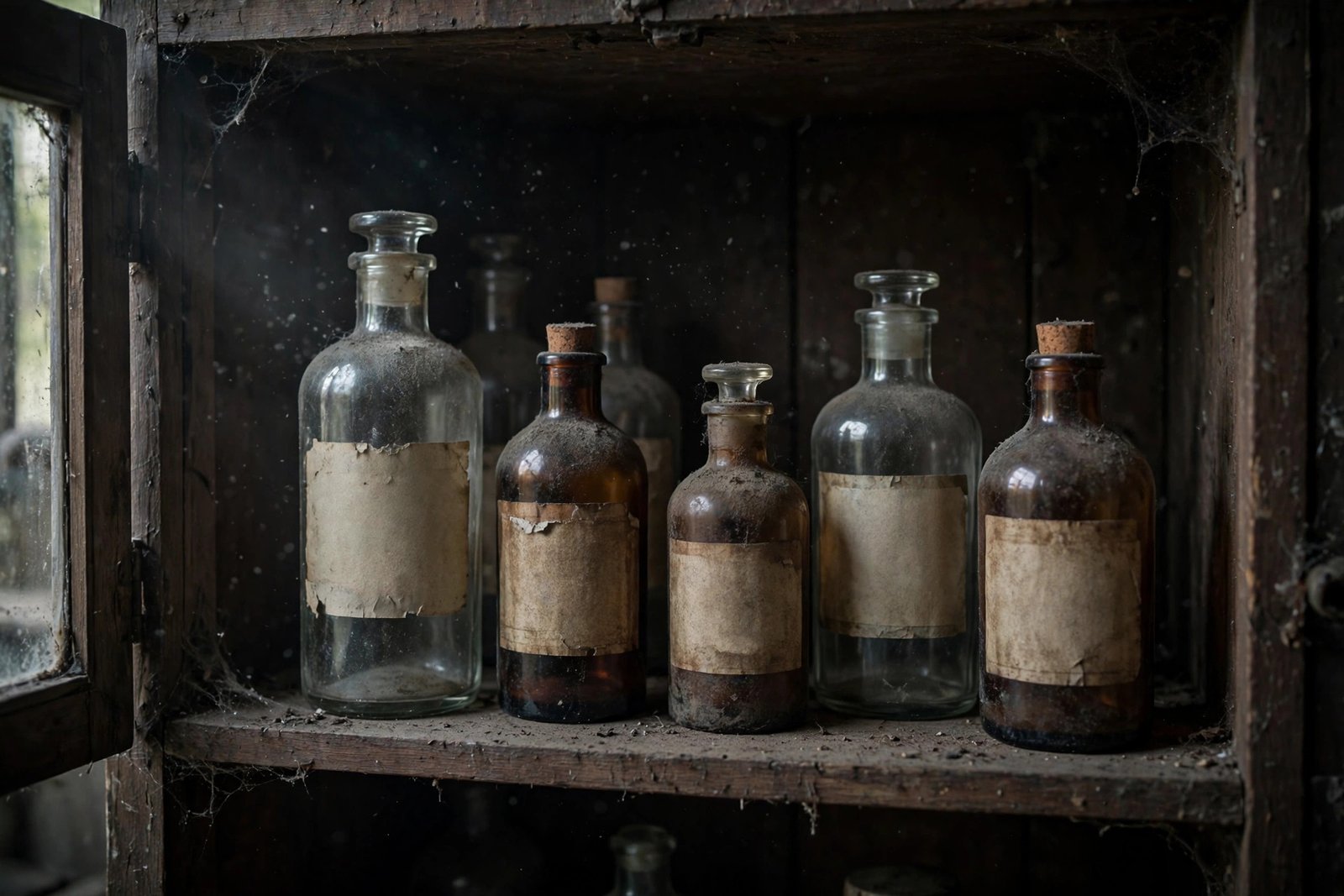 Old chemical bottles forgotten in storage are still dangerous long after their dates pass.
What an expiry date actually means
When a maker puts a date on a chemical product, that date is the end of a guarantee, not the start of safety. Makers test stability, often with accelerated stability testing — exposing a product to heat and humidity to simulate ageing — and then set deliberately conservative dates. Past that date, the maker simply stops guaranteeing the product.
That distinction matters enormously for poison. For a poison, the property being guaranteed usually includes its lethality. So when the date passes, the maker is no longer guaranteeing that the poison works as labelled. That is very different from guaranteeing that it is harmless.
Storage conditions change the picture further. Heat, light, humidity and air all speed up chemical breakdown, so the same product can age very differently in a cool dark cupboard versus a hot, damp shed. And there is no way to tell by looking at a bottle which way it has gone.
The three fates of an expired poison
Every expired poison ends up in one of three places:
- Weaker. Some organic compounds break down gradually, and the product no longer works as intended. But "weaker" is not "safe" — what remains is unpredictable, and you cannot measure how much strength is left by looking at it.
- The same. Many active ingredients are chemically stable for years. The date passes and almost nothing changes. The product is as dangerous as the day it was made.
- More dangerous. A few chemicals degrade into something worse than the original, or become physically more hazardous — for example, explosive — as they age.
The rest of this article shows all three fates with real examples, because the honest answer to "does poison expire" is that it depends entirely on which poison you mean.
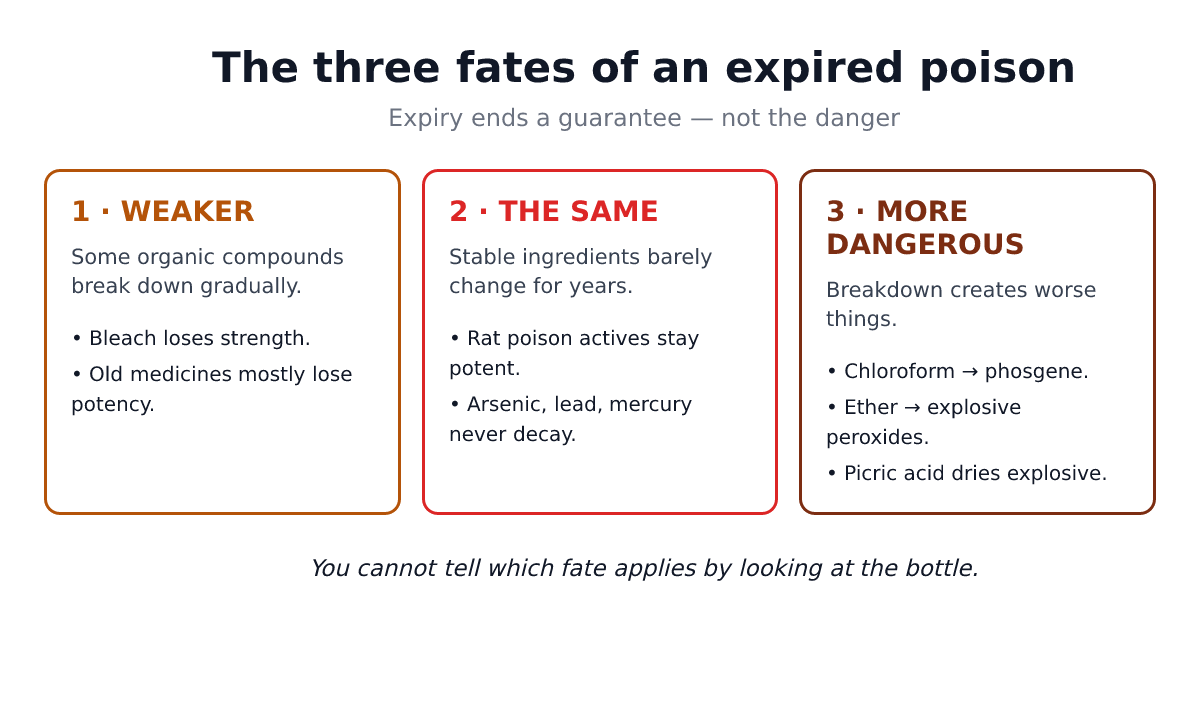 The three fates of an expired poison — weaker, unchanged, or more dangerous — by poison type.
Rat poison: the date is about the bait, not the poison
Rat poison is the clearest example of how misleading an expiry date can be. The date on a rodenticide packet is mostly about the bait going stale. The grains, flavours and attractants mixed into the bait degrade over time, so rats lose interest in eating it. The active ingredient is a different story.
Anticoagulant rodenticides such as warfarin, brodifacoum and bromadiolone, and others such as bromethalin, cholecalciferol and zinc phosphide, stay potent long after the printed date. The poison itself degrades incredibly slowly. An expired packet is therefore not safer — it is mainly less likely to be eaten by the rats, which is a pest-control failure, not a safety improvement.
The Missouri Poison Center notes that most rodenticides do have a shelf life, and that active ingredients degrade faster when stored in humidity or temperature extremes — but it also warns that expired product working less well can lead people to overapply it. That is the trap: a weaker-looking product tempts people to put out more of it, which puts more poison into the environment while the risk to children, pets and wildlife stays the same. Zinc phosphide carries an extra hazard even when old, because it can still release hazardous phosphine gas.
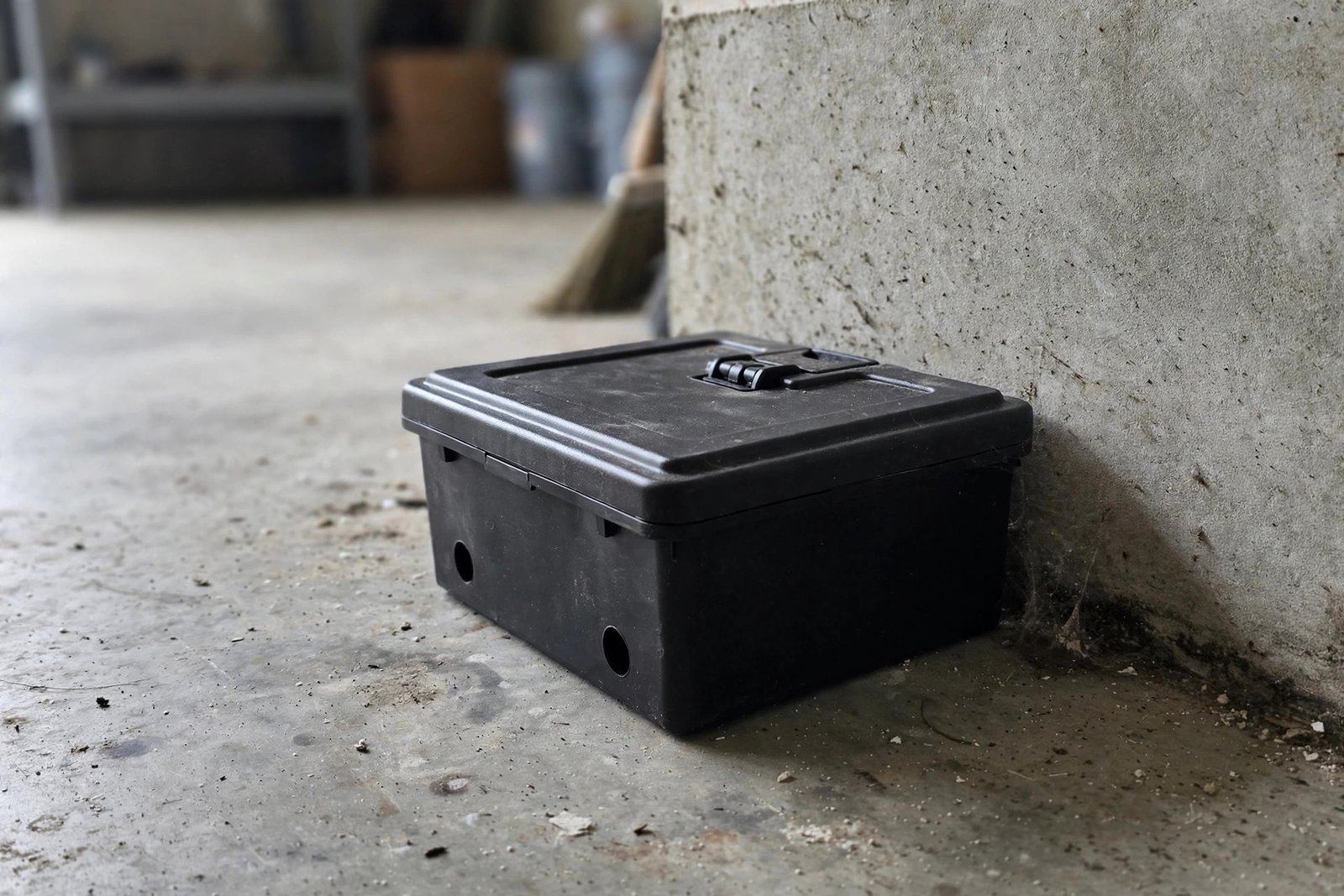 A secured bait station: the bait inside can stay lethal long after the packet's date passes.
Bleach: weaker at cleaning, still harmful to touch
Household bleach is sodium hypochlorite, and it breaks down over time into salt and oxygen. Its shelf life is roughly 6 to 12 months, and it loses about 20% of its effectiveness per year — figures cited by Reader's Digest from Mississippi's state chemist and Clorox's in-house scientist. Lab Alley notes that a 5% solution loses roughly 50% of its available chlorine in 300 days at room temperature.
So old bleach is genuinely worse at disinfecting and whitening. But "worse at cleaning" is not "harmless." Expired bleach is still an irritant and still corrosive, and it is nowhere near as innocuous as the salt water it is slowly becoming. And one rule never expires with it: never mix bleach with ammonia, which produces toxic chloramine gas, or with acids, which release chlorine gas. That is true of fresh bleach and old bleach alike.
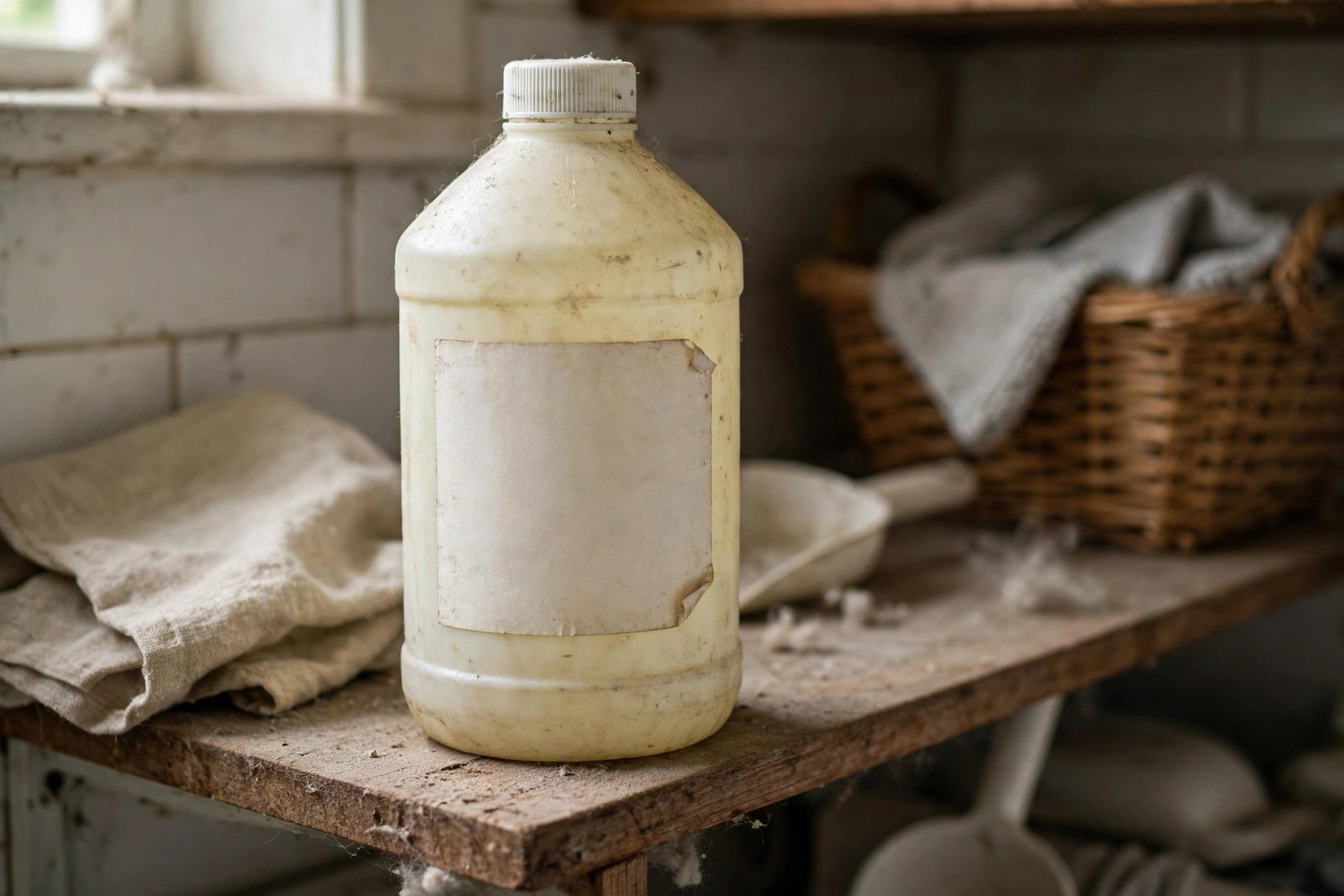 Old bleach loses cleaning power over time — but it stays an irritant and a corrosive.
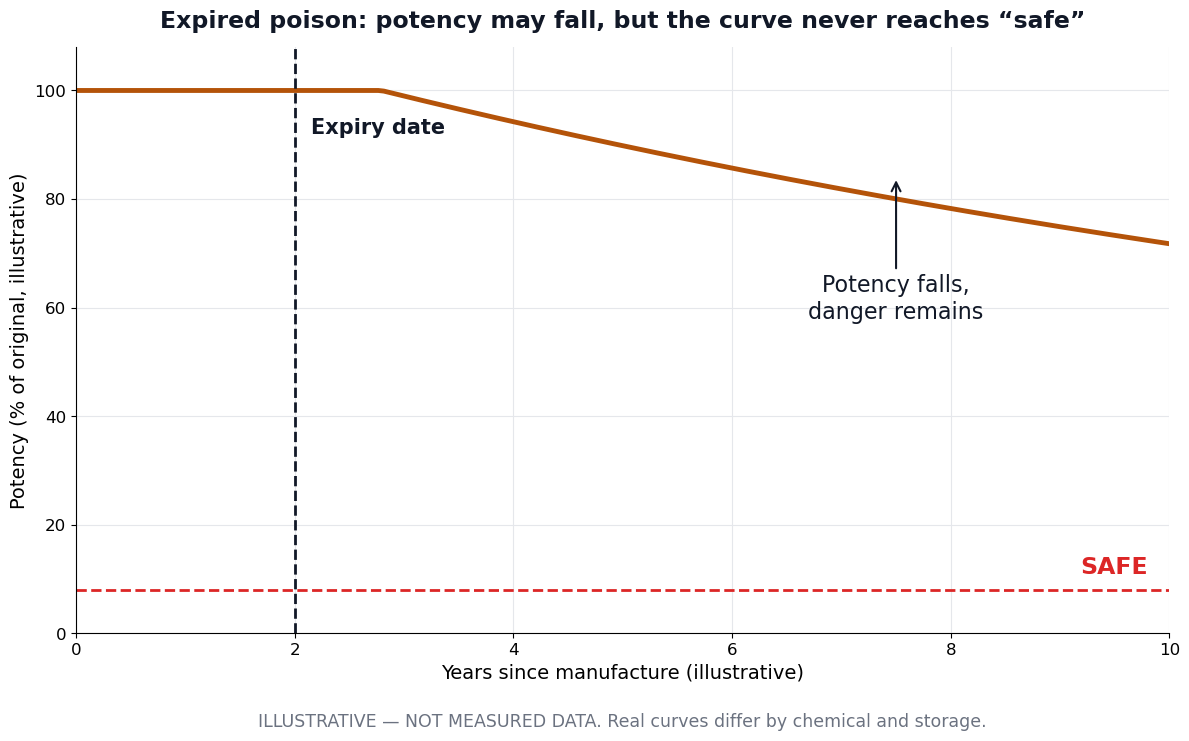 Illustrative only, not measured data: potency may fall after expiry, but the curve never crosses into "safe."
Pesticides: the same logic, briefly
The same logic covers most household pesticides and insecticides. Their dates mark guaranteed effectiveness, not a safety boundary, and breakdown is slow and heavily dependent on storage. An old tin of insecticide that no longer kills insects reliably can still harm a child, a pet, or a non-target animal. Do not read an expiry date as permission to handle it casually.
Medicines: the revealing contrast
Medicines show why expiry dates confuse people — because with medicines, the story points the other way. The FDA and the US Department of Defense ran the Shelf Life Extension Program (SLEP) from 1986, testing stockpiled medicines past their dates. Across more than 3,000 lots of 122 different drugs, about 88% retained potency past expiry, with an average extension of 66 months — roughly five and a half years.
A drug's expiry date is the last date the maker guarantees at least 90% of its labelled potency. For most solid medicines, passing that date mainly means a weaker dose, not a new danger. There are real exceptions where expiry genuinely matters: insulin, nitroglycerin, rescue inhalers, seizure medicines, and liquid antibiotics, where contamination is an added risk. And there is one famous historical case — old tetracycline was historically reported to become toxic after expiry, though modern formulations have largely addressed that concern.
The contrast is the point. With medicine, expiry mostly means "might not work." With poison, expiry never means "now safe." The two product types fail in opposite directions, and confusing them is exactly how people get hurt.
Inorganic poisons: the ones that effectively never expire
A large class of poisons simply does not decay. Arsenic trioxide does not expire. Lead acetate does not expire. Mercury compounds do not expire. Cyanide salts kept in sealed containers remain lethal indefinitely. The reason is basic chemistry: these are elements and simple inorganic compounds, and an atom of arsenic is an atom of arsenic whether it was refined last year or a century ago. There is no complex molecule to fall apart.
Even when inorganic poisons react with their surroundings, the products tend to stay toxic. Mercury oxide is still poisonous. Lead paint weathers into lead dust, which is more easily inhaled and arguably more dangerous than the intact paint was. For this whole class, time does not diminish the hazard — it sometimes moves it into a form that is easier to encounter by accident.
The more-dangerous exceptions: three chemicals that get worse with age
This is the part most short answers leave out. A few chemicals do not just stay dangerous — they become more dangerous as they age.
Chloroform turns into phosgene. Chloroform exposed to light and air degrades into phosgene, an extremely toxic gas, by a light-catalysed reaction: 2CHCl₃ + O₂ → 2COCl₂ + 2HCl. That is why chloroform is stored in the dark, in amber bottles, stabilised with ethanol. Old or improperly stored chloroform is therefore more dangerous than fresh chloroform: anyone exposed gets a double hit, the chloroform itself plus the phosgene already present in the vapour. Tulane University's environmental health and safety guidance says to dispose of chloroform 12 months after opening, or after 3 years unopened if it is ethanol-stabilised.
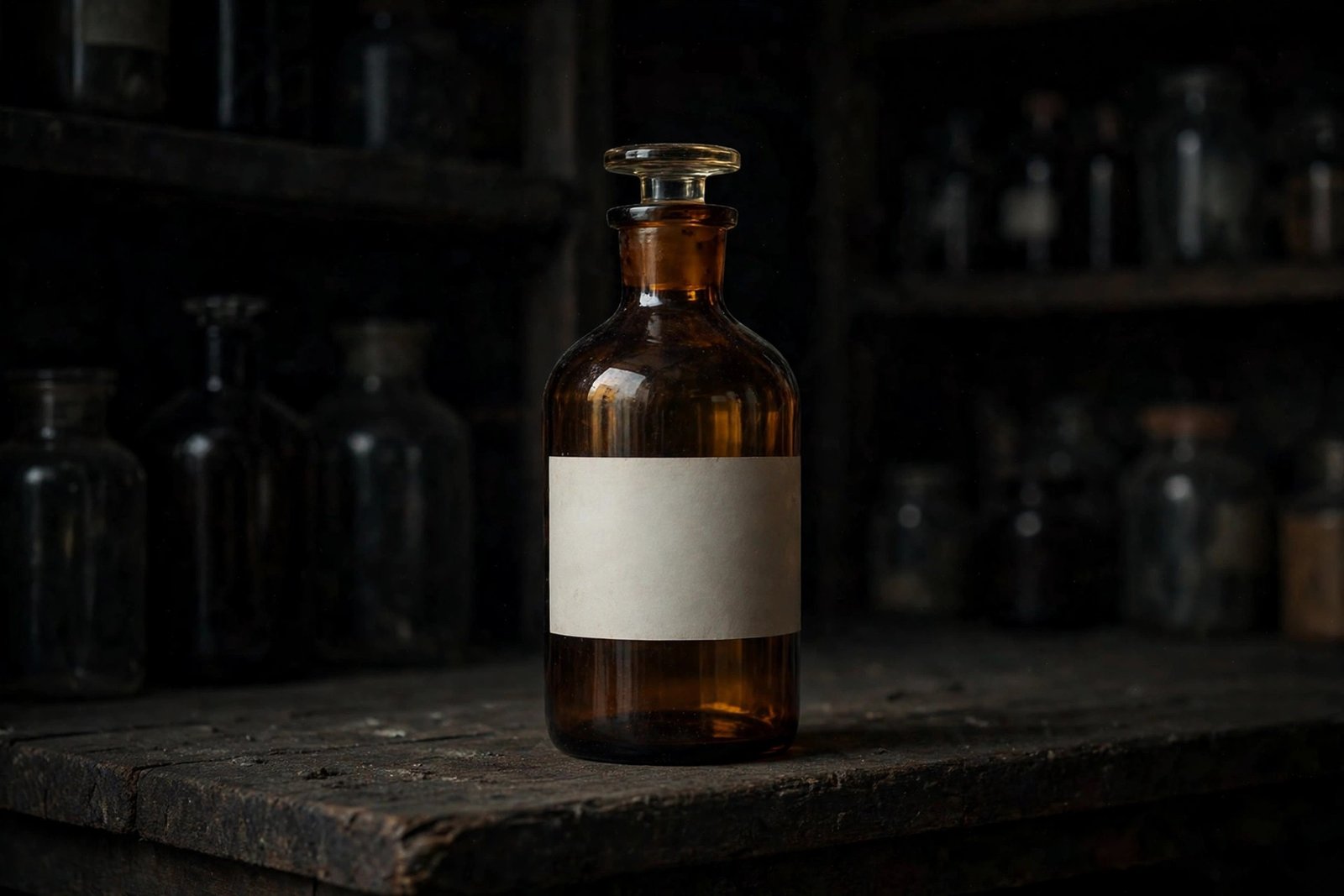 Chloroform is kept in amber bottles in the dark for a reason: light and air turn it into phosgene gas.
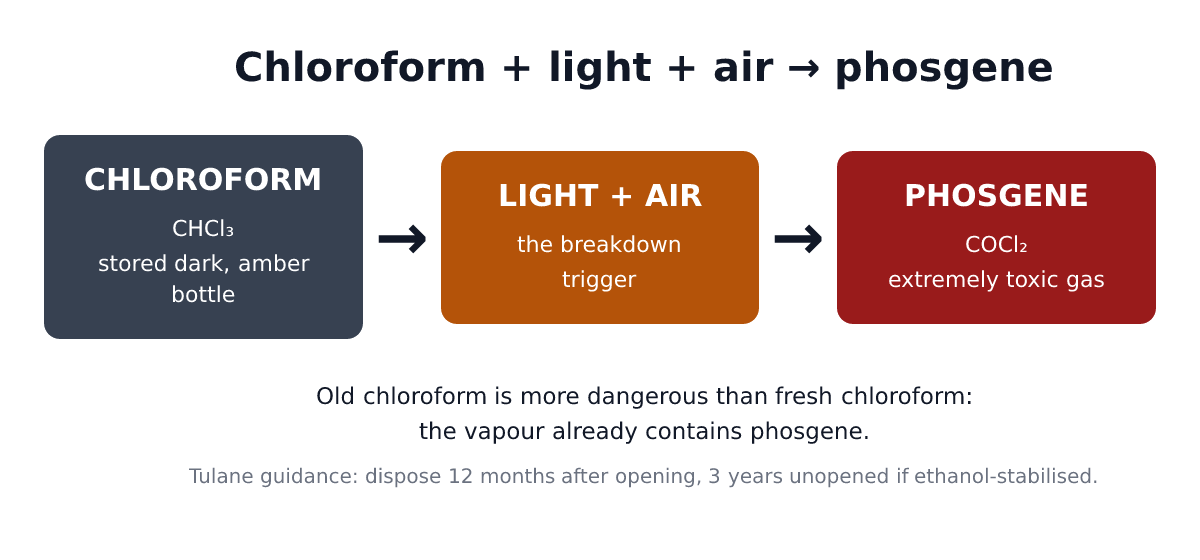 Chloroform + light + oxygen → phosgene, an extremely toxic gas. This is why old chloroform is more dangerous, not less.
Old ether can explode. Diethyl ether reacts with air and light to form explosive peroxides. Those peroxides can detonate when concentrated by distillation or evaporation, or on shock or heat. The University of York's safety page records a bottle of diethyl ether exploding after years of storage. Opened containers should not be kept beyond roughly 6 to 12 months. This is a chemical that does not become safer with age — it becomes a bomb.
Dry picric acid is a high explosive. Picric acid must be kept wet, with at least 10 to 30% water depending on the institution's protocol. In dry form it is a shock-sensitive high explosive: the University of Auckland's protocol gives its detonation velocity as 7,350 metres per second, against 7,300 for TNT. Worse, it forms metal picrates on contact with metals and concrete, and those salts are even more sensitive — calcium picrate is friction-sensitive. Case Western Reserve University's guidance is blunt: if you find an old container of dry picric acid with a metal cap, do not touch it. Removing it is a job for the bomb squad or environmental health and safety, literally.
At a glance: what expiry changes, and what it does not
| Poison type | What expiry actually changes | Still dangerous? |
|---|---|---|
| Rat poison (anticoagulants and others) | Bait goes stale; active ingredient stays potent | Yes — long after the date |
| Bleach (sodium hypochlorite) | Loses about 20% of its effectiveness per year | Yes — still an irritant and corrosive |
| Household pesticides | Guaranteed effectiveness fades, slowly | Yes |
| Medicines (for contrast) | Mostly a weaker dose; a few exceptions matter | Different question — see the medicines section |
| Inorganic poisons (arsenic, lead, mercury, cyanide salts) | Effectively nothing | Yes — indefinitely |
| Chloroform | Degrades into phosgene gas | Yes — more dangerous |
| Diethyl ether | Forms explosive peroxides | Yes — explosion risk |
| Picric acid | Drying out makes it a shock-sensitive explosive | Yes — explosion risk |
Why "a bit weaker" is still not safe
Even for poisons that genuinely lose strength, "weaker" never means "safe to consume," for four reasons:
- The dose is unpredictable. You cannot know how much potency is left, so there is no safe amount to assume. A dose that would only sicken an adult can seriously harm a child or a pet.
- Children and pets are the ones who find old products. Forgotten bottles in sheds, garages and cupboards are exactly where children and animals encounter them.
- Secondary poisoning. A poisoned rodent can poison a pet or wild animal that eats it, long after the bait itself has expired.
- The overapplication trap. When an expired product seems to work less well, people use more of it — more poison in the environment, same risk to everyone who is not the target.
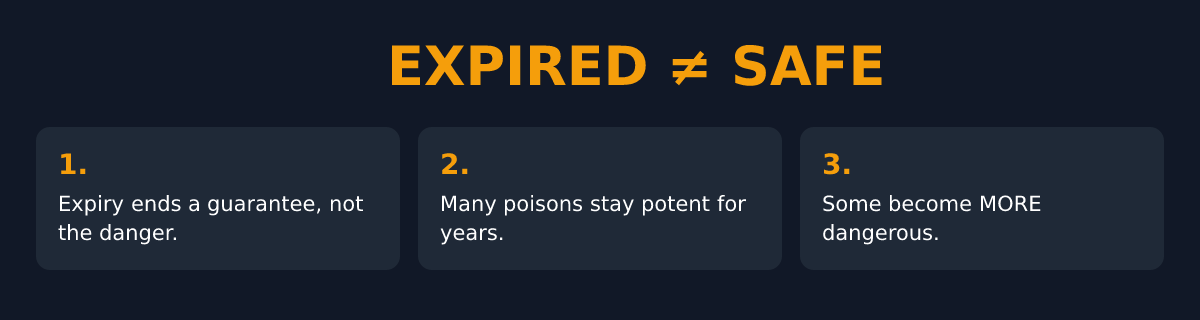 Expired ≠ safe: three reasons the date on the bottle is not a safety boundary.
Popular opinions: what people say on Reddit and Quora
The question itself circulates as a classic showerthought — "if poison expires, will it be more or less deadly?" — and as a Quora chemistry question, and the answers disagree with each other so sharply that the question keeps coming back. Here are the claims you will actually meet online, and how each one holds up against the facts above.
"It just gets weaker, so expired poison is basically safe." This is probably the most common forum answer, and it is the most dangerous one. Verdict: myth. Some poisons do get weaker, but many stay potent for years, and nothing on the bottle tells you how much strength is left. Weaker is not safe.
"Toxicity doesn't change after the expiration date." This one-line answer is popular because it sounds scientific. Verdict: partly true. It holds for chemically stable products — rat poison actives, inorganic poisons — but it is misleading as a blanket rule, because some chemicals genuinely degrade and a few become worse.
"Expired rat poison makes rats immune." Seen in question-and-answer threads. Verdict: myth. What actually happens is bait shyness: rats eat a sub-lethal amount, feel sick, and learn to avoid the bait — and the bait itself goes stale. That is not immunity, and the poison still kills pets, wildlife and children who encounter it.
"Expired poison becomes MORE poisonous." A common gut-feel answer: expiry must add intensity. Verdict: myth as a general rule, true for specific chemicals. Chloroform degrading into phosgene, ether forming explosive peroxides, and picric acid drying into an explosive are real cases — but they are exceptions, not the rule.
"It depends on the poison and how it was stored." This is the answer serious Quora chemistry contributors give: organic compounds break down, inorganic ones do not, and storage conditions decide the speed. Verdict: true. It is the correct framing, and it is the backbone of this article.
The pattern is worth noticing: the shortest, most confident answers online are the least accurate, and the careful answers all say the same thing — it depends on the chemical, and "depends" is never a reason to assume safety.
Safe disposal: what to do with expired poison
- Follow the label directions first — they are specific to the product.
- Take household chemical poisons to a household hazardous waste collection event or site, run by your local waste or health department.
- Take expired medicines to a drug take-back program, where one is available.
- As a last resort only, Poison Centers and FDA guidance describe an at-home method for many household toxins: mix the substance with an undesirable material such as cat litter or used coffee grounds, seal it in a plastic bag or container, and then place it in the regular trash, so it cannot be accidentally swallowed by people or pets.
- Never pour toxic chemicals down the drain or into the regular trash without following the guidance for that product.
- Remember that even an empty container can hold toxic residue — dispose of packaging as the label directs.
If someone is exposed
Call your local poison control centre or emergency services immediately. Do not try home remedies, and do not induce vomiting unless a professional tells you to. Do not wait to see whether symptoms develop — with poisons, early professional advice is the treatment.
Frequently asked questions
Does rat poison expire?
Yes, but the date is about the bait's effectiveness, not the poison's danger. The bait goes stale and rats lose interest, while the active ingredient stays potent long after the date. Expired rat poison is still lethal to children, pets and wildlife.
Does bleach expire?
Yes — household bleach has a shelf life of roughly 6 to 12 months and loses about 20% of its effectiveness per year. But expired bleach is still an irritant and corrosive, and it must never be mixed with ammonia or acids.
Does expired medicine become poison?
Generally no. Most expired medicines mainly lose potency. The exceptions are medicines where precise dosing is critical or contamination is a risk — insulin, nitroglycerin, rescue inhalers, seizure medicines and liquid antibiotics. One historical exception, old tetracycline, was reported to become toxic, though modern formulations have largely addressed that.
Can poison become more dangerous after expiry?
Yes, for specific chemicals. Chloroform degrades into phosgene gas, old ether forms explosive peroxides, and picric acid becomes a shock-sensitive explosive when it dries out. As a general rule, though, "more dangerous" is the exception — the rule is that expired poison stays dangerous.
Sources and further reading
Missouri Poison Center (rodenticides); Tulane University Environmental Health and Safety (time-sensitive chemicals); University of York Department of Biology (peroxide-forming chemicals); University of Auckland Chemical Risk Management Protocol (picric acid); Case Western Reserve University Environmental Health and Safety (picric acid); FDA / US Department of Defense Shelf Life Extension Program, as reported; Reader's Digest, citing Mississippi's state chemist and Clorox's in-house scientist (bleach); Lab Alley (sodium hypochlorite shelf life).
This article is for general information only and is not medical advice. If someone has been exposed to a poison, call your local poison control centre or emergency services immediately.
Found this answer useful? This post is part of a series that takes questions many people search for but nobody has answered properly, and gives the real, detailed answer. If you have a question you want answered this way, or you need help with your own website or content, reach out through asadwebs.com.
Be the first to share a useful question or thought.