
Direct answer: Fluoride in tap water at the recommended United States level of 0.7 milligrams per litre is neither proven poison nor proven beyond doubt. The cavity benefit is real: the CDC reports drinking fluoridated water reduces tooth decay by about 25% in children and adults. The brain risk is also no longer a fringe claim: the US National Toxicology Program concluded in 2024, with moderate confidence, that higher fluoride exposure is consistently associated with lower IQ in children, and a 2025 meta-analysis of 74 studies found the same inverse association. The honest gap sits exactly where most people drink: at 0.7 mg/L, the NTP said the data were insufficient to determine whether IQ is affected, while the best-quality studies in the 2025 meta-analysis still showed an inverse association below 1.5 mg/L. So the fair verdict is this: high fluoride clearly carries a signal worth taking seriously, ordinary fluoridated water has a real dental benefit, and the safety of the everyday level — especially total exposure during pregnancy and early childhood — is genuinely unresolved. Anyone who tells you the case is closed, in either direction, is selling you a slogan, not the science.
Turn on a tap in most American cities and you are drinking the outcome of one of the longest arguments in public health. One side calls fluoridation one of the greatest achievements of the twentieth century, a cheap, invisible shield that has saved millions of teeth, especially for children whose families cannot afford a dentist. The other side calls it mass medication without consent, a chemical dosed into everyone's water whether they want it or not, now linked by federal scientists to lower IQ in children. In 2024 a federal judge agreed the risk was serious enough to order the Environmental Protection Agency to act. In 2025 two states banned the practice outright. In 2026 an appeals court threw the judge's order out — on procedure, without deciding the science — and sent the whole fight back to square one.
That whiplash is exactly why this question belongs in this series. It is searched by millions of parents, argued furiously in comment threads and council meetings, and answered almost everywhere by people who have already picked a side. The real answer is messier, and more useful: the two camps are arguing about different doses, different kinds of evidence, and different values, and the most important number in the debate is not in your tap at all. It is your total exposure, from every source combined.
First, what is actually in the water?
Fluoride is a naturally occurring mineral, found in rocks, soil, water and food. It is not invented in a laboratory for water treatment. What water fluoridation does is adjust the level: if a community's water is naturally low in fluoride, a small amount of a fluoride compound is added to bring it up to the level recommended for preventing cavities. If the water is naturally high, nothing is added — and in some places, fluoride must be removed.
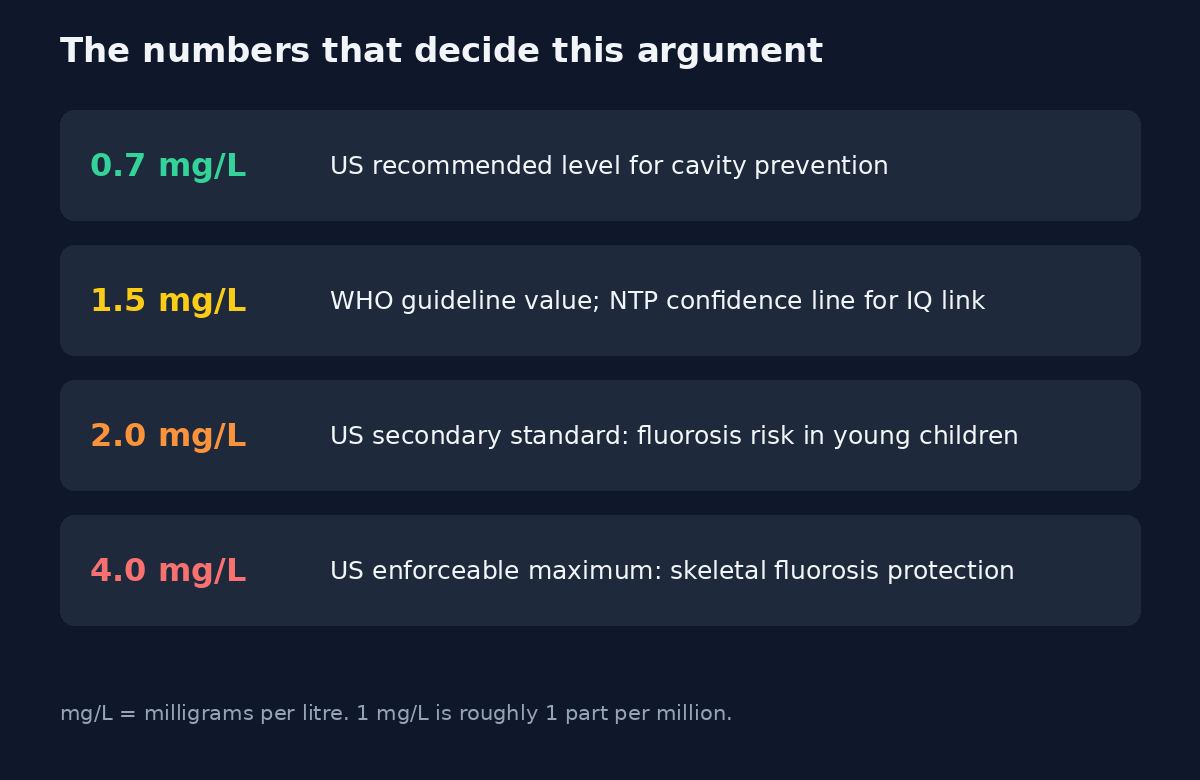
The numbers matter, because this entire debate is a debate about dose. Here is the ladder, in milligrams per litre (mg/L), where 1 mg/L is roughly 1 part per million:
- 0.7 mg/L — the United States Public Health Service recommendation since 2015, a single level chosen to maximise cavity prevention while minimising dental fluorosis.
- 1.5 mg/L — the World Health Organization's guideline value for fluoride in drinking water, and the line above which the NTP expressed moderate confidence in the IQ association.
- 2.0 mg/L — the US secondary standard: above this, water systems must notify consumers, because regular consumption may increase the risk of dental fluorosis in children under nine.
- 4.0 mg/L — the US enforceable maximum contaminant level, set to protect against skeletal fluorosis, a painful bone condition from many years of very high exposure.
Keep that ladder in mind. Almost every misleading claim in this debate comes from sliding up or down it without telling you. A study of children drinking water at 3 or 4 mg/L does not prove that water at 0.7 mg/L harms anyone. A study showing benefit at 0.7 mg/L does not prove that 3 mg/L is safe. The question is never "is fluoride safe?" in the abstract. It is always "at what dose, for whom, and from all sources combined?"
A short history: from a Michigan experiment to a national habit
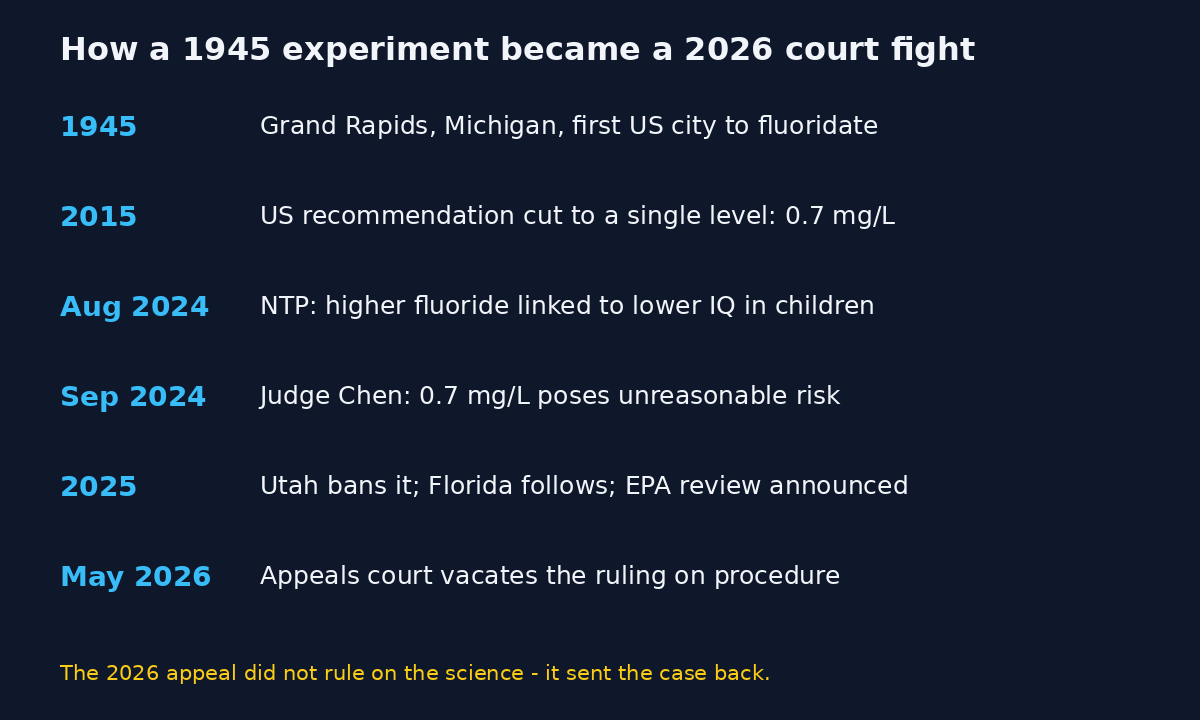
In January 1945, Grand Rapids, Michigan, became the first city in the United States to fluoridate its water supply deliberately to prevent tooth decay. Cavities in children fell, other cities followed, and by 1951 fluoridation was official policy of the US Public Health Service. The CDC later named fluoridation of drinking water one of the ten great public health achievements of the twentieth century, alongside vaccination and motor-vehicle safety, because of the dramatic decline in tooth decay that followed.
For decades the recommended range was 0.7 to 1.2 mg/L, varying with climate on the theory that people in hotter places drink more water. In 2015 the recommendation was simplified to a single level, 0.7 mg/L, partly because Americans were now getting fluoride from many other sources — toothpaste above all — and the old upper range was no longer needed to get the benefit.
That last point is the hinge of the modern debate. In 1945, fluoridated water was nearly the only fluoride most children got. Today it is one source among several: fluoride toothpaste used twice a day, mouth rinses, dental treatments, some foods and teas, and, for babies, infant formula mixed with tap water. The benefit case and the risk case both changed when the background exposure changed — and the argument has never fully caught up.
The case for fluoridation, stated fairly
The case for keeping fluoride in the water rests on three claims, and the first two are strong.
First, it works on teeth. The mechanism is mostly topical, not systemic: fluoride in saliva and on tooth surfaces helps remineralise enamel and makes it more resistant to acid from bacteria. The CDC's headline figure is that drinking fluoridated water reduces cavities by about 25% in children and adults, and the Community Preventive Services Task Force has reported even larger reductions in children when fluoridation starts early, with cavities rising again when fluoridation stops. Systematic reviews, including Cochrane reviews, have consistently found fewer decayed teeth in fluoridated communities, for both baby teeth and adult teeth.
Second, it is equitable in a way almost nothing else in dentistry is. Toothpaste helps only if you buy it and use it properly. A dentist helps only if you can get an appointment and pay for it. Fluoridated water reaches everyone on the same supply, regardless of income, education or insurance, including the children who need it most. This is the argument dentists return to whenever a ban is proposed: remove fluoride from the water, they say, and the cavities will not fall evenly. They will fall hardest on the poorest children.
Third, supporters say the safety record at 0.7 mg/L is long and reassuring: eighty years of use, endorsed by the CDC, the American Dental Association, the American Medical Association and the World Health Organization, with the main established side effect being dental fluorosis — white spots or, at higher exposure, staining and pitting of developing teeth — which is cosmetic in its mild form and does not affect tooth function. Severe fluorosis is rare at recommended levels.
That is a serious case. It is also, as we will see, a case that answers a slightly different question from the one the critics are now asking.
The case against fluoridation, stated fairly
The case against rests on four arguments, and they deserve the same fair hearing.
Argument one: consent and dose. Nobody's dose is controlled. A baby drinking formula mixed with tap water, a labourer drinking litres on a hot day, a pregnant woman, a child who also swallows toothpaste — all get different amounts from the same tap, and none of them chose it. Supporters call this a public-health trade-off, like chlorinating water. Critics call it medication without a prescription, and point out that no doctor would prescribe the same dose to every patient regardless of age, weight or health.
Argument two: the IQ signal. This is the argument that changed the debate from a fringe fight into a federal court case, and it is built on studies, not vibes. We will examine it in full below, because it is the load-bearing claim of the whole controversy.
Argument three: the benefit has shrunk. Critics argue that the 25% figure comes substantially from an era before fluoride toothpaste, when water was the only source. Today, they say, toothpaste delivers fluoride directly to teeth — the topical route that does most of the work — so the extra benefit of swallowing it in water is smaller than it was in 1945, while the risk, if any, comes precisely from swallowing it. If the benefit now comes mostly from the toothpaste, why keep the water route at all?
Argument four: other countries manage without it. Most of Western Europe does not fluoridate its water — Germany, France, the Netherlands, Sweden and others rely on fluoride toothpaste, and in some places fluoridated salt or milk — and their children's teeth improved over the same decades, too. Supporters reply that Europe's improvement came from the same fluoride, delivered differently, and that salt and milk programmes have their own coverage problems. But the European example at least proves that fluoridated water is not the only way to get the dental benefit, which weakens any claim that removing it must be a catastrophe.
The IQ evidence: what the federal review actually found
In August 2024, after years of work and peer review, the National Toxicology Program (NTP) — part of the US National Institutes of Health — published its monograph on fluoride exposure and neurodevelopment and cognition. It was a systematic review, not a single experiment: it gathered and graded the published studies on fluoride and children's IQ, mostly observational studies from countries including China, India, Iran, Mexico and Canada, where natural fluoride levels in water are often far higher than in the United States.
Its headline conclusion, stated with moderate confidence, was that higher fluoride exposure is consistently associated with lower IQ in children. Of the studies rated high quality, 18 of 19 found that higher fluoride was associated with lower IQ, and most of the lower-quality studies pointed the same way. The associations were mainly — but not exclusively — seen at exposures above the WHO guideline value of 1.5 mg/L.
And then came the sentence that both camps have spent two years trying to bury: the NTP explicitly did not conclude that fluoride at the recommended US level of 0.7 mg/L lowers children's IQ. It said there was insufficient data to determine whether exposure at that level affects cognitive development. The monograph also did not assess the dental benefits of fluoride or perform a risk-benefit analysis — it was a hazard review, answering "can higher fluoride be linked to lower IQ?" rather than "is your tap water safe?"
In January 2025, the same research team published a meta-analysis in JAMA Pediatrics covering 74 epidemiological studies and more than 20,000 children. It found a significant inverse association between fluoride exposure and children's IQ scores overall, with a standardised mean difference of minus 0.45, and a dose-response pattern: in individual-level analyses, each 1 mg/L increase in urinary fluoride was associated with a decrease of 1.63 IQ points, or 1.14 points when only low-risk-of-bias studies were included. For fluoride measured in water, the association stayed inverse when exposure was restricted to below 4 mg/L and below 2 mg/L, but was not statistically significant below 1.5 mg/L. For fluoride measured in urine — which captures total exposure from all sources, not just water — and among low-risk-of-bias studies, the inverse association persisted below 1.5 mg/L.
That distinction, water versus urine, is the whole argument in miniature. Water concentration is what a water company controls. Urine concentration is what a body actually experienced, from water plus toothpaste plus food plus everything else. The critics say the urine result proves the risk reaches into ordinary exposure. The defenders say urine is a noisy measure — a spot sample reflects recent intake, not a lifetime — and that the water result below 1.5 mg/L, the number that actually describes a fluoridated supply, was not significant.
Two prospective cohort studies carry special weight because they followed mothers and children over time in North America rather than comparing villages with very different water. Green and colleagues in Canada (2019) found that higher maternal urinary fluoride during pregnancy was associated with lower IQ in boys, though the association was not statistically significant in girls. Bashash and colleagues in Mexico found a similar prenatal association. Defenders criticise the spot urine samples and the statistical handling; the authors and their supporters reply that the findings survived sensitivity analyses and were replicated in two countries. Neither side has produced a study that makes the other side's result go away.
The honest summary of the IQ literature is therefore uncomfortable for everyone. At high exposure, the signal is consistent enough that dismissing it requires explaining away dozens of studies across a dozen countries. At the recommended US level, the signal is unresolved: the monograph says insufficient data, the meta-analysis says the water-only result below 1.5 mg/L is not significant while the urine and high-quality results still point the wrong way. "Unresolved" is not the same as "safe", and it is not the same as "harmful". It means the study that would settle the question — a large, well-controlled study of children at exactly 0.7 mg/L from water, with total exposure measured properly — has not been done, and the studies we do have were mostly not designed to answer that exact question.
The court case: a judge, a reversal, and a question nobody answered
The science did not stay in journals. In 2016, Food & Water Watch and the Fluoride Action Network petitioned the EPA under the Toxic Substances Control Act to ban the addition of fluoride to drinking water. The EPA denied the petition, the groups sued, and after two bench trials, Senior Judge Edward Chen of the Northern District of California ruled on 24 September 2024 that fluoridation at 0.7 mg/L "poses an unreasonable risk of reduced IQ in children" and ordered the EPA to start a regulatory proceeding to address it.
Read that ruling carefully, because both camps have misquoted it. Chen did not conclude with certainty that fluoridated water injures public health. The Toxic Substances Control Act sets a lower bar: an unreasonable risk of injury is enough to oblige a regulatory response. Chen found that bar met, on the preponderance of the evidence, drawing heavily on the NTP review. It was the first time a court had ordered the EPA to start such a rulemaking proceeding after denying a citizen petition — and critics of fluoridation celebrated it as proof, which it was not. A legal finding of unreasonable risk is not a scientific finding of proven harm, just as a legal defeat is not a scientific vindication.
Then came the reversal that most coverage of this debate has not caught up with. On 21 May 2026, a panel of the Ninth Circuit Court of Appeals vacated Chen's order. The panel did not rule on the science either way. It held that the district court had abused its discretion by effectively taking over the case — holding it open to await new evidence, including the NTP monograph, and running a second trial on evidence the parties had not initially agreed to present — and sent the case back to the district court to decide the merits on the first trial's record alone, and to address standing. The EPA, notably, had not challenged the factual merits of Chen's risk finding on appeal, so the appeals court did not endorse or reject them.
The result is a peculiar stalemate. As of this writing, no federal ruling requires the EPA to change fluoridation practice, and no federal ruling declares fluoridation safe. The scientific question is open in both directions, and the legal question is back where it started, on a narrower and older record. Anyone still citing the 2024 ruling as the final word, or the 2026 vacatur as proof of safety, is either out of date or being selective. Both documents matter, and neither settles the science.
The politics: two states ban it, Washington reassesses, and the map splits
While the courts argued, politics moved faster. On 27 March 2025, Utah's governor signed HB 81, making Utah the first US state to ban adding fluoride to public water systems, effective 7 May 2025. Florida followed in May 2025 with a provision in its farm bill, SB 700, barring local governments from adding fluoride to public drinking water. Other states debated similar measures through 2025 and into 2026. In April 2025, Health Secretary Robert F. Kennedy Jr. said he planned to direct the CDC to stop recommending fluoridation, and the EPA announced a review of new science on fluoride safety.
Supporters of the bans frame them as a consent victory: if the science is uncertain, they argue, the decision should belong to individuals, not water systems. Opponents frame them as a public-health loss: dentists warned that Utah, which already had low fluoridation coverage, would see cavities rise, with the poorest children hit first. The honest truth is that we will not know who was right for years. Cavities take time to appear, and the first post-ban cavity data will be argued over just as fiercely as the IQ data, with both sides blaming or crediting every wiggle in the trend.
There is also a quieter point that gets lost in the state-ban headlines. Fluoridation was never federally mandated in the United States. The CDC recommends, the Public Health Service recommends, but the decision has always been local — which is why coverage has always varied wildly, why some cities have fluoridated for eighty years while neighbouring towns never have, and why the map now looks like a patchwork rather than a national policy. The bans did not overturn a federal mandate. They removed a local choice, in the name of individual choice. That irony is worth sitting with, whichever side you are on.
The dose problem: why your tap number is not your exposure
If there is one idea to take from this article, it is this: the number on your water report is not your dose. Dose is total fluoride from everything, over time, during the windows that matter most — pregnancy and early childhood, when teeth and brains are developing.
A child who drinks fluoridated water, brushes twice a day with fluoride toothpaste and swallows some of it, and eats food prepared with fluoridated water gets more than the tap number suggests. A child in a non-fluoridated town who brushes carefully and never swallows toothpaste may get less total fluoride than a child in a fluoridated town who brushes sloppily — or the reverse, depending on habits. That is why the urine studies matter and why they frustrate everyone: urine captures the total, but imperfectly, from a single moment.
It is also why the practical advice in this debate is less dramatic than the rhetoric. Nobody needs to panic about a glass of tap water, and nobody needs to pretend the question is settled. What you can actually do is find out your own number: water suppliers publish annual quality reports showing the fluoride level in your supply, and the CDC's "My Water's Fluoride" database covers participating states. If your water is naturally high — above 2 mg/L — the guidance is already clear and uncontroversial: young children should use an alternative source, because fluorosis risk is established there. If your water sits at 0.7 mg/L, you are in the zone the science has not settled, and the decision that matters most is the boring one: make sure children brush with fluoride toothpaste and spit rather than swallow, because that delivers the topical benefit without adding much swallowed dose.
As for filters, the facts are mundane and often misstated online. Ordinary carbon filter pitchers remove very little fluoride. Reverse-osmosis systems and distillation do remove most of it, but they also remove other minerals, cost more, waste water, and need maintenance. Boiling water does not remove fluoride — it concentrates it slightly as water evaporates. None of this is a recommendation for or against filtering; it is simply what the methods do, so that a decision made from a scare post does not accidentally achieve the opposite of what was intended. If you have specific health concerns, or you are pregnant or caring for an infant, the right next step is a conversation with your dentist or clinician, not a comment thread.
At a glance: claim vs evidence
| Claim you will hear | What the evidence actually says |
|---|---|
| Fluoride in tap water is proven poison | Not proven at 0.7 mg/L; the NTP found insufficient data at that level, though high-quality studies below 1.5 mg/L still showed a signal in urine-based analyses |
| Fluoride is proven completely safe | Not proven either; higher exposure is consistently linked to lower IQ in children, with moderate confidence from the NTP |
| The 2024 court ruling proved harm | It found an "unreasonable risk" under a legal standard, not certain injury — and the order was vacated in 2026 on procedure, without deciding the science |
| The 2026 appeal proved safety | It did not; the panel ruled on how the trial was managed and sent the case back on a narrower record |
| Fluoridation cuts cavities by about 25% | Supported by the CDC and systematic reviews, though the added benefit over toothpaste alone is debated |
| Europe proves fluoridation is unnecessary | Europe gets fluoride from toothpaste, salt or milk instead — it proves other delivery routes exist, not that fluoride itself is useless |
| Removing fluoride will destroy children's teeth | Unknown and uneven: harm, if it comes, will fall hardest on children without regular dental care |
| A filter pitcher removes fluoride | Ordinary carbon pitchers remove very little; reverse osmosis and distillation remove most of it |
| Dental fluorosis is the only known risk | It is the only established risk at recommended levels; the IQ question at higher exposure is a separate, unresolved signal |

Popular opinions: how divided people actually are
The arguments below are paraphrased from the recurring positions in forums, social media threads, council meetings and comment sections — not quoted posts, and no usernames are invented or cited. They show the real shape of the divide, which is not "science versus ignorance" but different values colliding over the same uncertainty.
"I've drunk fluoridated water all my life and I'm fine, and so are my kids." This is the most common defence, and it is understandable. Its weakness is that population risk does not work that way: a small average shift in IQ across millions of children would be invisible in any one family, including a family that feels fine. Verdict: a reassuring anecdote, not a refutation — the claim being debated is about averages, not about any individual.
"They're putting chemicals in our water without our consent — that alone is enough to ban it." This camp is right that consent is genuinely absent: nobody opts in to fluoridation individually. Its weakness is that the same logic applies to chlorine, which disinfects the same water, and to many public-health measures. Verdict: a serious values argument, but it proves a point about consent, not a point about brain harm.
"My dentist says it's safe, and dentists know teeth." Dentists do know teeth, and their professional bodies overwhelmingly support fluoridation. The weakness is scope: the IQ question is a neurodevelopment question, and dental expertise does not settle it. Verdict: strong authority on the benefit, weaker authority on the risk.
"The government hid the NTP report for years, so of course I don't trust them now." The NTP review did face a long, contested path to publication, including peer review by the National Academies and a period when it was not released, which the court case helped force into the open. The weakness is the leap: a delayed report is evidence of bureaucratic mess, not proof that every reassurance since has been a lie. Verdict: the delay really happened and really damaged trust; distrust is not itself a study result.
"I just use a filter and fluoride toothpaste and stop worrying." This is the quietest camp, and in practical terms the most defensible: topical fluoride from toothpaste for the dental benefit, filtered water to cut the swallowed dose, no argument required. Its weakness is equity: it works for people who can afford a reverse-osmosis system and remember to maintain it, which is precisely the population least at risk from cavities. Verdict: a sensible personal strategy that cannot be a public policy.
"Europe doesn't do it and their kids' teeth are fine, so America is just behind." Partly true and partly misleading: European children do benefit from fluoride, delivered through toothpaste and, in some countries, salt. Their teeth improved, but not without fluoride. Verdict: a useful counterexample to "water or nothing", not a proof that fluoride itself is pointless.
Notice the pattern, familiar from every public-health fight: the loudest voices treat uncertainty as proof of their own position. The pro-fluoridation side reads "insufficient data at 0.7" as "safe at 0.7". The anti-fluoridation side reads "associated with lower IQ at higher exposure" as "proven to lower your child's IQ from your tap". Both readings go beyond what the documents say. The documents say something less shareable and more honest: higher is worse, lower is less certain, and the level most people drink sits in the uncertain zone.
How to decide for yourself
If you drink fluoridated water at 0.7 mg/L, the evidence gives you no reason to panic, and no honest basis for total reassurance either. If you oppose fluoridation on consent grounds, you do not need the IQ studies to make that case — it stands on its own as a values argument. If you support it on equity grounds, you do not need to pretend the IQ question has been answered — it has not, and pretending otherwise is what destroys trust when the next study lands.
A practical approach that follows the evidence looks like this: find out your local fluoride level from your supplier's annual report; keep fluoride toothpaste as the main dental defence, with children spitting, not swallowing; if your water is above 2 mg/L, follow the established guidance for young children and use an alternative source; if you want to reduce swallowed fluoride, understand what your filter actually removes before buying it; and treat any post — from either camp — that claims this question is settled as a sign to check the source, not to share the post.
Fluoride is not a villain hiding in your tap, and it is not a miracle you should never question. It is a mineral with a real dental benefit, a real cosmetic risk at higher exposure, and a brain signal at higher exposure that nobody has yet managed to explain away or to prove at the everyday level. The tap will keep running while the argument continues. The least you can do is know which number you are actually drinking, what that number does and does not prove, and who benefits most from keeping the question open — which, for once, is not a camp at all. It is anyone still willing to read past the slogan.
Frequently asked questions
Is fluoride in tap water safe?
At the recommended US level of 0.7 mg/L, safety is not settled in the way either camp claims. The dental benefit is well supported, dental fluorosis is the established side effect, and the IQ evidence is consistent at higher exposure but unresolved at 0.7 mg/L specifically — the NTP said the data were insufficient at that level, while high-quality studies in the 2025 meta-analysis still showed an inverse association at lower exposures when total exposure was measured.
Does fluoride lower children's IQ?
Higher fluoride exposure is consistently associated with lower IQ in children, according to the NTP's 2024 monograph (moderate confidence) and a 2025 JAMA Pediatrics meta-analysis of 74 studies. The association is clearest above 1.5 mg/L. Whether it holds at the recommended 0.7 mg/L in drinking water alone is the unresolved part: the water-only result below 1.5 mg/L was not statistically significant, while urine-based and low-risk-of-bias results still pointed the same way.
What did the court actually decide about fluoride?
In September 2024, Judge Edward Chen found fluoridation at 0.7 mg/L posed an "unreasonable risk" of reduced IQ in children under the Toxic Substances Control Act and ordered the EPA to act. That is a legal risk finding, not proof of certain injury. In May 2026, the Ninth Circuit vacated the order on procedural grounds — how the trial was managed — without ruling on the science, and sent the case back to the district court on the first trial's record.
Why did Utah and Florida ban fluoridation?
Utah became the first state to ban adding fluoride to public water systems in March 2025 (effective 7 May 2025), followed by Florida in May 2025. Supporters cited consent, uncontrolled dosing and the IQ research; opponents, including dental organisations, warned cavities would rise, especially among children without regular dental care. Fluoridation was never federally mandated, so the bans removed a local choice rather than overturning a national requirement.
Should I filter fluoride out of my water?
That is a personal decision, not a medical prescription in this article. Know the facts first: ordinary carbon filter pitchers remove very little fluoride, while reverse-osmosis systems and distillation remove most of it. Boiling does not remove it. Fluoride toothpaste, used properly and spat out, delivers the main dental benefit topically. If you are pregnant, caring for an infant, or your water is above 2 mg/L, speak to your dentist or clinician about your situation.
Do other countries fluoridate their water?
Most of Western Europe does not, relying instead on fluoride toothpaste and, in some countries, fluoridated salt or milk. Their children's dental health also improved over recent decades — which shows fluoridated water is not the only delivery route, though it does not show fluoride itself is useless, since Europeans still get fluoride from those other sources.
Sources and further reading
- National Toxicology Program, "Monograph on the State of the Science Concerning Fluoride Exposure and Neurodevelopment and Cognition: A Systematic Review", 2024 — moderate-confidence conclusion on higher exposure and lower IQ in children; insufficient data at 0.7 mg/L.
- Taylor KW et al., "Fluoride Exposure and Children's IQ Scores: A Systematic Review and Meta-Analysis", JAMA Pediatrics, 2025;179:282-292 — 74 studies, inverse association, dose-response, and the below-1.5 mg/L distinction between water and urine measures.
- Green R et al., "Association Between Maternal Fluoride Exposure During Pregnancy and IQ Scores in Offspring in Canada", JAMA Pediatrics, 2019.
- CDC, "About Community Water Fluoridation" — https://www.cdc.gov/fluoridation/about/index.html — 0.7 mg/L recommendation and about 25% cavity reduction.
- CDC, "Community Water Fluoridation Recommendations" — https://www.cdc.gov/fluoridation/about/community-water-fluoridation-recommendations.html
- Food & Water Watch v. EPA, N.D. Cal., 24 September 2024 (Judge Chen's unreasonable-risk ruling), and Ninth Circuit memorandum disposition vacating that order, 21 May 2026 — https://www.jdsupra.com/legalnews/ninth-circuit-vacates-order-requiring-3426820/
- "Court overturns landmark fluoride ruling, sides with EPA" — https://www.eenews.net/articles/court-overturns-landmark-fluoride-ruling-sides-with-epa/
- "Florida becomes second US state to ban fluoride in drinking water" — https://medicalxpress.com/news/2025-05-florida-state-fluoride.html
- American Dental Association, "Fluoridation Facts" 2025 — EPA standards (MCL 4 mg/L, secondary standard 2 mg/L) — https://ebooks.ada.org/fluoridationfacts/51
- US Public Health Service recommendation for fluoride concentration in drinking water (2015): single level of 0.7 mg/L.
This article is for general information only and is not medical advice. If you have specific health concerns, or you are pregnant or caring for an infant, speak to your dentist or clinician.
Found this answer useful? This post is part of a series that takes questions many people search for but nobody has answered properly, and gives the real, detailed answer. Earlier in the series: whether seed oils are toxic, whether organic food is actually healthier, the MSG food fight and whether expired poison becomes safe. If you have a question you want answered this way, reach out through asadwebs.com.
Be the first to share a useful question or thought.