
Direct answer: No — not at the amounts in normal food. Monosodium glutamate (MSG) is the sodium salt of glutamic acid, an amino acid your body makes and that occurs naturally in tomatoes, cheese, mushrooms and breast milk. The US Food and Drug Administration (FDA) classes added MSG as "generally recognized as safe" (GRAS). Decades of double-blind trials have failed to reproduce the famous symptoms at normal meal-time doses. That verdict comes with two honest caveats, and this article keeps them in full view: a small number of people report mild, short-lived symptoms after a large dose taken without food, and Europe's food safety authority set a daily ceiling for added glutamates that high consumers can exceed. Neither caveat turns a normal serving into a poison — but both explain why the argument refuses to die.
If you want a fight at a dinner table, skip politics and ask about MSG. One side will tell you it gives them a pounding headache, a flushed face and a tight chest every single time. The other side will tell you it is in your parmesan, your tomatoes and your Doritos, that the whole scare was prejudice dressed up as science, and that you are imagining it. Both sides are absolutely sure. Both sides have anecdotes. And both sides, as this article will show, are partly right about something — just not about the thing they are shouting about.
That is exactly why MSG belongs in this series. It is a question millions of people search, with answers that are usually either a one-line dismissal or a one-line warning, and almost never the full, messy truth. The truth is more interesting than either camp's slogan, and it starts, improbably, with a single letter to a medical journal in 1968.
What MSG actually is — and what it is not
MSG is not a mysterious powder invented in a laboratory last Tuesday. In 1908, Japanese chemist Kikunae Ikeda isolated glutamate from kombu, the seaweed used to make dashi stock, and identified it as the source of a savoury taste that did not fit the four tastes then recognised: sweet, salty, sour and bitter. That fifth taste is now called umami. Ikeda patented a way to produce the sodium salt of glutamic acid, and commercial production began the following year.
Today MSG is mostly made by fermenting starch, sugar beets, sugar cane or molasses — a process the FDA compares to making yoghurt, vinegar and wine. Chemically, the glutamate in MSG is the same glutamate released when your body digests protein. The FDA puts the scale of that in plain numbers: an average adult eats about 13 grams of glutamate a day from the protein in food, while intake of added MSG is estimated at around 0.55 grams a day. Added MSG is, in other words, a small top-up on a substance you already eat in quantity, every day, from entirely ordinary foods.
That single fact does not settle the debate — dose, timing and individual sensitivity still matter — but it does kill the simplest version of the scare story. If glutamate itself were toxic at food levels, tomatoes, parmesan, mushrooms, soy sauce and your own digestive system would all be in the dock alongside it. They are not, because the question was never really "is glutamate poisonous?" It was "does added MSG, in the way it is actually eaten, cause symptoms?" That is a narrower question, and it is the one the trials tested.
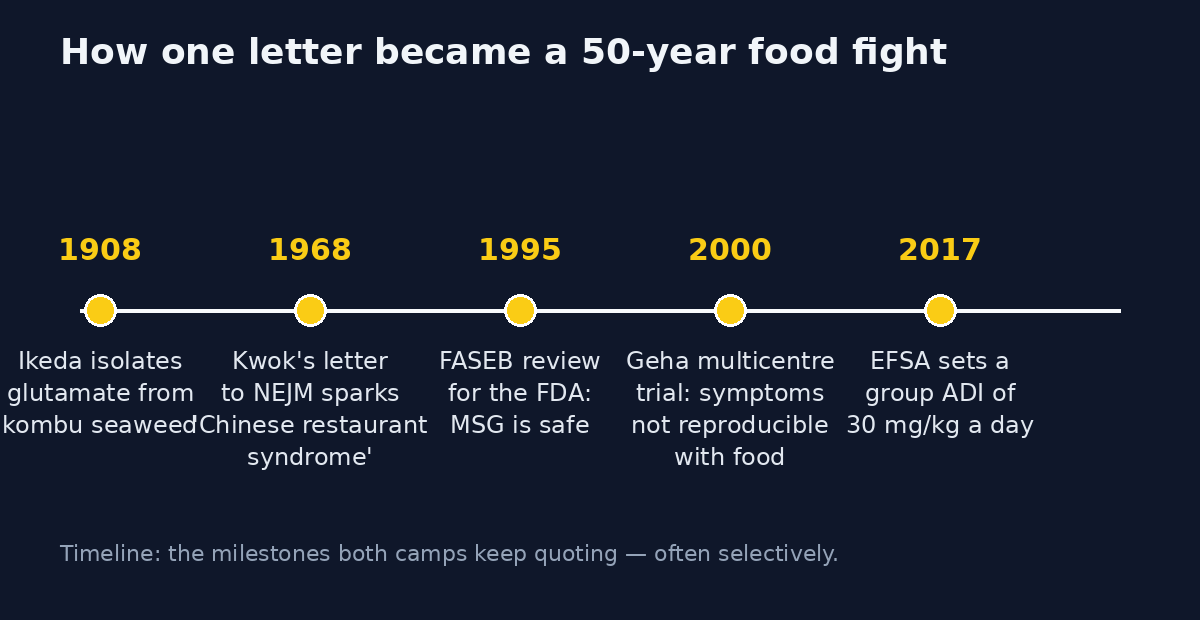 From a laboratory discovery in 1908 to a regulatory ceiling in 2017: the milestones both camps quote, usually selectively.
1968: the letter that launched a panic
On 4 April 1968, the New England Journal of Medicine published a short letter from a doctor signing himself Robert Ho Man Kwok. He described symptoms he experienced after eating at American Chinese restaurants serving northern Chinese food: numbness at the back of the neck, gradually radiating to both arms and the back, general weakness and palpitations, starting about 20 minutes after the meal. He offered several possible culprits — Chinese cooking wine, the high sodium content of some dishes, and the common use of MSG by Chinese cooks. He did not claim proof. He asked a question.
The journal was flooded with replies from readers describing their own unpleasant experiences after Chinese meals, and the list of symptoms ballooned: headache, flushing, sweating, tightness of the jaw and chest, tingling, nausea, even chest pain. Editors dubbed the collection "Chinese Restaurant Syndrome". Newspapers picked it up. Within a few years, a one-man observation had hardened in the public mind into a medical condition with a name, a cuisine attached to it, and a villain: MSG.
Two details from that origin story matter, and both are routinely left out of the retelling. First, Kwok himself listed several theories, not one — only MSG stuck. Second, MSG was already everywhere in Western processed food: soups, crisps, canned stews, seasoning blends sold under the brand name Accent. Nobody coined "Soup Can Syndrome" or "Crisp Packet Syndrome". The syndrome got a cuisine's name, not a chemical's name, and that naming choice shaped everything that followed.
There is also a twist that shows how unreliable this story's folklore has become. Years later, another physician claimed he had written the Kwok letter as a prank under a pseudonym. Journalists who checked the claim found that Kwok was a real person, and his family confirmed he had written it — the prank claim, by that reporting, was itself the hoax. The honest position is therefore not "it was all a joke" but something less tidy: a genuine letter, with genuine uncertainty in it, that a credulous media and a prejudiced moment turned into a certainty.
What the blinded trials actually found
This is where the debate should have ended, and where it gets genuinely interesting — because the trials did not produce the clean sweep either camp claims.
In the 1990s, the FDA asked the Federation of American Societies for Experimental Biology (FASEB) to review MSG safety independently. FASEB concluded that MSG is safe, with a narrow exception: a small number of people — estimated at under 1% of the population — might experience mild, short-lived symptoms such as headache, numbness, flushing, tingling, palpitations and drowsiness after consuming 3 grams or more of MSG without food. A typical serving of food with added MSG contains less than 0.5 grams. Eating 3 grams or more in one go, on an empty stomach, is, in the FDA's words, unlikely.
The largest and most rigorous test came in 2000, when Geha and colleagues ran a multicentre, double-blind, placebo-controlled study in 130 people who believed they reacted to MSG. The results are the single most misquoted finding in this whole debate, so read them carefully. Large doses of MSG given without food did elicit more symptoms than placebo in some of these self-identified sensitive people. But the responses were infrequent, inconsistent, and not reproducible — the same person did not reliably react to MSG and not to placebo across challenges. And crucially, the responses were not observed when MSG was given with food. That last clause is the whole ballgame, because MSG is essentially always eaten with food.
An earlier double-blind study with 71 healthy volunteers, using capsules and specially formulated drinks at doses of 1.5, 3.0 and 3.15 grams before breakfast, found something equally telling: most participants reported no response to either placebo (86%) or MSG (85%), and symptoms previously attributed to MSG did not occur at a significantly higher rate than with placebo. The researchers also identified a flaw that undermined many earlier studies: MSG has a distinctive taste, so a "blind" test in which participants can taste which sample is MSG is not really blind at all.
Put together, the trial record supports a nuanced verdict that frustrates both camps. Camp A cannot point to a reproducible reaction at meal-time doses in a well-blinded trial. Camp B cannot honestly say "nobody ever reacts to anything" — at very high doses without food, a small group reports real, if mild and transient, symptoms, and the mechanism is still not fully understood. What the trials do rule out is the popular version: that a normal restaurant meal reliably triggers headaches, numbness or palpitations through MSG alone.
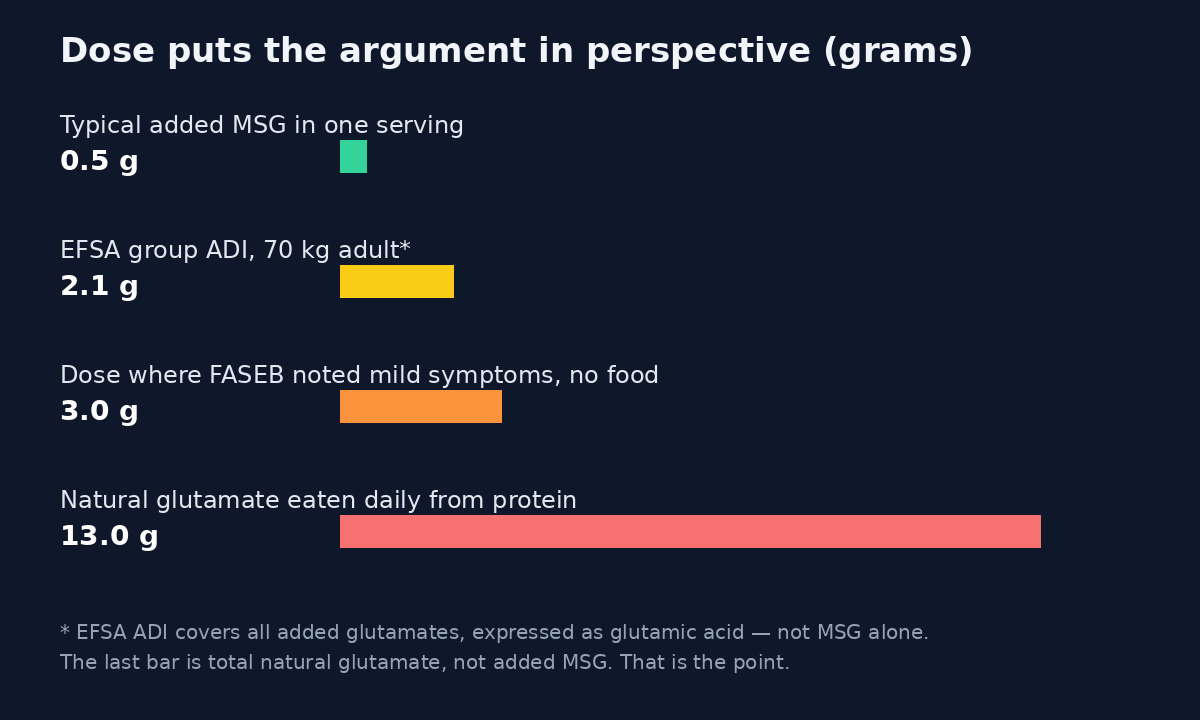 Dose is the difference between a seasoning and a scare story. A normal serving sits far below the dose where even sensitive people reported symptoms — and far below the glutamate you eat naturally every day.
The EFSA twist both camps misuse
If you want to see motivated reasoning in action, watch what each camp does with Europe. In 2017, the European Food Safety Authority (EFSA) re-evaluated glutamic acid and its salts (E 620 to E 625) and set a group acceptable daily intake (ADI) of 30 milligrams per kilogram of body weight per day, expressed as glutamic acid. For a 70-kilogram adult, that is 2.1 grams a day of added glutamates. EFSA also found that estimated exposure could exceed that ADI, and even doses associated with effects such as headache in humans, for some population groups — and it recommended reviewing the maximum levels permitted in foods.
Camp A waves this as proof: "Even Europe admits MSG exceeds safe levels!" Camp B waves it away: "The ADI is absurd — it sits below normal dietary intake." Both readings distort the document. EFSA did not ban glutamates, did not declare MSG unsafe as normally used, and explicitly noted that its exposure estimates could not separate added glutamates from naturally occurring glutamate in foods, which likely overestimated exposure to the additives themselves. Later reviews made the same point more bluntly: background glutamate intake from protein is around 15 grams a day for meat-eaters, fish-eaters, vegetarians and vegans alike, and the contribution of food additives to total glutamate intake is marginal.
The fair reading is this: EFSA applied a standard safety factor (100-fold below the no-effect dose in an animal neurodevelopmental study, 3,200 mg/kg a day) to derive a conservative ceiling, then found that real-world exposure estimates — which lump natural and added glutamate together — can cross it. That is a reason to review permitted levels and to keep studying high consumers, especially children. It is not evidence that your takeaway last Friday poisoned you, and it is not nothing either. A science-first article should say both of those things, because both are true.
Why only Chinese restaurants got the sign
Walk past a Chinese restaurant and you may still see "No MSG" in the window. Walk past a crisp factory, a soup cannery or a burger chain and you will not, even though their products may contain just as much free glutamate — sometimes under other names, such as hydrolysed vegetable protein, autolysed yeast extract or simply "natural flavours", all of which deliver glutamate without the letters M-S-G on the label. The FDA is explicit on this point: foods with added MSG must list it by name, but products containing ingredients that naturally contain free glutamate cannot claim "No MSG" on the pack.
Historians of the panic argue that this asymmetry is the tell. In 1960s America, Chinese restaurants were already stereotyped as unclean or suspicious in popular culture, and a new, unfamiliar savoury taste — umami, a word most Western diners had never heard — arrived attached to a cuisine that was already othered. The same chemical in a familiar packet of crisps raised no alarm; in a dish from a cuisine people distrusted, it became a syndrome. You do not have to accept every version of that argument to accept its core observation: the fear tracked the cuisine, not the chemistry. If it had tracked the chemistry, the signs would have been on every supermarket aisle.
That history does not, by itself, prove MSG safe — a fear can be prejudiced in origin and still land on a real hazard by accident. But it does explain why the burden of proof ran backwards for fifty years: MSG had to prove itself innocent, dish by dish, trial by trial, while salt, sugar and fat — all with far stronger evidence of harm at high intake — never had to carry a cuisine's name in their warning label.
So why do some people still feel ill after the meal?
This is the question the science owes its most honest answer, because dismissing real symptoms as "all in your head" is both rude and wrong. People do feel unwell after some restaurant meals. The evidence says MSG at normal doses is an unlikely culprit in most cases — but "unlikely culprit" is not "you imagined it". Several other suspects fit the symptoms better, and they often arrive in the same meal:
- Sodium load. A single restaurant meal can carry a day's salt or more. Thirst, flushing, headache and a racing feeling after a very salty meal are well recognised, and MSG itself is only about 12% sodium compared with about 39–40% for table salt — so blaming the MSG while ignoring the salt in the same dish gets the chemistry backwards.
- Alcohol, histamine and sheer quantity. Cooking wine, aged and fermented foods, and simply eating a very large, rich meal late at night can each produce headache, flushing, warmth and discomfort. Researchers have noted that histamine in some foods produces symptoms people interpret as MSG-related.
- The nocebo effect. In trials, people who believe they are MSG-sensitive report symptoms on placebo at striking rates — in one early study, a quarter of self-identified sensitive subjects reacted to placebo alone. Expectation is not fakery: the headache is real, the trigger is the belief, and telling someone their belief caused it does not make the headache go away.
- Something else in the dish. A genuine allergy or intolerance — to shellfish, peanut, wheat in soy sauce, or another ingredient — is far more plausible than an MSG reaction, and far more dangerous to miss. Anyone with recurring, severe symptoms after meals should see a clinician rather than settling on MSG as the explanation.
None of this means your experience is invalid. It means the likeliest explanation is usually not the one on the window sign — and that misattributing symptoms to MSG can delay finding the real trigger.
At a glance: claim vs evidence
| Claim you will hear | What the evidence actually says |
|---|---|
| MSG causes headaches after Chinese meals | No consistent link at normal meal-time doses in double-blind trials; symptoms not reproducible with food |
| MSG is a dangerous chemical | It is the sodium salt of an amino acid you eat daily; FDA: GRAS; EFSA: authorised, with a conservative ADI for added glutamates |
| A few people react to it | True in a narrow sense: mild, short-lived symptoms reported after 3 g or more without food, in under 1% by FASEB's estimate |
| "No MSG" means glutamate-free | False: yeast extract, hydrolysed protein and natural flavours can deliver glutamate without added MSG |
| MSG makes food addictive and causes obesity | No reliable link at normal dietary levels in human studies; animal obesity findings used doses far beyond human eating |
| The scare was purely racist | Overstated as a sole cause, fair as a description of why the fear attached to one cuisine and not to crisps and soup |
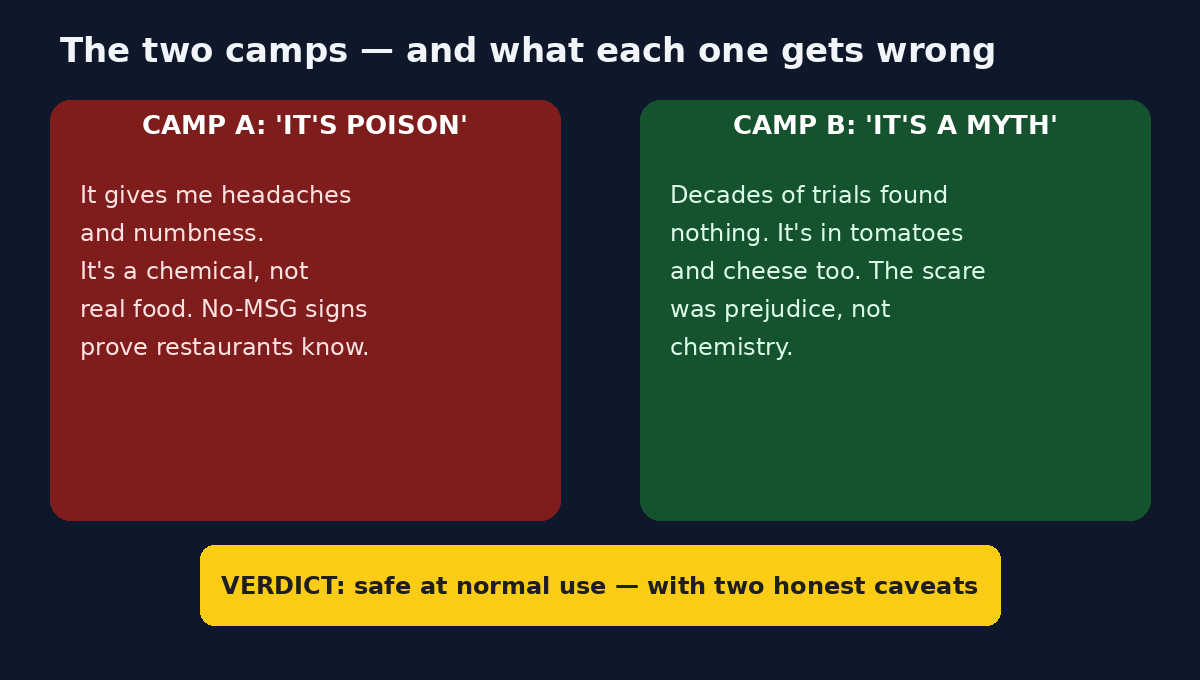 The debate in one picture: each camp has a point, and each camp overclaims it.
Popular opinions: how divided people actually are
The arguments below are paraphrased from the recurring positions in food forums and discussion threads — not quoted posts, and no usernames are invented or cited. They are included because they show the real shape of the divide, which is not "science vs ignorance" but two different ways of weighing the same incomplete experience.
"Every single time I eat it, I get a headache. Don't tell me it's in my head." This is the most common and most heartfelt position. Its strength is lived experience, repeated many times. Its weakness, as the trials show, is that repeated experience without blinding cannot separate MSG from salt, alcohol, portion size or expectation — all of which travel with the same meal. Verdict: the symptoms deserve respect; MSG as the proven cause does not yet have the evidence.
"It's a racist myth, full stop. Science settled this decades ago." This camp is right about the trial record at normal doses and right about the history. Its weakness is overconfidence: it skips the FASEB caveat about high doses without food, skips the EFSA ADI debate, and treats anyone reporting symptoms as either lying or bigoted. Verdict: right on the main claim, wrong to close the file completely.
"It's basically salt, so stop panicking." Close, but not exact. MSG does contain far less sodium than salt by weight, and swapping some salt for MSG can cut a dish's sodium while keeping flavour — one reason chefs and some public-health researchers defend it. But "like salt" understates it: salt's risks are well mapped at population level, while MSG's high-dose, empty-stomach effects are a separate, smaller question. Verdict: a useful comparison, not an identity.
"If it were safe, restaurants wouldn't put up No MSG signs." This argument mistakes marketing for toxicology. Restaurants put up the signs because customers ask for them, and customers ask because fifty years of headlines told them to. A sign that says "we heard you" is not a safety data sheet. Verdict: the signs prove the scare worked, not that it was right.
"Scientists were paid by the flavour industry, so I don't trust the trials." Industry funding of food science is a legitimate thing to scrutinise, and some MSG research has had industry links. But the core findings — FDA and FASEB reviews, the multicentre Geha trial, EFSA's independent re-evaluation — come from regulators and academic centres, and EFSA's ADI, if anything, cuts against industry interests. Dismissing all of it requires a conspiracy larger than the evidence. Verdict: scepticism is healthy; blanket dismissal is not.
"I just avoid it anyway. Why risk it for a seasoning?" This is the quietest camp, and the hardest to argue with. Avoiding added MSG costs almost nothing if you cook at home, and personal caution is not a scientific claim. The only flaw is when private caution is presented as public proof: "I avoid it, therefore it is dangerous" does not follow. Verdict: a reasonable personal choice, not evidence.
Notice the pattern: the loudest voices are the most certain, and the most certain voices are the ones the evidence supports least. The careful position — safe at normal use, with real caveats at the extremes — is also the least shareable position. That, more than chemistry, is why this argument has lasted fifty years.
How to decide for yourself
If you enjoy food with added MSG, the evidence gives you no reason to stop on safety grounds at normal servings. If you think you react to it, try separating the variables before settling on a verdict: note the salt, alcohol and portion size in the same meal, and whether the same symptoms follow a salty meal without MSG — a home-cooked salty soup, for example. If symptoms are severe, recurring, or involve breathing difficulty, swelling or chest pain, see a clinician promptly and do not self-diagnose an MSG allergy; a true food allergy to another ingredient is more urgent and more treatable when identified.
If you want to cut added MSG, read labels for "monosodium glutamate" itself — the FDA requires it to be listed by name when added — and know that yeast extract and hydrolysed vegetable protein are not MSG but do add free glutamate. If you want to cut sodium, MSG can actually help: because it is only about 12% sodium against salt's roughly 39%, replacing part of the salt in a recipe with a smaller amount of MSG can keep the savoury depth while lowering total sodium. That is a practical upside the scare story never mentions.
And if you run a restaurant, the "No MSG" sign is a business decision, not a scientific one. Customers who ask for it are not fools; they are people responding, rationally, to fifty years of noise. The kindest answer is not a lecture but a choice — and a kitchen that can say, honestly, what is in the food either way.
Frequently asked questions
Is MSG bad for you?
At the amounts in normal food, the evidence says no for most people. The FDA classes it as generally recognized as safe, and double-blind trials have not reproduced symptoms at meal-time doses. Mild symptoms have been reported after 3 grams or more taken without food, which is far above a typical serving of under 0.5 grams.
Does MSG cause headaches?
There is no consistent evidence that it does at normal doses. Headaches after restaurant meals are more plausibly linked to salt load, alcohol, dehydration, portion size, histamine-containing foods, or expectation effects. If headaches reliably follow meals, a clinician can help separate those causes far better than a label can.
Is MSG the same as gluten?
No. Glutamate and glutamic acid have nothing to do with gluten, as the FDA stresses. A person with coeliac disease may react to wheat that may be present in soy sauce, but not to the MSG in the product.
Why do only Chinese restaurants advertise "No MSG"?
Because the 1968 scare attached the chemical's name to a cuisine rather than to the many Western processed foods that also contain glutamate. The signs survived as marketing — a response to customer demand shaped by decades of headlines — not as a toxicology finding.
Should children or pregnant women avoid MSG?
Regulators have not singled out MSG for avoidance by these groups at normal dietary levels. EFSA's 2017 re-evaluation did note that exposure estimates could exceed its conservative ADI for some groups, including younger people, which is why it recommended reviewing permitted levels. Anyone with specific medical concerns should ask their clinician rather than relying on a general article.
Sources and further reading
- US Food and Drug Administration, "Questions and Answers on Monosodium Glutamate (MSG)" — fda.gov
- Geha et al., "Review of Alleged Reaction to Monosodium Glutamate and Outcome of a Multicenter Double-Blind Placebo-Controlled Study", Journal of Nutrition, 2000 — pubmed.ncbi.nlm.nih.gov/10736382
- "The monosodium glutamate symptom complex: assessment in a double-blind, placebo-controlled, randomized study" — pubmed.ncbi.nlm.nih.gov/9215242
- EFSA Panel on Food Additives, "Re-evaluation of glutamic acid (E 620), sodium glutamate (E 621)..." EFSA Journal, 2017 — pmc.ncbi.nlm.nih.gov/articles/PMC7009848
- Genetic Literacy Project, "Debunking the 'MSG is harmful' myth" — geneticliteracyproject.org
- Hektoen International, "A bad taste in the mouth: Over fifty years of doubt about MSG" — hekint.org
This article is for general information only and is not medical advice. If you have recurring or severe symptoms after eating, speak to a clinician.
Found this answer useful? This post is part of a series that takes questions many people search for but nobody has answered properly, and gives the real, detailed answer. If you have a question you want answered this way, reach out through asadwebs.com.
Be the first to share a useful question or thought.