
Direct answer: Organic food is not meaningfully more nutritious than conventional food, bite for bite — but it is also not a scam. The honest verdict, after two major reviews and decades of follow-up, is a split decision: vitamins and minerals are essentially the same, some antioxidants are higher in organic crops, pesticide residues and cadmium are lower, and no study has proven that eating organic makes you live longer or avoid disease. The label guarantees how food was farmed, not how healthy it is. If you have limited money to spend on food, eating more fruit and vegetables of any kind beats eating fewer organic ones — every time.
Stand in any supermarket and you can watch the argument happen without a word being spoken. One shopper fills a basket with organic spinach, organic strawberries and organic milk, paying nearly double without flinching. The shopper behind them buys the conventional versions, shakes their head at the receipt, and mutters something about a con. Both are sure the other one is being fooled. Both have a point. Neither has the whole story.
That is exactly why organic food belongs in this series. It is a question millions of people search every week, it splits families, forums and dinner tables into two furious camps, and the answers most people get are either a sales pitch or a sneer. The real answer is more useful than either: organic farming changes some measurable things about food, leaves other things completely unchanged, and the thing most buyers think they are paying for — a proven health advantage — is the one thing science has not delivered.
First, the misunderstanding at the heart of the fight
Most of the argument comes from people answering different questions. One camp hears “organic” and thinks “healthier, safer, more nutritious.” The other camp hears the same word and thinks “a farming method with a premium price tag.” The label itself sides with the second camp.
Under the United States Department of Agriculture (USDA) National Organic Program, “organic” describes how food is produced: cultural, biological and mechanical practices that support ecological balance and conserve biodiversity. Synthetic fertilisers, sewage sludge, irradiation and genetic engineering may not be used. Organic produce must be grown on soil that had no prohibited substances applied for three years before harvest. Organic animals must be fed organic feed and must not be given antibiotics or hormones.
Notice what is missing from that definition: any promise that the food is healthier, safer, or higher in quality. The USDA itself frames organic as a production and labelling standard. An organic biscuit can still be a biscuit — high in sugar, salt and fat — and an organic ready meal can still be ultra-processed. The label tells you about the farm, not about the food on your plate.
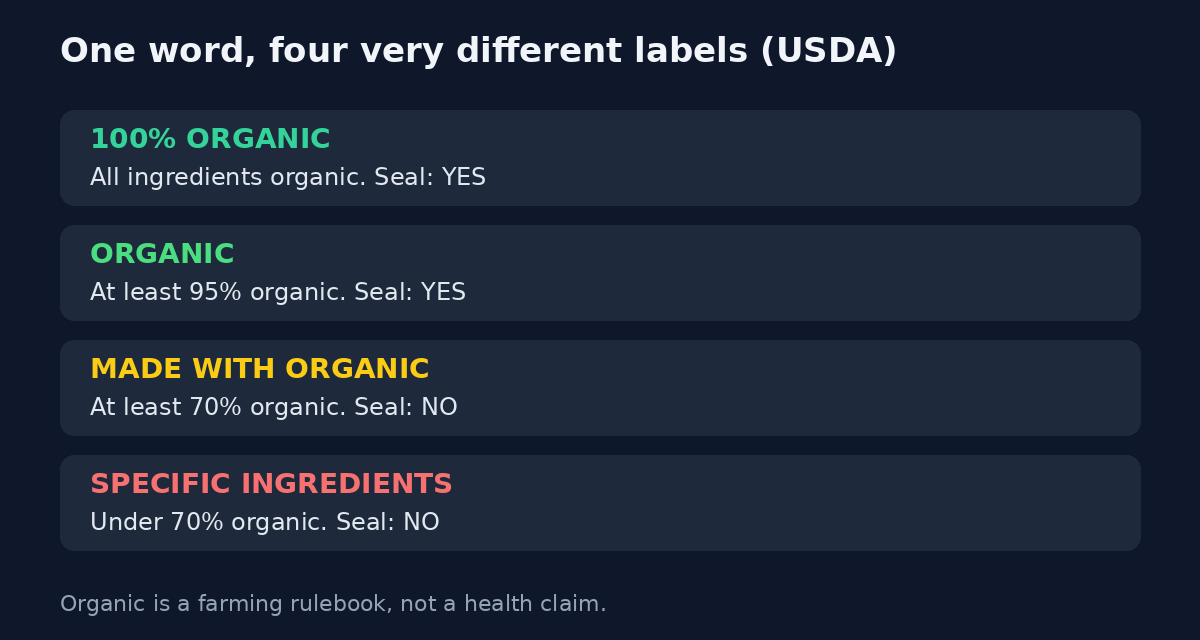
That distinction also explains why “organic” is not one thing. For multi-ingredient products there are four tiers, and only the top two may carry the USDA Organic seal:
| Label wording | What it means | USDA seal? |
|---|---|---|
| 100% Organic | All ingredients are certified organic | Yes |
| Organic | At least 95% organic ingredients | Yes |
| Made with organic ingredients | At least 70% organic ingredients | No |
| Specific organic ingredients | Under 70% organic ingredients | No |
And “organic” does not mean “pesticide-free.” Organic farming restricts synthetic pesticides but allows substances on an approved National List, including some natural pesticides and a few synthetic ones, and crops can pick up residues from drift or from soil. That single fact punctures the strongest slogan on both sides: Camp A cannot claim zero chemicals, and Camp B cannot claim the label means nothing at all.
What the nutrition evidence actually says
The most cited review remains the Stanford study published in the Annals of Internal Medicine in 2012. Crystal Smith-Spangler and colleagues examined 17 human studies and 223 studies of nutrient and contaminant levels in foods — fruits, vegetables, grains, milk, eggs, chicken, pork and meat. Their conclusion, quoted endlessly and selectively ever since, was that the published literature “lacks strong evidence that organic foods are significantly more nutritious than conventional foods.”
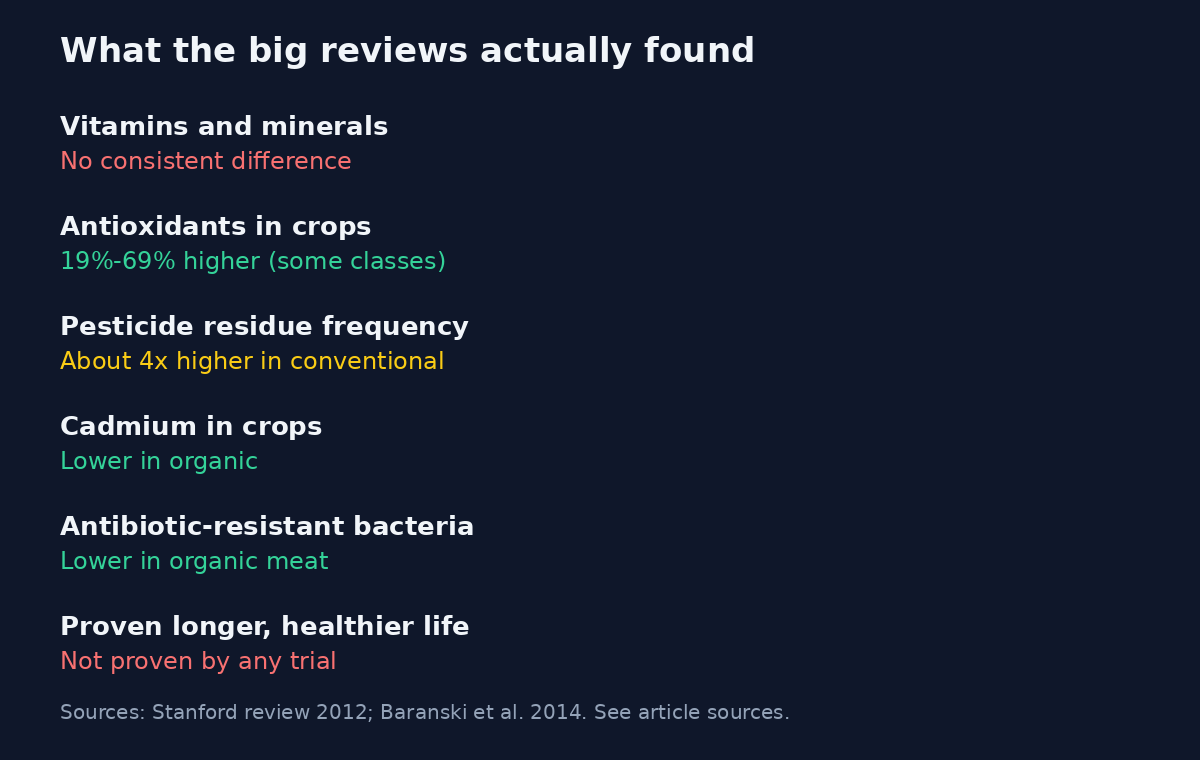
The detail matters more than the headline. The review found no consistent differences in vitamin content between organic and conventional produce. Only one nutrient — phosphorus — was significantly higher in organic produce, and the authors themselves noted that phosphorus deficiency is so rare that the difference has little clinical meaning. Studies of people eating organic or conventional diets found no clinically meaningful differences in biomarker or nutrient levels in blood, urine, breast milk or semen. The senior author, Dena Bravata, summed it up bluntly: “There isn't much difference between organic and conventional foods, if you're an adult and making a decision based solely on your health.”
Two years later, a larger review of crops told a more nuanced story. Barański and colleagues, in the British Journal of Nutrition in 2014, analysed 343 peer-reviewed publications and found that organic crops had substantially higher concentrations of a range of antioxidants: phenolic acids about 19% higher, flavanones about 69% higher, stilbenes about 28% higher, flavones about 26% higher, flavonols about 50% higher, and anthocyanins about 51% higher. They also found lower concentrations of the toxic metal cadmium in organic crops, and pesticide residues about four times more frequent in conventional crops.
Do those two reviews contradict each other? Not really — they measure different things. Stanford asked whether the food you eat is significantly more nutritious and whether that shows up in people. Barański asked whether the chemical composition of crops differs. Both can be true at once: organic crops can contain more of certain plant compounds, while the overall nutritional difference for a person eating a varied diet remains small. Antioxidants are genuinely interesting compounds, and higher levels in a crop are a real finding — but “more antioxidants in the plant” is not the same as “measurably healthier people,” and no trial has bridged that gap. The researchers themselves linked many of these compounds to reduced chronic-disease risk in other dietary studies, which is suggestive, not proof that switching your shopping basket changes your fate.
The pesticide question, answered honestly
If nutrition is a draw, pesticides are where organic genuinely wins a measurable point — and where both camps immediately overstate it.
The Stanford review found that organic produce had a 30% lower risk of detectable pesticide contamination than conventional produce (a risk difference, meaning the share of samples with any detectable residue was lower, not that the health risk fell by 30%). Crucially, pesticide levels in both organic and conventional foods generally fell within allowable safety limits, and the difference in the risk of exceeding maximum allowed limits was small. Two studies of children found lower levels of pesticide residues in the urine of children on organic diets, though what that means for child health remains unclear.
The Barański review, with its fourfold difference in residue frequency, points the same way: you are less likely to encounter residues on organic crops, and when you do, the mix is different. Organic growers use approved substances, not the full conventional spray programme. For people who want to minimise exposure — especially parents of young children, and during pregnancy, when researchers have raised the most questions about early-life exposure — that is a legitimate reason to choose organic, even if it is not a proven health gain.
But the honest counterweight is just as real. Regulatory limits exist precisely because residues below them are judged safe, and conventional produce passes those limits the overwhelming majority of the time. Washing produce under running water, scrubbing firm items, discarding outer leaves of leafy vegetables and peeling where appropriate all reduce surface residues and bacteria — for organic and conventional produce alike. Nobody should skip washing because a label says organic, and nobody should skip fruit and vegetables because they cannot afford the organic version. The single biggest, best-proven dietary move in this whole debate is not switching labels. It is eating more plants, however they were grown.
There is a related point about meat that rarely makes it into the shouting. The Stanford review found that conventional chicken and pork carried a higher risk of bacteria resistant to three or more antibiotics — a risk difference of 33%. Organic rules ban routine antibiotics in livestock, so organic meat lowers that particular exposure. Again, the clinical significance for an individual eater is unclear, but at population level, antibiotic resistance is one of the few areas where the farming method has consequences beyond the farm gate.
The cancer study that set the internet on fire
In October 2018, a French study gave Camp A its favourite headline: people who ate the most organic food had a 25% lower risk of cancer. The study, by Julia Baudry and colleagues in JAMA Internal Medicine, followed 68,946 adults in the NutriNet-Santé cohort for a median of about four and a half years. Participants scored their organic consumption across 16 food categories, and the highest scorers had a lower overall cancer risk than the lowest scorers, with the strongest signals for postmenopausal breast cancer and non-Hodgkin lymphoma. The authors themselves said the findings needed confirmation before organic food could be proposed as a cancer-prevention strategy.
Here is why that headline needs its footnotes. First, the absolute difference was small: the authors reported an absolute reduction in risk of about 0.6 percentage points over the follow-up period. A 25% relative reduction sounds enormous; a 0.6-point absolute reduction sounds like what it is — a modest association in one observational study. Second, people who eat the most organic food are, on average, wealthier, better educated, more physically active, and already eating more fruit, vegetables and whole grains and less processed and red meat. The researchers adjusted for many of those factors, but residual confounding — the leftover influence of a generally healthier life that statistics cannot fully strip out — remains the obvious alternative explanation, and the authors acknowledged it. Third, when the results were broken into subgroups, the association lost statistical significance in younger adults, in men, in never-smokers and current smokers, and in people with a high-quality diet overall. Fourth, no link appeared for prostate or colorectal cancers, and the follow-up was short for a disease that develops over decades.
None of that makes the study worthless. It is a large, prospective, peer-reviewed cohort study, and it is exactly the kind of finding that deserves a bigger, longer follow-up. But it is one observational study, and observational studies cannot prove that the organic label caused the difference. The honest summary is: an intriguing association, unconfirmed, with a plausible alternative explanation (healthier people buy organic) that fits the data just as well. Anyone selling you organic food as proven cancer prevention is selling you a headline, not the study.
Environment and animals: real reasons, different question
Some of the strongest arguments for organic have nothing to do with your body. Organic farming bans synthetic fertilisers and most synthetic pesticides, requires crop rotation and soil care, and gives livestock outdoor access and organic feed. For buyers who care about soil health, biodiversity, water quality, farm-worker exposure to sprays, or animal welfare, those are genuine, verifiable differences — and they are the differences the label actually certifies.
But they cut both ways, and a fair article says so. Organic yields are generally lower per hectare than conventional yields, which means producing the same amount of food can require more land — a real environmental cost that critics rightly raise. Organic farms still use pesticides, including copper sulphate and pyrethrin, which are “natural” but not harmless. And organic certification is a paid, inspected system: farmers pay certifiers, which is why sceptics argue the system runs partly on trust and paperwork. None of that makes organic farming bad. It makes it a trade-off, like every farming system, rather than a moral pure zone.
The key discipline is to keep the questions separate. “Is organic better for the soil?” and “Is organic better for farm animals?” are questions with real evidence behind them. “Is organic healthier for me?” is a different question, with a weaker answer. Mixing them up is how a good argument about farming becomes a bad claim about nutrition.
So where is the money actually well spent?
Organic food costs more — often substantially more on fresh produce — and for families on tight incomes that premium has a real opportunity cost: money spent on the organic label is money not spent on more food, or on other things entirely. So the practical question is not “organic or not?” but “if I am going to pay extra, where does it buy the most?”
The evidence points to a sensible pecking order. First, spend on quantity and variety before labels: a basket full of conventional vegetables beats a small basket of organic vegetables, because the health gains from eating plants at all dwarf the differences between farming methods. Second, if you do pay a premium, prioritise foods you eat often, in large amounts, and with thin skins you actually eat — the classic examples health agencies mention are peaches, grapes, strawberries and nectarines. Third, skip the premium on thick-skinned or peeled produce such as avocados, onions, pineapple and sweet corn, where residues on the part you throw away matter far less. Fourth, do not be fooled by organic junk: organic crisps, organic sweets and organic sugary drinks are still crisps, sweets and sugary drinks, and the label adds nothing to their nutritional value. Fifth, wash everything, organic or not, under running water — it removes dirt, bacteria and surface residues, and it costs nothing.
There is one more trap worth naming, because it catches thoughtful shoppers: the idea that buying organic excuses the rest of the diet. A household that buys organic meat and organic snacks but eats few vegetables has bought the label and missed the point. Diet quality — plenty of plants, whole grains, modest processed meat, not too much sugar, salt and alcohol — matters far more than the farming method behind any single item. Organic can be part of a good diet. It cannot rescue a bad one.
At a glance: claim vs evidence
| Claim you will hear | What the evidence actually says |
|---|---|
| Organic is far more nutritious | No consistent vitamin or mineral advantage; some antioxidants higher in organic crops, but no proven health gain in people |
| Organic means pesticide-free | False: approved substances are allowed, and residues can arrive from drift or soil; residue frequency is lower, not zero |
| Organic cuts cancer risk by 25% | One observational study found a 25% relative association; absolute difference about 0.6 points, unconfirmed, confounded by healthier lifestyles |
| Conventional food is poisoned | False: residues generally fall within safety limits; washing and peeling reduce them further |
| Organic is just a scam label | Overstated: the label certifies real farming rules — no synthetic fertilisers, no routine antibiotics, outdoor access for animals |
| Organic junk food is healthy | False: organic sugar is still sugar; the label says nothing about the nutritional profile |
| Paying more means eating better | Only if the premium does not shrink your basket: more conventional vegetables beat fewer organic ones |
Popular opinions: how divided people actually are
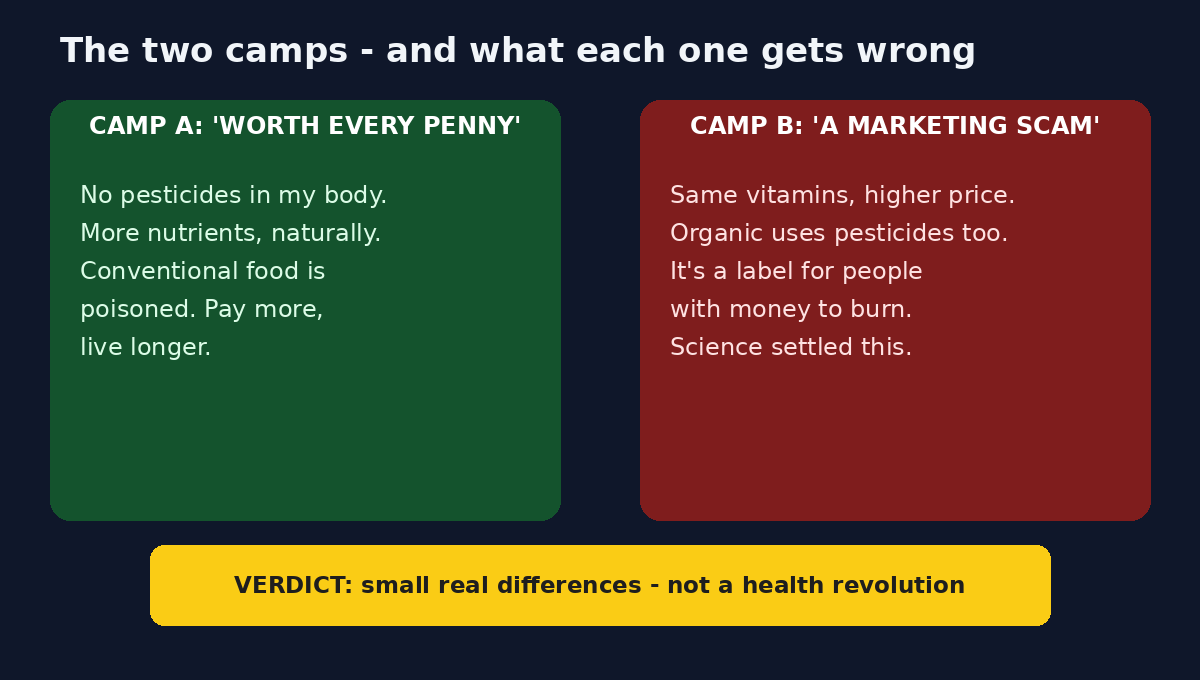
The arguments below are paraphrased from the recurring positions in food forums and discussion threads — not quoted posts, and no usernames are invented or cited. They are included because they show the real shape of the divide, which is not “science versus ignorance” but different values pulling in different directions.
“I buy organic for my kids, and I don't care what the studies say.” This is the most emotionally powerful position, and the hardest to argue with on its own terms. Parents are not buying a nutrient table; they are buying peace of mind about pesticide exposure during pregnancy and early childhood, where the research questions are sharpest. Its weakness is only when it becomes a claim about other people's children: precaution for your own family is not proof of harm to everyone else's. Verdict: a reasonable personal choice, especially for foods children eat often — not evidence of a general health effect.
“It's a tax on people who don't understand science.” This camp is right that the nutritional case is weak and that marketing exploits the word “organic” ruthlessly. Its weakness is that it dismisses every buyer as gullible, ignoring the real farming, environmental and animal-welfare reasons people pay, and the real residue and antibiotic differences. Verdict: right on the nutrition headline, wrong to call the whole label meaningless.
“Organic tastes better, so it's worth it.” Taste is personal, and freshness, variety and ripeness often matter more than farming method — a freshly picked conventional tomato beats a tired organic one. But some organic produce, especially from smaller farms and farmers' markets, is picked riper and sold faster, which genuinely tastes better. Verdict: sometimes true, but it is a freshness and variety effect, not a certification effect.
“If organic weren't better, why would hospitals and schools buy it?” Some institutions do buy organic, usually for environmental, local-economy or precautionary reasons, not because a trial proved it healthier. Institutional purchasing is a policy choice, not a scientific finding. Verdict: the fact that an institution buys something proves it has a policy, not that the science settled the question.
“The studies are funded by chemical companies, so I don't trust them.” Industry funding deserves scrutiny in food science, and some pesticide research has industry links. But the two reviews at the centre of this article were not industry marketing: the Stanford review received no external funding, and the Barański review was funded by the European Union and an organic farming charity — funding that, if anything, leans the other way. Dismissing both because of a general suspicion about funding requires ignoring who actually paid. Verdict: scepticism is healthy; blanket dismissal is not.
“I buy organic when it's close in price, conventional otherwise.” This is the quietest camp, and the one the evidence supports best. It captures the real residue and farming differences without sacrificing quantity or variety, and it refuses to turn a shopping choice into an identity. Verdict: the most defensible strategy in the whole debate — and, tellingly, the least likely to start an argument online.
Notice the pattern, familiar from every food fight: the loudest voices are the most certain, and the most certain voices are the ones the evidence supports least. The careful position — small real differences, no proven health revolution, spend where it matters — is also the least shareable position. That, more than chemistry, is why this argument has lasted decades.
How to decide for yourself
If you enjoy organic food and can afford it without cutting back on fruit and vegetables, the evidence gives you no reason to stop. You are buying lower residue exposure, stricter farming rules, and, for meat and dairy, no routine antibiotics — all real, if modest, things. If you cannot afford it, or you can only afford it by buying less produce, the evidence is firmly on your side too: conventional fruit and vegetables, washed well, are an excellent choice, and eating more of them is the single best move available.
A practical plan that follows the evidence looks like this: fill most of your basket with a wide variety of conventional fruit and vegetables; spend any organic premium on thin-skinned produce you eat often; buy organic meat, eggs or dairy if animal welfare or antibiotic use matters to you; ignore the organic label entirely on crisps, sweets and sugary drinks; and wash everything under running water before eating. That plan will not win you an argument in a comment thread. It will, however, match what the science actually says — which is rarer, and more useful, than winning the argument.
Frequently asked questions
Is organic food actually healthier than conventional food?
Not in any large, proven way. Reviews find no consistent vitamin or mineral advantage, though some antioxidants are higher in organic crops and residues and cadmium are lower. No trial has proven that eating organic makes people healthier or live longer. The label certifies farming methods, not health outcomes.
Does organic mean pesticide-free?
No. Organic farming bans most synthetic pesticides but allows approved substances, and residues can also arrive from neighbouring fields or soil. Organic produce has a lower frequency of residues, not zero residues. Wash all produce, organic or not.
Is organic food worth the extra money?
It depends on what you value and what you sacrifice. If the premium does not reduce how much fruit and vegetables you buy, and you value lower residue exposure, farming practices or animal welfare, it can be worth it. If paying more means buying less produce, it is not — quantity and variety matter more.
Should children eat organic food?
There is no regulatory advice that children must eat organic. Some parents prioritise organic for foods children eat often, because early-life pesticide exposure is the area researchers watch most closely, and studies have found lower urinary pesticide levels in children on organic diets. The proven priority remains the same for children as for adults: plenty of fruit and vegetables, washed well, whatever the label.
Is organic junk food healthier than regular junk food?
No. Organic sugar, organic crisps and organic biscuits have essentially the same nutritional profile as their conventional versions. The organic label describes how ingredients were farmed, not whether the finished product is a healthy choice.
Sources and further reading
- Smith-Spangler C et al., “Are organic foods safer or healthier than conventional alternatives? A systematic review”, Annals of Internal Medicine, 2012 — greenmedinfo.com
- Barański M et al., “Higher antioxidant and lower cadmium concentrations and lower incidence of pesticide residues in organically grown crops”, British Journal of Nutrition, 2014 — pubmed.ncbi.nlm.nih.gov/24968103 and pmc.ncbi.nlm.nih.gov/articles/PMC4141693
- Baudry J et al., “Association of frequency of organic food consumption with cancer risk: findings from the NutriNet-Santé prospective cohort study”, JAMA Internal Medicine, 2018 — pmc.ncbi.nlm.nih.gov/articles/PMC6583612
- USDA, “Understanding the USDA Organic Label” — usda.gov
- MedlinePlus, “Pesticides on fruits and vegetables” — medlineplus.gov
This article is for general information only and is not medical advice. If you have specific health concerns, speak to a clinician.
Found this answer useful? This post is part of a series that takes questions many people search for but nobody has answered properly, and gives the real, detailed answer. Earlier in the series: the MSG food fight and whether expired poison becomes safe. If you have a question you want answered this way, reach out through asadwebs.com.
Be the first to share a useful question or thought.