
Direct answer: No — seed oils are not toxic in the way the viral claim says, and the human evidence points the other way on the two biggest charges. In controlled trials, raising linoleic acid — the omega-6 fat at the centre of the fight — did not raise inflammatory markers. In large long-term studies, people with higher plant-oil intake, including soybean and canola oil, had lower mortality, not higher. That does not make seed oils a health food, and it does not clear everything they touch: oil reused for hours in a commercial fryer genuinely degrades, and the ultra-processed foods that carry most seed oils are unhealthy for many other reasons. The honest verdict is narrower than either camp admits: ordinary home cooking with fresh seed oil is not poisoning you, swapping butter for plant oil helps your heart on the evidence we have, and the real villain in this story is much more likely the fried, ultra-processed diet around the oil than the oil itself.
Open a bottle of sunflower oil in 2026 and you are not just cooking dinner. You are picking a side. One camp calls that bottle poison, an industrial chemical that is quietly driving obesity, heart disease and chronic inflammation. The other camp calls it a heart-healthy staple, backed by decades of trials, and calls the scare a marketing grift. Restaurants have switched fryers over it. A United States health secretary has campaigned against it. Comment threads under any seed-oil post turn into a war within minutes, with both sides absolutely certain the other is either bought or brainwashed.
That is exactly why seed oils belong in this series. It is a question millions of people search, it has two furious camps, and most of the answers on offer are either a scare reel or a dismissive eye-roll. The real answer is more useful than either, because the two camps are not even arguing about the same thing half the time. One side is arguing about a molecule in a laboratory. The other is arguing about what happens in a human body. And a third thing — what happens to oil in a fryer at 190 degrees for eight hours — keeps getting smuggled into both arguments as if it were the same as a tablespoon in a home frying pan. Separate those three arguments, and the fight gets a lot clearer.
First, what counts as a seed oil?
“Seed oil” is not a scientific category. It is a kitchen shorthand for refined oils pressed from seeds: soybean, canola (from rapeseed), corn, sunflower, safflower, cottonseed, grapeseed and rice bran. Critics have bundled eight of them into a list nicknamed the “Hateful Eight”: canola, corn, cottonseed, grapeseed, rice bran, soy, sunflower and safflower. Olive oil, avocado oil and peanut oil are usually left out of the attack, even though they are also plant oils, because they are richer in monounsaturated fat and carry a healthier reputation — a distinction that matters, and that we will come back to.
What the eight share is a high proportion of linoleic acid, an omega-6 polyunsaturated fat. Linoleic acid is essential: the body cannot make it, so some must come from food. The argument was never really about whether a trace of it is needed. It is about amount. Modern diets, especially diets heavy in processed food, contain far more linoleic acid than diets did a century ago. Historical consumption data cited in debate coverage put the rise in United States soybean-oil intake at more than a thousandfold between 1909 and 1999. That is a real, enormous change in what people eat. The question is whether that change caused the chronic-disease era that followed it — or merely arrived at the same time as a hundred other changes.
| Oil | Main fat type | Where you meet it most |
|---|---|---|
| Soybean | Polyunsaturated, linoleic-rich | Frying, salad dressings, processed foods |
| Canola | Monounsaturated, some linoleic | Everyday cooking, baking, dressings |
| Sunflower | Polyunsaturated (standard) or monounsaturated (high-oleic) | Frying, snacks, margarine |
| Corn | Polyunsaturated, linoleic-rich | Frying, baked goods, margarine |
| Safflower | Polyunsaturated (standard) or monounsaturated (high-oleic) | Salad oils, frying |
| Cottonseed | Polyunsaturated with more saturated fat | Commercial frying, snacks |
| Grapeseed | Polyunsaturated, linoleic-rich | Salad dressings, light frying |
| Rice bran | Mixed, with antioxidants | Asian cooking, frying |
Notice the trap already: “seed oils” lumps together oils with quite different fat profiles. Canola is mostly monounsaturated, like olive oil. Soybean and corn are heavily polyunsaturated. High-oleic sunflower oil, bred to be mostly monounsaturated, is a different product from standard sunflower oil. Any claim that treats all eight as one identical chemical is already cutting corners.
The case against seed oils, stated fairly
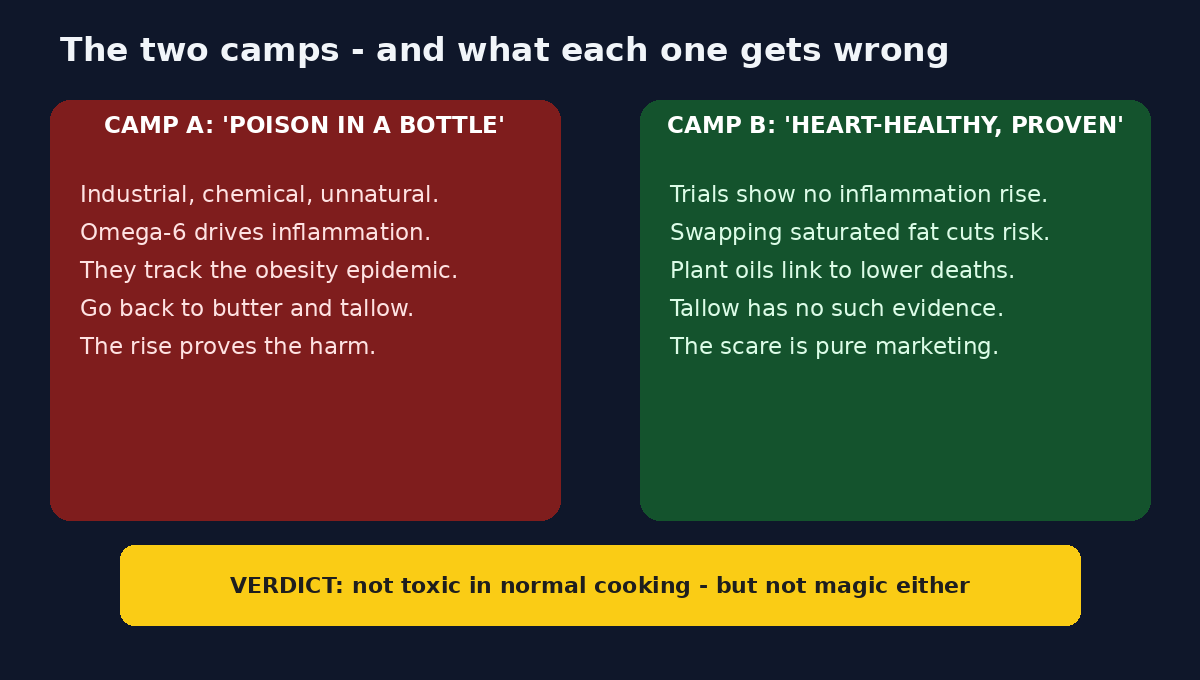
Before testing the claims, they deserve a fair hearing, because they are not random. They are built on four arguments, each of which sounds plausible until it meets human data.
Argument one: omega-6 drives inflammation. Linoleic acid can be converted in the body to arachidonic acid, which is the raw material for some signalling molecules that promote inflammation. Follow the arrow, the argument goes, and more seed oil means more inflammation, and chronic inflammation sits underneath heart disease, diabetes and arthritis. It is a clean biochemical story. The problem is that human bodies do not follow clean arrows.
Argument two: the omega-6 to omega-3 ratio has exploded. As seed-oil intake rose, the ratio of omega-6 to omega-3 fats in the diet rose with it. Critics argue that this imbalance crowds out anti-inflammatory omega-3 fats and tilts the whole system toward inflammation. This is the version of the claim that even official reports have treated most seriously, as we will see — but a ratio is not a mechanism, and ratios can move for many reasons, including simply eating less fish.
Argument three: the oils are industrial and unnatural. Most refined seed oils are extracted with the solvent hexane, then bleached and deodorised. Critics present this as chemical contamination: a factory product, not a food. The word “industrial” does a lot of work here, because it invites the reader to conclude that processing itself equals harm, without showing that any harmful residue survives in the bottle at a meaningful level.
Argument four: the rise tracks the disease. Seed-oil consumption soared across the twentieth century, and obesity, diabetes and heart disease soared alongside it. The curves go up together, so the argument runs, the oil must be a driver. This is the argument that feels strongest in a chart and weakest in a laboratory, because two curves rising together is the oldest trap in epidemiology.
Each of these deserves its own test. So let us run them, one by one, against the human evidence rather than the theory.
The inflammation test: the claim that fails in people
If the inflammation claim were true, it should be easy to demonstrate: feed people more linoleic acid, measure their inflammatory markers, and watch them rise. Researchers have done exactly that, repeatedly, and the markers have not risen.
The most cited test is a systematic review by Guy Johnson and Kevin Fritsche, published in the Journal of the Academy of Nutrition and Dietetics in 2012. They gathered 15 randomised controlled trials in healthy adults that deliberately varied dietary linoleic acid and measured markers of chronic inflammation, including C-reactive protein (CRP), fibrinogen, cytokines, soluble vascular adhesion molecules and tumour necrosis factor-alpha. None of the 15 reported a significant rise in those markers from higher linoleic acid. Their conclusion was blunt: “virtually no evidence is available from randomised, controlled intervention studies among healthy, noninfant human beings to show that addition of linoleic acid to the diet increases the concentration of inflammatory markers.”
That was not a one-off. A 2017 meta-analysis by Su and colleagues, pooling 30 randomised trials with 1,377 participants, reached the same conclusion: higher linoleic acid intake had no significant effect on blood inflammatory markers. A 2018 review by Innes and Calder, covering the omega-6 literature more broadly, likewise found no strong evidence that dietary omega-6 intake drives systemic inflammation in humans. The mechanism that sounds so convincing on paper — more linoleic acid, more arachidonic acid, more inflammation — does not operate at meaningful levels in the diets people actually eat, because conversion of linoleic acid to arachidonic acid is tightly regulated and only a small fraction converts.
Observational evidence runs the same way, which is unusual and worth noting. A pooled analysis by Marklund and colleagues in 2019, covering 30 prospective studies and nearly 70,000 people, found that higher linoleic acid levels in the blood were associated with lower rates of cardiovascular disease, lower cardiovascular mortality and less ischemic stroke — the opposite direction from the scare claim. A separate large review in Critical Reviews in Food Science and Nutrition, summarised in 2026 coverage after examining hundreds of studies across inflammation, heart disease, cancer, liver fat, weight and diabetes, reached the same broad verdict: the human evidence does not support the claim that seed oils drive inflammation, and replacing saturated fat with linoleic-rich oils tended to help, not harm, on heart and liver measures.
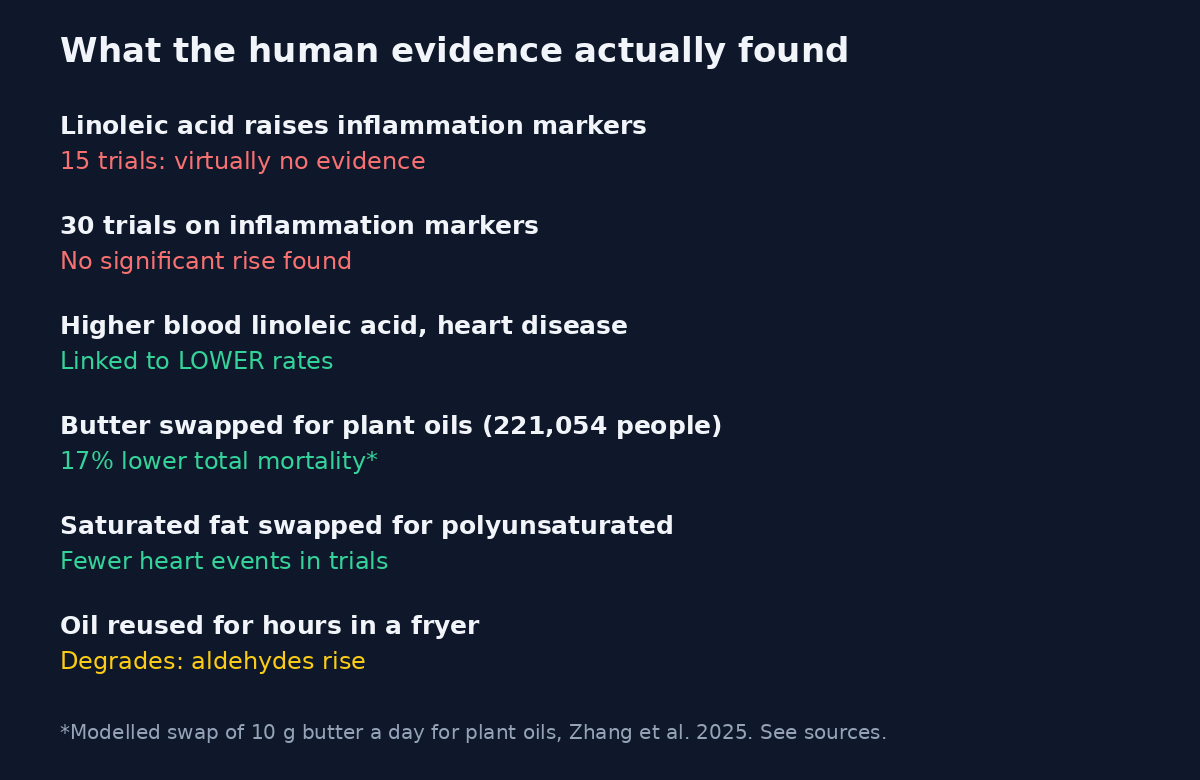
None of this proves seed oils are a superfood. It proves something narrower and more important: the load-bearing claim of the scare — that eating seed oil inflames your body — has been tested in people and has not held up. A theory that fails its own direct test does not get to keep its conclusion on the strength of a diagram.
The heart test: what happens when you swap the fat?
The strongest evidence in this whole debate is not about seed oils in isolation. It is about substitution: what happens when people replace saturated fat with unsaturated fat? That is the comparison that matters in a real kitchen, because nobody eats oil in a vacuum. You fry in something, and the choice is usually between a plant oil and an animal fat.
The American Heart Association's 2017 presidential advisory reviewed the trial evidence on exactly that swap and concluded that replacing saturated fat with polyunsaturated fat reduced cardiovascular disease events by roughly 30 percent, a benefit the advisory likened to statin therapy. A Cochrane review of trials that cut saturated fat and replaced it with polyunsaturated fat reached a similar conclusion: fewer cardiac events. The Association's updated 2026 dietary guidance kept the same direction, recommending plant oils such as olive oil and canola oil in place of animal fats such as butter and beef tallow, and listing soybean oil and canola oil among fats high in unsaturated fat, against butter and tallow among fats high in saturated fat.
Then came the study that put numbers on the kitchen swap itself. In March 2025, Zhang and colleagues published a prospective cohort study in JAMA Internal Medicine covering 221,054 adults across three large United States cohorts, followed for up to 33 years, with 50,932 deaths recorded. The highest butter intake was associated with a 15 percent higher risk of total mortality than the lowest intake. The highest total plant-based oil intake was associated with a 16 percent lower total mortality. Modelling a swap of just 10 grams of butter a day — roughly two teaspoons — for an equivalent amount of plant-based oils was associated with a 17 percent lower total mortality and a 17 percent lower cancer mortality. The plant oils in the study included safflower, soybean, corn, canola and olive oil, so this is not a result that can be waved away as “only olive oil did it”: higher intakes of canola and soybean oil individually were each associated with lower total mortality.
Cohort studies cannot prove cause on their own. People who cook with plant oils also tend to eat differently in other ways, and researchers adjust for those differences without ever fully removing them. That caveat applies to every observational result in this article, on both sides. But the pattern matters: randomised trials show the swap lowers LDL cholesterol and cardiac events, and the largest long-term cohorts show the same direction on deaths. The anti-seed-oil case needs a mechanism strong enough to overturn both, and its mechanism — inflammation — is the one that failed its direct test.
There is also a fairness point about the older trials critics sometimes cite. Some early trials that fed people seed-oil-rich diets used margarines that then contained trans fats, which are now known to be harmful and have since been largely removed from the food supply. Blaming the seed oil for harm caused by the trans fat it was packaged with is like blaming the bread for a poisoned sandwich. Modern refined seed oils are not a source of industrial trans fats in the way those old margarines were.
The correlation trap: two curves, one hundred causes
The most shareable chart in the seed-oil war shows two lines rising together: seed-oil consumption and obesity. It is genuinely striking, and genuinely weak evidence. The same chart could be drawn for air conditioning, television ownership, car use, screen time, sugar intake, portion sizes, sedentary jobs, sleep loss, ultra-processed food sales and a dozen other twentieth-century changes. Curves that rise together prove that two things changed in the same era, not that one caused the other.
The confound that matters most is ultra-processed food. Seed oils are everywhere in ultra-processed food — crisps, biscuits, fried snacks, ready meals, pastries — because they are cheap, neutral-tasting and shelf-stable. Ultra-processed food now makes up more than half of the calories Americans eat at home, and higher ultra-processed intake is reliably linked to worse health across dozens of outcomes. So people who eat the most seed oil are very often people who eat the most ultra-processed food, which is also high in salt, sugar, refined starch and additives, and low in fibre, vegetables and whole foods. Singling out the oil inside that package, while ignoring everything else in the package, is a textbook confounding error.
This also explains a puzzle that confuses both camps: how can seed oils be linked to better outcomes in studies, yet appear in all the worst foods? Because the studies that find benefit are mostly comparing fats within otherwise similar diets, or comparing people who cook at home with plant oils against people who cook with butter. The foods that carry seed oils in the worst diets are bad for reasons that have little to do with which fat was used to fry them. A doughnut fried in tallow is still a doughnut. A salad dressed with soybean oil is still a salad. The oil is not the meal.
Hexane, bleaching and “industrial”: what processing actually leaves behind
The processing argument is the one that feels most disgusting, and disgust is a powerful persuader. Hexane is a petroleum-derived solvent, and the idea of food washed in it is understandably off-putting. But the relevant question is not what touches the seed during extraction. It is what remains in the bottle, and at what level.
Refining — which includes degumming, neutralising, bleaching and deodorising — is designed to remove free fatty acids, pigments, odours and other unwanted compounds, including residual solvent. Regulators in the United States and Europe set limits on hexane residues in extracted oils, and the trace levels that remain in finished refined oils are far below those limits and are judged safe by food-safety authorities. “Industrial” processing, in this case, is largely purification, not contamination. The same logic applies to many ordinary foods: flour is milled in factories, milk is pasteurised, salt is refined. Factory processing alone is not evidence of harm.
That does not mean processing is irrelevant. Refining does strip out some micronutrients, including some vitamin E, which is a point even the 2025 Make America Healthy Again (MAHA) Commission report noted. Cold-pressed or extra-virgin oils retain more of those compounds, which is a genuine, if modest, nutritional difference. But a modest loss of vitamin E is a long way from “poison,” and it is a reason to prefer less-refined oils where flavour and price allow — not a reason to declare refined oils toxic.
If processing is your main concern, the honest version of the argument is about preference, not poison: you may prefer oils that are pressed rather than solvent-extracted, just as you may prefer butter churned from cream. That is a legitimate taste and food-philosophy choice. It becomes misleading only when it is dressed up as a toxicology finding that the residue data do not support.
Heat: the one place the critics have a real point
Here the story changes, and fairness requires saying so plainly. The seed-oil critics are weakest on fresh oil and strongest on abused oil, and collapsing those two into one claim is the central error of the whole debate.
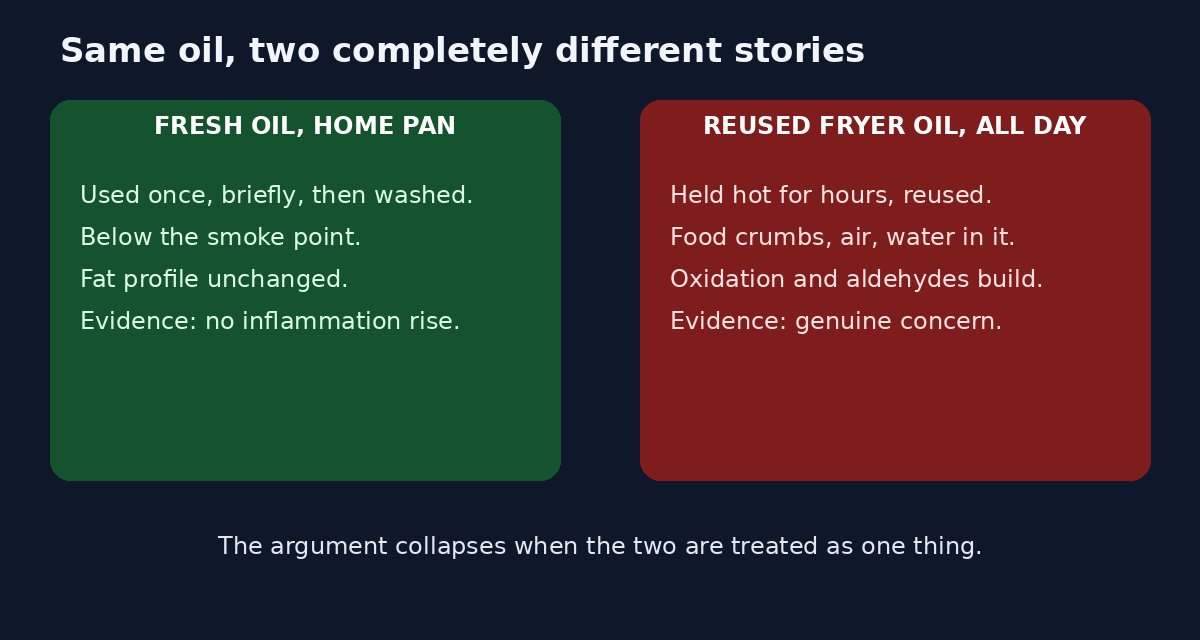
When any unsaturated oil is heated, it oxidises. When it is held at frying temperature — around 180 to 190 degrees Celsius in commercial fryers — for hours, exposed to air, water from food and crumbs, and reused across batch after batch, it degrades: hydrolysis breaks triglycerides into free fatty acids, oxidation creates peroxides and then aldehydes, and polymerisation thickens the oil and darkens it. A 2025 study using high-field nuclear magnetic resonance spectroscopy, heating rapeseed, sunflower, sesame and peanut oils to 190 degrees Celsius while frying chicken nuggets, found significant increases in aldehyde compounds, including genotoxic and cytotoxic alpha,beta-unsaturated aldehydes, in all oils tested under thermal and light exposure. These are real degradation products, and repeated exposure to heavily degraded oil is a genuine concern — one reason food-safety guidance everywhere treats repeatedly reheated oil as something to limit, not reuse indefinitely.
But note what that study tested: oil held hot and reused, the commercial-fryer condition. A tablespoon of canola oil used once to sauté vegetables at home, below its smoke point, then washed away, is not biologically identical to oil that has sat in a fryer all day. The dose, the duration, the temperature and the reuse are the whole story. The same is true of every cooking fat: butter burns at a lower temperature than refined canola oil, and overheated butter produces its own smoke and degradation products. No fat is immune to abuse.
| Fat (typical, refined unless stated) | Approximate smoke point | Best home use |
|---|---|---|
| Butter | About 150°C | Low-heat cooking, finishing, baking |
| Extra-virgin olive oil | About 190°C | Dressings, sautéing, medium heat |
| Beef tallow | About 200°C | Roasting, frying |
| Refined canola oil | About 204°C | Everyday frying, baking, sautéing |
| Refined sunflower oil | About 227°C | Frying, roasting |
| Refined soybean oil | About 230°C | Frying, baking |
Smoke points vary by brand, refinement and freshness, so treat these as typical values, not laboratory guarantees. The practical rules that follow from the heat evidence are simple and uncontroversial: do not heat any oil until it smokes, do not reuse deep-frying oil repeatedly at home, discard oil that is dark, foamy, thick or rancid-smelling, and eat deep-fried food — whatever the fat — as an occasional food, not a daily staple. Those rules protect you against the real risk without requiring you to throw away a fresh bottle of canola oil.
The tallow comeback: Washington, restaurants and the report that hedged
No account of this fight is complete without the political turn, because it is what took seed oils from wellness forums to restaurant fryers. United States Health Secretary Robert F. Kennedy Jr. has called seed oils one of the most unhealthy ingredients in foods and has said Americans are being unknowingly poisoned by them, urging a return to butter and beef tallow. The restaurant chain Steak 'n Shake announced in early 2025 that it would fry in 100 percent beef tallow across its United States locations, and was publicly praised for the switch. “Make Frying Oil Tallow Again” merchandise followed. For supporters, this was a long-overdue correction. For nutrition scientists, it was a swap with no trial evidence behind it: as one Tufts nutrition professor put it in coverage of the debate, she was not aware of any study showing a benefit from substituting soybean oil with beef tallow, lard or butter.
The most revealing document in the whole saga is the one written by the people leading the charge. The MAHA Commission's flagship report, published in May 2025, discussed seed oils in strikingly milder language than the campaign rhetoric. It noted that refining strips out some micronutrients such as vitamin E, and that the oils “contribute to an imbalanced omega-6 to omega-3 ratio, a topic of ongoing research for its potential role in inflammation.” That is as far as it went: a topic of ongoing research, a potential role, no poison claim, no call for a ban. When the report written by the movement's own commission will not call seed oils harmful, that is a clue about the strength of the case — and about the gap between a slogan and a scientific finding.
Public opinion, meanwhile, is less polarised than the internet suggests. A 2025 survey by Purdue University's Center for Food Demand Analysis and Sustainability, reported in coverage of the debate, found that around half of Americans held a positive view of seed oils, while only about 9 percent shared the view that they are harmful to consume and about 11 percent believed they increase the risk of chronic conditions. The loudest voices in this fight are a minority on both sides. Most people are quietly cooking with whatever is in the cupboard — which, on the evidence, is a perfectly reasonable place to be.
There is also a question the tallow camp rarely answers: if seed oils are the driver of obesity, why did the swap in the other direction — replacing saturated fat with plant oils — lower LDL cholesterol and cardiac events in trials, and why do the largest cohorts link plant-oil intake to lower mortality? A theory that cannot explain its own counter-evidence is not a theory. It is a preference with a chart attached. And preferences are fine: tallow tastes wonderful for roast potatoes, butter is irreplaceable in a croissant, and nobody needs a trial to justify enjoying them. What preferences do not get to do is rewrite the trial record.
At a glance: claim vs evidence
| Claim you will hear | What the evidence actually says |
|---|---|
| Seed oils cause inflammation | Trials that raised linoleic acid found virtually no rise in inflammatory markers (15 trials, 2012; 30 trials, 2017) |
| Omega-6 overload is poisoning us | Higher blood linoleic acid is linked to lower, not higher, heart disease in pooled cohorts of nearly 70,000 people |
| Swapping to tallow is healthier | No trial shows a benefit from swapping soybean oil for tallow or butter; the swap the other way lowers LDL and cardiac events |
| Hexane in the bottle is toxic | Refining removes most residue; finished oils sit far below regulatory limits judged safe |
| Heating seed oil makes it toxic | True for oil abused for hours and reused — a real concern; not shown for fresh oil used once at home |
| The rise in seed oils caused obesity | Two curves rising together; ultra-processed food, sugar, portions, inactivity and sleep all rose too — confounding, not proof |
| Seed oils are a health food | Overstated: they are a better swap than butter for heart risk, not a nutrient powerhouse; olive oil and whole foods beat them on overall quality |
Popular opinions: how divided people actually are
The arguments below are paraphrased from the recurring positions in food forums, social media threads and comment sections — not quoted posts, and no usernames are invented or cited. They are included because they show the real shape of the divide, which is not “science versus ignorance” but different fears, values and experiences pulling in different directions.
“I cut out seed oils and my skin, joints and energy all improved.” This is the most common personal testimonial, and it is usually sincere. Its weakness is attribution: cutting out seed oils almost always means cutting out ultra-processed food, takeaways and fried snacks at the same time, and often cooking more at home. Any of those changes, alone, could explain feeling better. Verdict: a real experience, a shaky causal claim — the improvement is believable, the ingredient blamed for it is not proven.
“It's all a scam by influencers selling tallow and beef-fat skincare.” This camp is right that a lucrative market has grown up around the scare, from “seed-oil-free” labels to premium tallow products. Its weakness is that commercial interest on one side does not prove the science on the other side wrong — seed-oil producers are also a vast industry with plenty to lose. Verdict: right to follow the money, wrong to treat it as a verdict on the trials.
“My grandmother fried in lard and lived to ninety, so the science is lying.” Anecdotes about long-lived relatives are emotionally powerful and statistically empty: a single long life proves nothing about a population, and grandmothers also walked more, smoked less in some eras, ate smaller portions and cooked from scratch. Verdict: a fond memory, not a study — and survivorship bias in its purest form.
“If they were safe, why did restaurants have to switch back?” Restaurant switches are presented as proof, but they are business decisions responding to customer demand and publicity, not peer-reviewed findings. A chain changing its fryer oil tells you what its customers want to hear, not what a trial found. Verdict: marketing signal, not scientific evidence.
“The studies are funded by Big Food, so I don't trust any of them.” Industry funding deserves scrutiny, and food science has real conflicts. But the key trials and cohorts here come from universities, public cohorts and independent reviews, and the inflammation result has been replicated by different teams in different countries. Dismissing all of it requires a conspiracy large enough to include the researchers, the journals and the data. Verdict: scepticism is healthy; blanket dismissal is a way of never having to change your mind.
“I just use olive oil for everything and don't think about it.” This is the quietest camp, and the most defensible. Olive oil is mostly monounsaturated, well studied, and it sidesteps the whole argument — while still being a plant oil that the scare, taken literally, should also condemn. The fact that most critics exempt olive oil is itself revealing: the fight was never really about “plant oils” in general. Verdict: the most practical strategy in the debate — and, tellingly, the least likely to start an argument online.
Notice the pattern, familiar from every food fight: the loudest voices are the most certain, and the most certain voices are the ones the evidence supports least. The careful position — fresh seed oil in normal cooking is not toxic, reused fryer oil is a real problem, and the overall diet matters far more than any single fat — is also the least shareable position. That, more than chemistry, is why this argument has lasted so long.
How to decide for yourself
If you cook at home with fresh canola, soybean or sunflower oil and you like the results, the evidence gives you no reason to throw the bottle away. If you prefer olive oil, butter or tallow for flavour, tradition or cooking performance, the evidence gives you no reason to feel guilty about that either — provided you understand the trade: on heart risk, the trial and cohort evidence favours plant oils over butter and tallow, not the other way round. Taste and tradition are legitimate reasons to choose a fat. A claimed health advantage for tallow is not, on current evidence, one of them.
A practical plan that follows the evidence looks like this: cook mostly at home, with fresh oil, below its smoke point, and do not reuse deep-frying oil repeatedly; favour olive oil or canola for everyday cooking if you want the best-studied, most monounsaturated option; keep butter and tallow for the dishes where they genuinely taste better, as an occasional pleasure rather than the default; eat deep-fried and ultra-processed foods rarely, whatever fat they were fried in; and put your real effort into the overall pattern — more vegetables, whole grains, legumes and fish, less ultra-processed food, sugar and salt. That pattern, not any single bottle, is what the trials and cohorts actually reward.
Seed oils are not poison. They are also not medicine. They are a cheap, neutral, well-studied cooking fat that became a symbol in a much larger argument about processed food, industry, politics and trust. The symbol is doing a lot of work that the molecule never did. Once you see that, the question stops being “are seed oils toxic?” and becomes the far more useful one: “what am I actually eating, how was it cooked, and how often?” Answer those three honestly, and the bottle on your shelf stops being a battlefield and goes back to being what it always was — just oil.
Frequently asked questions
Are seed oils toxic?
Not in the sense the viral claim means. Human trials found that raising linoleic acid did not raise inflammatory markers, and large cohorts link higher plant-oil intake to lower mortality. Heavily degraded, repeatedly reused frying oil is a separate and genuine concern, but it is not the same as fresh oil used once at home.
Do seed oils cause inflammation?
On current human evidence, no. A 2012 systematic review of 15 randomised trials found virtually no evidence that added linoleic acid raised inflammatory markers in healthy adults, and a 2017 meta-analysis of 30 trials reached the same conclusion. The biochemical pathway exists on paper, but conversion to arachidonic acid is tightly regulated and the expected rise in markers does not appear in people.
Is beef tallow healthier than seed oil?
On heart-risk evidence, no. Trials show that replacing saturated fat with polyunsaturated fat lowers LDL cholesterol and cardiac events, and a 2025 cohort study of 221,054 adults linked higher plant-oil intake to lower mortality while higher butter intake was linked to higher mortality. No comparable trial evidence shows a benefit from swapping seed oil for tallow.
Is hexane in seed oil dangerous?
Refined seed oils are extracted with hexane and then refined, which removes most residue. Finished oils contain only trace levels, far below regulatory limits that food-safety authorities judge safe. If you prefer to avoid solvent extraction entirely, cold-pressed oils are available — that is a preference, not a toxicology verdict on refined oils.
Should I throw away all my seed oils?
There is no evidence-based reason to. Keep fresh oil, store it away from heat and light, do not heat it until it smokes, and do not reuse deep-frying oil repeatedly. If you want one simple upgrade, use olive oil or canola for everyday cooking and keep butter and tallow for occasional dishes where flavour matters most.
Sources and further reading
- Johnson GH, Fritsche K, “Effect of dietary linoleic acid on markers of inflammation in healthy persons: a systematic review of randomized controlled trials”, Journal of the Academy of Nutrition and Dietetics, 2012 — ncbi.nlm.nih.gov/books/NBK117084
- Zhang Y et al., “Butter and plant-based oils intake and mortality”, JAMA Internal Medicine, 2025 — pubmed.ncbi.nlm.nih.gov/40048719
- Su H et al., “Dietary linoleic acid intake and blood inflammatory markers: a systematic review and meta-analysis of randomized controlled trials”, Food & Function, 2017
- Innes JK, Calder PC, “Omega-6 fatty acids and inflammation”, Prostaglandins, Leukotrienes and Essential Fatty Acids, 2018
- Marklund M et al., pooled analysis of linoleic acid biomarkers and cardiovascular outcomes, 30 prospective studies, 2019
- Analysis of harmful aldehydes generated in edible oils during deep-frying, Foods, 2025 — pmc.ncbi.nlm.nih.gov/articles/PMC11816481
- MAHA Commission report, May 2025, discussion of seed oils and the omega-6 to omega-3 ratio — summarised in drnoc.substack.com and tapestry.news
- American Heart Association, 2026 dietary guidance to improve cardiovascular health, Circulation, 2026 — summarised in health.com
This article is for general information only and is not medical advice. If you have specific health concerns, speak to a clinician.
Found this answer useful? This post is part of a series that takes questions many people search for but nobody has answered properly, and gives the real, detailed answer. Earlier in the series: whether organic food is actually healthier, the MSG food fight and whether expired poison becomes safe. If you have a question you want answered this way, reach out through asadwebs.com.
Be the first to share a useful question or thought.