
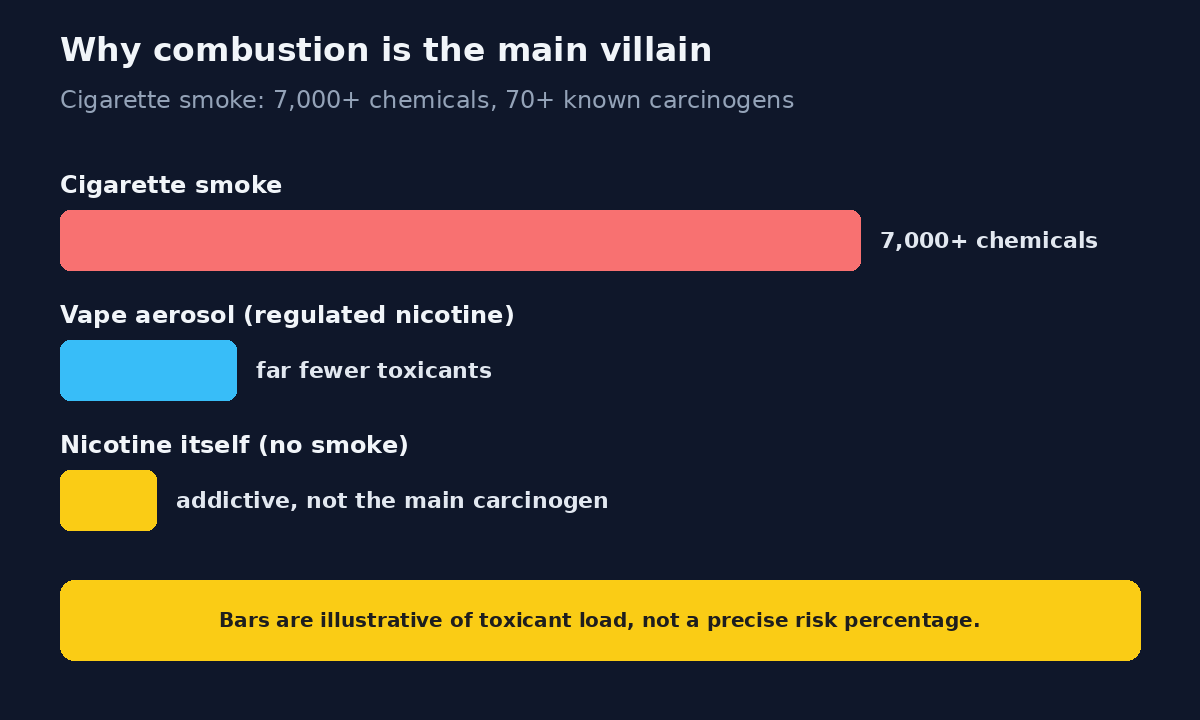
Direct answer: Yes — for a person who already smokes, switching completely to vaping is substantially safer than continuing to smoke, but vaping is not safe in any absolute sense, and for a person who does not smoke, starting to vape only adds risk. That split verdict is why the same question produces two completely opposite headlines. In the United Kingdom, the standing public-health estimate, first published by Public Health England in 2015 and repeated in later government evidence reviews, is that vaping is around 95% less harmful than smoking. The NHS puts it more plainly: vaping is not completely risk-free, but it poses a small fraction of the risk of smoking. The reason is combustion. A cigarette burns tobacco and produces smoke containing more than 7,000 chemicals, including tar and carbon monoxide and more than 70 known carcinogens. A vape heats a liquid and produces an aerosol with far fewer toxicants, at far lower levels, and with no tar and no carbon monoxide. That does not make the aerosol harmless — it still delivers addictive nicotine, it can irritate lungs and airways, illicit products can contain dangerous additives, and the long-term effects of decades of vaping are simply not yet known, because vaping has not existed long enough for those studies to exist. England's Chief Medical Officer summarised the official position in one sentence that is worth memorising: if you smoke, vaping is much safer; if you do not smoke, do not vape.
Ask whether vaping is safer than smoking in any online forum and you will get a fight, not an answer. One side posts the 95% figure as if it settled everything in 2015. The other side posts photographs from the 2019 lung-injury outbreak in the United States, or a story about a teenager who cannot stop vaping, as if that settled everything the other way. Both sides are quoting real events. Neither side is giving you the full picture, because the question they are answering is not quite the question you asked. "Safer than smoking" and "safe" are two different claims, and most of the argument online comes from people defending one claim while attacking the other. This article separates them: what smoke does that vapour does not, what vapour still does, what the 95% number really means and where it came from, what the 2019 outbreak actually proved, what the youth data really shows about a gateway into smoking, and what a sensible decision looks like for a smoker, a former smoker, and a non-smoker. The debate is the content here — but the evidence, read carefully, does settle most of it.
First, what smoking does — and why it sets such a low bar
To judge whether something is safer than smoking, you first have to be honest about how dangerous smoking is. It is not mildly unhealthy. According to the US Surgeon General, cigarette smoke contains more than 7,000 chemicals and chemical compounds, hundreds of which are toxic and more than 70 of which are known to cause cancer. The NHS lists tar and carbon monoxide as the two most destructive elements in tobacco smoke. Tar is not one chemical; it is the sticky residue of burned tobacco that coats lungs and carries carcinogens into lung tissue. Carbon monoxide is a poisonous gas that binds to haemoglobin in the blood and reduces the oxygen the blood can carry, straining the heart. Add benzene, formaldehyde, arsenic, hydrogen cyanide and radioactive polonium-210, and you have a product that kills around half of its long-term users, causes most lung cancers, and drives heart disease, stroke, chronic obstructive pulmonary disease (COPD), and cancers of the mouth, throat, oesophagus, bladder, pancreas and more.
That grim baseline matters because it explains why public-health agencies can say something is "much less harmful" without saying it is harmless. A product does not need to be benign to be dramatically safer than cigarettes. It only needs to remove the burning. Almost all the death and disease from tobacco comes from combustion, not from nicotine itself. Nicotine is the reason people keep smoking — it is addictive, it raises heart rate and blood pressure, and it is harmful in pregnancy — but nicotine on its own is not what fills lungs with tar or floods blood with carbon monoxide. That distinction, between the drug people are addicted to and the smoke that kills them, is the entire logic of harm reduction, and it is the reason patches, gum and lozenges have been sold for decades without anyone calling them "just as bad as smoking." Vaping applies the same logic with a product that mimics the hand-to-mouth habit of smoking, which is part of why it works better for some smokers than a patch does.
What a vape actually produces
A typical nicotine vape heats a liquid — usually propylene glycol and vegetable glycerine, plus nicotine and flavourings — until it forms an aerosol that the user inhales. There is no burning, no ash, and no smoke in the tobacco sense, so there is no tar and no carbon monoxide. Laboratory studies consistently find that the aerosol contains far fewer toxicants than cigarette smoke, and at much lower concentrations. The Royal College of Physicians, in its landmark 2016 report, concluded that the hazard from long-term vapour inhalation was unlikely to exceed 5% of the harm from smoking tobacco, while stressing that the long-term picture was still uncertain. Later UK government evidence reviews, including the 2022 update, maintained the same overall position: vaping is substantially less harmful than smoking, though not risk-free.
That "far fewer" needs a qualifier that vaping advocates sometimes skip. Fewer does not mean none. Vape aerosol can contain formaldehyde and acetaldehyde, especially when a device overheats or runs dry — the so-called dry puff that tastes harsh and burnt, which users normally avoid precisely because it tastes terrible. It can contain tiny metal particles from the heating coil, including nickel, chromium and lead, at levels that vary wildly between regulated and illicit products. Flavouring chemicals that are safe to eat are not automatically safe to inhale: diacetyl, a buttery flavouring linked to a rare lung condition called bronchiolitis obliterans (nicknamed "popcorn lung" after cases in popcorn-factory workers who inhaled it in industrial quantities), was found in some early e-liquids and is now banned in UK-regulated liquids — but it illustrates why "food-safe" is the wrong test for something you breathe. And nicotine itself, while not the main carcinogen, is not a neutral passenger: it is addictive, it can raise blood pressure and heart rate, it can cause headaches, dizziness and nausea, and it is particularly concerning for adolescents whose brains are still developing, and in pregnancy.
The 95% figure: what it is, and what it is not
No number in the vaping debate is quoted more often, or more misleadingly, than "95% less harmful." It comes from a 2015 Public Health England evidence review, which concluded that the best current estimate was that e-cigarettes were around 95% less harmful than tobacco cigarettes. The figure was an expert judgement, not a measurement from a clinical trial. It traced back to a 2014 multi-criteria analysis in which a panel of experts rated nicotine products against each other on a range of harm criteria; e-cigarettes scored about 4% of the maximum relative harm of cigarettes, and Public Health England rounded that into its famous "around 95% less harmful" headline. The authors themselves said their understanding of e-cigarette hazards was at a very early stage and based on limited evidence. The Lancet published an editorial calling the foundation "extraordinarily flimsy," and critics have pointed out ever since that expert opinion, however well-informed, is not the same as epidemiological proof.
Does that mean the figure is worthless? No — but it means it should be quoted with its caveats, which its loudest quoters usually drop. First, it is a statement about overall relative harm across many criteria, not a claim that vaping cuts your cancer risk by exactly 95%, or your heart-disease risk by exactly 95%, or any single risk by exactly 95%. No study has measured those numbers over decades, because vaping has not existed for decades. Second, it was an estimate made when vaping devices were simpler and weaker than today's high-nicotine disposables and pod systems, and when illicit products were a smaller share of the market. Third, later UK reviews have kept the broad conclusion — substantially less harmful — without pretending the original number was precise. The NHS now phrases it as "a small fraction of the risk," which is both less quotable and more honest. The fair way to state it is this: the toxicant evidence strongly supports "much less harmful than smoking," while the exact percentage is an expert estimate, not a measured fact, and anyone who states it as a precise scientific measurement is overstating the evidence.
Does vaping actually help smokers quit?
Here the evidence is stronger than the 95% figure, and it comes from the gold standard of medical evidence: randomised trials. The Cochrane living systematic review of e-cigarettes for smoking cessation — updated through 2024 and 2025, covering dozens of trials and tens of thousands of participants — concluded with high certainty that nicotine e-cigarettes help more people stop smoking than nicotine replacement therapy such as patches and gum. That matters because quitting is hard: most unaided quit attempts fail, and the best available aid still only helps a minority. Vaping's advantage appears to come from combining nicotine delivery with the behavioural ritual of smoking — the hand-to-mouth action, the inhalation, the throat sensation — which patches and gum do not reproduce. For a smoker who has tried patches and failed, that difference can be decisive.
Two caveats keep this honest. The first is dual use. A smoker who vapes and keeps smoking has not gained the harm-reduction benefit: the smoke is still doing the damage, and studies find that continuing to smoke alongside vaping does not meaningfully reduce smoking-related disease risk. The benefit comes from switching completely, not from adding a vape to a cigarette habit. The second is that many people who quit smoking with a vape keep vaping afterwards. That is still a far better outcome than continued smoking — public-health agencies are explicit that long-term vaping after quitting smoking is preferable to returning to cigarettes — but it is not the same as being nicotine-free, and the ideal endpoint remains stopping vaping too, once the cigarette habit is broken. Some vapers also report that vaping becomes its own hard-to-break habit, which is a real cost even if it is a much smaller cost than smoking.
The 2019 outbreak: what EVALI proved, and what it did not
In 2019, hospitals across the United States began admitting young people with severe lung injury after vaping. The condition was named EVALI, short for e-cigarette or vaping product use-associated lung injury. By February 2020, the US Centers for Disease Control and Prevention (CDC) had recorded 2,807 hospitalised cases and 68 deaths across all 50 states. For the camp that calls vaping just as dangerous as smoking, EVALI is exhibit A: proof that vaping can destroy lungs quickly, not just hypothetically over decades. For the other camp, it is a story about a contaminated black market, not about regulated nicotine vaping at all. The investigation, read in full, supports the second reading much more than the first — but with a warning attached.
The CDC's laboratory work found vitamin E acetate in the lung fluid of 48 out of 51 EVALI patients tested in one major study, and in none of 99 healthy comparison samples. Vitamin E acetate is an oil sometimes used to thicken illicit THC (cannabis) vape cartridges, and it is not an ingredient in regulated nicotine e-liquids. Most EVALI patients reported using THC-containing products, usually bought from informal or illicit sources rather than licensed shops. When the supply of those cartridges was disrupted and the additive was identified, cases fell sharply. The outbreak was therefore a tragedy of an unregulated market, not evidence that ordinary regulated nicotine vaping routinely causes acute lung failure. But it is also a warning that cannot be waved away: the vape market, especially where it is unregulated or where illicit products are easy to buy, can deliver something genuinely dangerous without the user knowing, and "it was only the THC carts" is cold comfort to the families of the 68 people who died. The lesson is about product safety and regulation, not about nicotine vapour in general — and it is a reason to be deeply suspicious of cheap, unbranded, or suspiciously strong products from unofficial sellers.
The youth question: gateway, or moral panic?
No part of this debate generates more heat than young people and vaping, and here both camps can point to real numbers. On one side: youth vaping rose sharply in the late 2010s and early 2020s, driven by sweet flavours, colourful disposables, and social-media marketing. In England, NHS survey data found that around a quarter of 11 to 15-year-olds had tried vaping, with nearly one in ten vaping regularly. In the United States, the 2024 National Youth Tobacco Survey found 1.63 million middle and high school students currently vaping. Among teenagers who do vape, daily use has intensified: a 2025 study of more than 115,000 US teenagers found that the share of teen vapers using daily nearly doubled between 2020 and 2024, from about 15% to nearly 29%, and that more than half of daily vapers had tried and failed to quit. That is a genuine addiction problem in young people who, in many cases, had never smoked.
On the other side: youth smoking has collapsed over the same period. In the United States, youth cigarette smoking fell from 15.8% in 2011 to 1.7% in 2024, and the 2025 youth tobacco survey put overall youth vaping at 5.2%, its lowest level in a decade, with cigarette smoking unchanged at a historically low 1.4%. In New Zealand, a 2025 survey of more than 31,000 Year 10 students found daily vaping down from 8.7% to 7.1% and daily smoking at just 1.1%, with nearly 90% of students never having tried a cigarette. If vaping were a simple gateway that funnelled teenagers into smoking at scale, youth smoking should have risen as vaping rose. It did the opposite. The gateway evidence itself is contested: a 2025 umbrella review pooling 56 reviews found that young people who vape are about three times more likely to later report smoking, while a separate large review the same year graded that evidence as very low certainty, noting that the teenagers most likely to try vaping are also the teenagers most likely to try smoking for other reasons — a shared tendency towards risk-taking that observational studies struggle to separate from causation. Both findings can be true at once: at the individual level, a teenager who vapes is statistically more likely to later smoke; at the population level, vaping has not reversed the collapse in youth smoking, and may even have displaced some of it. What is not in doubt is that nicotine addiction in teenagers is itself a harm, regardless of whether it leads to cigarettes, and that is why regulators in the UK banned the sale of disposable vapes from 1 June 2025, restrict sales to over-18s, and continue to tighten rules on flavours, packaging and advertising that appeal to children.
The two camps, stated fairly
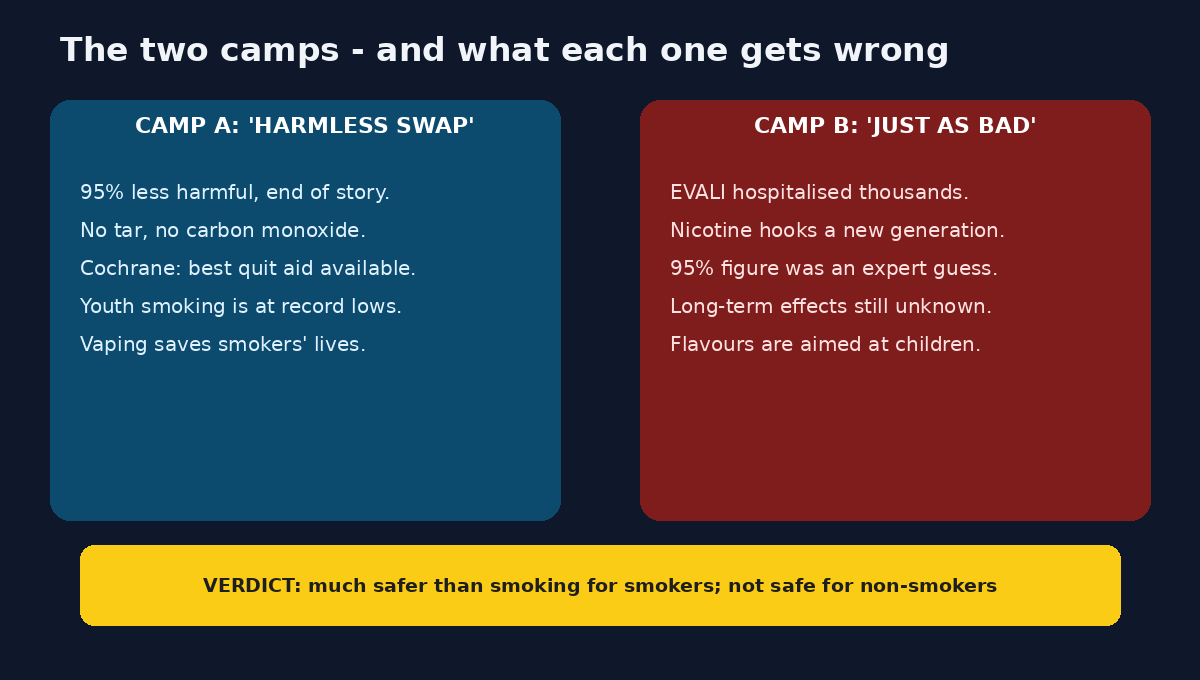
Camp A — "Vaping is basically harmless, and anyone who says otherwise is a prohibitionist." Its strongest argument is the toxicology and the quit data: no tar, no carbon monoxide, far fewer carcinogens, and Cochrane's high-certainty finding that nicotine vapes beat patches and gum for quitting. Its weakest habit is turning a relative claim into an absolute one. "95% less harmful" becomes "safe," long-term uncertainty becomes "proven harmless," and youth addiction becomes a footnote. It also tends to quote UK policy as if it were universal, when the United States has taken a far more cautious line — the FDA has never approved an e-cigarette as a quit-smoking aid — and the World Health Organization warns far more strongly about youth uptake and unknown long-term effects than UK agencies do.
Camp B — "Vaping is just as bad as smoking, and probably worse because it hooks children." Its strongest argument is the genuine unknown: nobody can honestly promise that 30 years of inhaling flavoured aerosol is safe, because nobody has done it yet, and the history of inhaled products counsels humility. Its youth argument is also real: a generation of teenagers is becoming nicotine-dependent through products that did not exist when smoking rates were falling. Its weakest habit is false equivalence. Treating a product with no tar and no carbon monoxide as equal to a product that kills half its long-term users requires ignoring the entire toxicology literature, and it has a perverse consequence: if smokers believe vaping is just as bad as smoking, they have no reason to switch, and they keep smoking — the one outcome both camps should agree is worst. Surveys in the UK have found that a large minority of smokers wrongly believe vaping is as harmful as smoking or more harmful, and that misperception itself costs lives by deterring switching.
Where the two camps actually agree (and what is still genuinely unresolved)
Strip away the slogans, and the camps agree on more than either admits. Both accept that cigarettes are uniquely deadly and that nobody should start smoking. Both accept that children and non-smokers should not vape — even the most enthusiastic harm-reduction advocates do not recommend vaping to a non-smoker. Both accept that dual use, smoking plus vaping, is not harm reduction at all. Both accept that illicit and unregulated products are dangerous in ways regulated products are not, as EVALI proved. And both accept, if pressed, that the long-term evidence is incomplete: the pro-vaping camp cannot produce 30-year safety data that does not exist, and the anti-vaping camp cannot produce 30-year harm data that does not exist either.
What is genuinely unresolved is the long tail: what happens to lungs, hearts and blood vessels after 20 or 30 years of daily vaping, whether flavoured aerosols cause subtle chronic damage that short studies miss, and whether the current generation of high-nicotine devices creates a more dependent population than earlier, weaker devices did. A second unresolved question is secondhand vapour. The evidence so far suggests the risk to bystanders is small compared with secondhand smoke — there is no sidestream smoke, and exhaled vapour contains far lower toxicant levels — but "small" is not "zero," and the precautionary case for keeping indoor spaces vape-free, especially around children, remains strong. A third is the policy puzzle: how to keep vapes accessible and attractive enough for adult smokers to switch, while making them inaccessible and unattractive enough that teenagers do not start. The UK's answer — regulated products, adult-only sales, a disposable ban, and flavour and advertising controls — is one attempt at that balance. The US answer — stricter authorisation, a higher purchase age of 21, and state-level flavour bans — is another. Neither has solved it completely.
At a glance: claim vs evidence
| Claim you will hear | What the evidence actually says |
|---|---|
| Vaping is 95% less harmful than smoking | That is a 2015 expert estimate from Public Health England, not a measured clinical result. Later UK reviews support "substantially less harmful" and the NHS says "a small fraction of the risk" — the direction is solid, the exact percentage is not precise. |
| Vaping is completely safe | No. Vape aerosol contains nicotine and other chemicals, can irritate airways, and its long-term effects are unknown. "Safer than smoking" is not the same as "safe." |
| Vaping is just as bad as smoking | Not supported. No tar, no carbon monoxide, far fewer toxicants at far lower levels, and switchers show sharply lower exposure to smoking-related carcinogens. Equal-harm claims ignore the toxicology. |
| Vaping causes popcorn lung | Diacetyl, a flavouring linked to bronchiolitis obliterans in factory workers inhaling industrial quantities, was found in some early liquids. It is banned in UK-regulated liquids, and no epidemic of popcorn lung among vapers has been observed — but it shows why inhalation safety differs from food safety. |
| The 2019 lung injuries prove nicotine vaping destroys lungs | No. EVALI (2,807 hospitalised cases, 68 deaths in the US by February 2020) was strongly linked to vitamin E acetate in illicit THC cartridges, found in 48 of 51 patients' lung fluid in one study. It proves unregulated products can be lethal, not that regulated nicotine vaping routinely causes acute lung failure. |
| Vaping is a gateway that is making youth smoking rise | Mixed. Individual-level studies find teen vapers are about three times more likely to later report smoking, but the evidence is graded low certainty and youth smoking has fallen to historic lows (1.4% in the US in 2025) while vaping rose and then fell. Youth nicotine addiction is a real harm on its own, gateway or not. |
| Vaping does not help anyone quit | Wrong. Cochrane's living review, with high certainty, finds nicotine e-cigarettes help more people stop smoking than nicotine replacement therapy. The benefit requires switching completely — dual use does not count. |
| Secondhand vapour is as dangerous as secondhand smoke | Not supported. Exhaled vapour has far lower toxicant levels than secondhand smoke and no sidestream smoke, so bystander risk is small by comparison — though keeping indoor spaces vape-free around children remains sensible. |
| Nicotine itself causes cancer | Nicotine is addictive and harmful in pregnancy and for adolescent brain development, but it is not classified as a carcinogen and is not the main cancer-causing agent in tobacco smoke. The smoke, not the nicotine alone, drives most tobacco cancer. |
Popular opinions: how divided people actually are
The arguments below are paraphrased from the recurring positions in forums, social media threads and comment sections — not quoted posts, and no usernames are invented or cited. They show the real shape of the divide, which is not "science versus ignorance" but different answers to different questions.
"The government literally says it is 95% safer, so why are we still debating this?" This camp is right that UK public health agencies back switching, and wrong about what the number means. It is an expert estimate about overall relative harm, not a laboratory measurement of any single disease risk, and it says nothing about a non-smoker starting to vape. Verdict: a true citation used to close a debate it does not close.
"My uncle switched to vaping and his cough disappeared in a month, so it works." The personal-experience defence, and a common one. Its strength is that it matches the toxicology: removing smoke often improves cough and breathing quickly. Its weakness is the same as every anecdote: one person's improvement does not measure long-term risk, and it says nothing about teenagers who never smoked. Verdict: a true story that proves switching helps smokers, not that vaping is harmless.
"Thousands of people got lung injuries from vaping in 2019 — case closed." This camp is right that EVALI happened and killed people, and wrong about what caused it. The outbreak was traced to vitamin E acetate in illicit THC cartridges, not to regulated nicotine liquids. Verdict: a real tragedy used to condemn a different product.
"It is just Big Tobacco 2.0 — the same companies selling a new addiction." Partly true about ownership: major tobacco companies now own large vape brands, and their history earns distrust. Its weakness is overreach: the fact that a tobacco company profits from a less harmful product does not make that product as harmful as cigarettes, and independent vape companies and public-health quit services exist alongside them. Verdict: a real trust problem, used to justify a false equivalence.
"If it were that safe, why did they ban disposables?" This sounds like common sense, but it confuses two different policy goals. The UK disposable ban of June 2025 was driven substantially by youth uptake and by plastic and battery waste, not by a finding that regulated vaping had suddenly become as harmful as smoking. Reusable vapes remain legal for adult smokers. Verdict: a policy aimed at children and waste, misread as a safety verdict on all vaping.
"I never smoked and I vape because it tastes nice — it cannot be that bad if shops sell it." This is the position the evidence most clearly rejects. Shops sell many things that are harmful in the wrong hands, age restrictions exist precisely because of that, and "safer than cigarettes" was never a claim about non-smokers. For a non-smoker, vaping adds nicotine dependence and airway irritation for no health benefit at all. Verdict: the one camp the evidence has no sympathy for.
Notice the pattern, familiar from every health fight: each side reads the same facts as proof of its own position. One side hears "much less harmful" and stops listening. The other hears "not risk-free" and stops listening. The official position — safer for smokers, not for non-smokers — is less satisfying than either slogan, because it requires you to ask who is asking before you answer. That is not evasion. It is the answer.
How to decide for yourself
A practical approach that follows the evidence, rather than a camp, looks like this. If you smoke and have tried other quit aids without success, switching completely to a regulated nicotine vape is, on current evidence, a substantially less harmful choice than continuing to smoke — and the benefit depends on switching completely, not on smoking less while vaping on the side. Free stop-smoking services, which can advise on products and support alongside them, are a better first port of call than a vape shop alone, and they exist precisely to help with this decision. If you have already quit smoking, do not restart nicotine in vape form: you have already won the hard part, and vaping would only reintroduce dependence. If you have never smoked, do not vape — not for flavour, not for social reasons, not because it looks less harmful than a cigarette you were never going to smoke anyway. If you are a parent, the conversation with a teenager is not "vaping will kill you like smoking" — teenagers can see that is an exaggeration — but "nicotine will hook you, daily use is getting harder to quit, and you are the customer the flavours were designed for." If you vape already and want to stop vaping too, reducing use gradually with support is a reasonable goal, but never let a failed attempt to quit vaping push you back to cigarettes: that would be trading a smaller risk for a much larger one.
Vaping is not safe, and it is not as dangerous as smoking. It is a less harmful alternative for people who smoke, a needless risk for people who do not, a genuine addiction problem for teenagers, and a product whose long-term story is still being written. The 95% figure is an estimate, not a guarantee. The lung-injury outbreak was a warning about unregulated markets, not a verdict on regulated nicotine. The youth data is a warning about addiction, not proof that smoking is coming back. The camps will keep fighting over the slogan. The evidence, read properly, points somewhere quieter: if you smoke, switching completely is worth it; if you do not smoke, do not start; and if you are selling vapes to children, or buying them from an unregulated seller, you are the part of this story nobody defends.
Frequently asked questions
Is vaping safer than smoking?
Yes, substantially, for a smoker who switches completely. UK public-health reviews estimate vaping is around 95% less harmful than smoking, and the NHS describes it as a small fraction of the risk — because there is no burning, no tar and no carbon monoxide. It is not risk-free, and it is not safer in any meaningful sense for a non-smoker, for whom it only adds risk.
Is vaping safe?
No product that delivers nicotine into the lungs can honestly be called safe. Vape aerosol contains nicotine and other chemicals, can irritate the airways, and its effects over decades are unknown. "Much less harmful than smoking" is the accurate claim; "safe" is not.
Can vaping help me quit smoking?
Yes — Cochrane's living review finds, with high certainty, that nicotine e-cigarettes help more people stop smoking than nicotine replacement therapy such as patches and gum. The benefit requires switching completely; smoking alongside vaping does not deliver it. Free stop-smoking services can help with a quit plan.
What caused the 2019 vaping lung injuries?
The EVALI outbreak in the United States (2,807 hospitalised cases and 68 deaths by February 2020) was strongly linked to vitamin E acetate, an additive in illicit THC vape cartridges, found in the lung fluid of 48 of 51 patients in one CDC-linked study. It was not caused by regulated nicotine e-liquids, but it showed how dangerous unregulated products can be.
Does vaping lead teenagers to smoke?
The evidence is mixed and contested. Teenagers who vape are statistically more likely to later report smoking — about three times more likely in one large 2025 review — but that evidence is graded low certainty, and youth smoking has fallen to historic lows (1.4% in the US in 2025) rather than rising. Teenage nicotine dependence is a harm in its own right, whatever happens next.
Should a non-smoker ever vape?
No. Every major health agency agrees on this point: children and adult non-smokers should never vape. There is no health benefit for a non-smoker, only nicotine dependence and airway irritation. The harm-reduction case for vaping applies only to people who already smoke.
Sources and further reading
- Public Health England, "E-cigarettes: an evidence update", August 2015 — the review behind the "around 95% less harmful than tobacco" estimate, based on expert judgement across harm criteria.
- Office for Health Improvement and Disparities, "Nicotine vaping in England: 2022 evidence update" — later UK government review maintaining that vaping is substantially less harmful than smoking, though not risk-free.
- NHS Better Health, "Vaping to quit smoking" — NHS position: vaping is not completely risk-free but poses a small fraction of the risk of smoking; children and non-smokers should never vape.
- Royal College of Physicians, "Nicotine without smoke: tobacco harm reduction", 2016 — hazard from long-term vapour inhalation unlikely to exceed 5% of the harm from smoking, with long-term uncertainty stressed.
- Lindson N et al., Cochrane living systematic review, "Electronic cigarettes for smoking cessation", updated 2024–2025 — high-certainty evidence that nicotine e-cigarettes help more people stop smoking than nicotine replacement therapy.
- US Centers for Disease Control and Prevention, EVALI outbreak reports and Morbidity and Mortality Weekly Report, November 2019 — vitamin E acetate found in lung fluid of EVALI patients; 2,807 hospitalised cases and 68 deaths recorded by February 2020, mostly linked to THC-containing products from informal sources.
- US Food and Drug Administration and CDC, National Youth Tobacco Survey 2024 and 2025 — 1.63 million US middle and high school students currently vaping in 2024; youth vaping down to 5.2% and cigarette smoking at 1.4% in 2025.
- US Surgeon General, "How Tobacco Smoke Causes Disease", 2010 — cigarette smoke contains more than 7,000 chemicals, hundreds toxic, more than 70 known to cause cancer.
- UK Government, single-use vape ban, 1 June 2025 — sale and supply of disposable vapes banned across England, Scotland and Wales, driven by youth uptake and environmental waste; reusable vapes remain legal for adults.
This article is for general information only and is not medical advice. If you smoke and want to quit, or if you are concerned about vaping, pregnancy, or a child's nicotine use, speak to a clinician or a free stop-smoking service about your personal situation.
Found this answer useful? This post is part of a series that takes questions many people search for but nobody has answered properly, and gives the real, detailed answer. Earlier in the series: whether aspartame is safe, whether sugar makes kids hyperactive, whether red meat causes cancer, whether fluoride in tap water is safe, whether seed oils are toxic, whether organic food is actually healthier, the MSG food fight and whether expired poison becomes safe. If you have a question you want answered this way, reach out through asadwebs.com.
Be the first to share a useful question or thought.