
Direct answer: For most people, aspartame in ordinary amounts is safe — but the full answer is messier than either camp admits. In July 2023, two arms of the World Health Organization looked at the same evidence on the same day and produced two headlines that sounded opposite: the cancer agency classified aspartame as possibly carcinogenic to humans, while the food-additives committee kept the acceptable daily intake unchanged at 40 milligrams per kilogram of body weight. Both were telling the truth, because they were answering different questions. The cancer agency asks whether something could cause cancer under any circumstances; the additives committee asks whether it causes harm at the amounts people actually consume. On the second question, the evidence says no — at normal intakes. A 70-kilogram adult would need roughly 9 to 14 cans of diet soft drink a day, every day, with no aspartame from any other source, just to reach the daily limit. There is one hard exception, and it matters: people with the rare genetic condition phenylketonuria (PKU) cannot process one of aspartame's breakdown products, and for them aspartame is not safe — which is why products carrying it must warn about phenylalanine. The honest verdict: a can or two of diet drink a day is not a cancer risk the evidence can support; a multi-can-a-day habit is not proven dangerous either, but it is exactly the habit the evidence cannot clear with confidence, and water is still the better default.
On 14 July 2023, the internet did what it always does with aspartame: it panicked, then it fought. Reuters had leaked the story two weeks earlier, and when the official announcement landed, the headlines split down the middle. One set screamed that the WHO had declared aspartame a possible carcinogen. The other set, published within hours, quoted regulators saying it was still safe. Both headlines were about the same announcement. Comment sections filled with two tribes who had been arguing about this sweetener since the 1990s — one posting rat-study papers, the other posting regulator statements — and neither side paused to notice that the two WHO bodies had not actually disagreed. They had done two different jobs, and the confusion between those jobs is the whole story of aspartame.
This article separates the questions that get tangled into one shouting match: what aspartame actually is and what your body does with it, what the 2023 verdicts really said, what the rat studies and the big human studies actually found, where the famous scary claims came from, and what a sensible person should do with a diet drink in their hand. The debate is the content here — but the facts, read carefully, do settle most of it.
First, what aspartame is — and where you will find it
Aspartame is a low-calorie sweetener about 200 times sweeter than sugar, which is why a tiny amount sweetens a whole can. It was discovered in 1965 by chemist James Schlatter at the pharmaceutical company G. D. Searle, reportedly by accident while he was working on an ulcer drug and tasted a compound on his finger. It is sold as a tabletop sweetener under names including Equal and Canderel, and it appears on ingredient lists in the European Union as E951. You will find it in diet and sugar-free soft drinks, sugar-free chewing gum, low-calorie yoghurts and desserts, some breakfast cereals, and tabletop sweetener packets — often alongside acesulfame-K, another sweetener that is frequently blended with it.
The reason it has been fought over for forty years is not that it is new or obscure. It is one of the most studied food additives in the world, approved in more than 100 countries, and consumed daily by hundreds of millions of people. That scale is precisely why every new study becomes a news event: if a substance used by that many people carried even a small risk, the population effect would be large. It is also why the evidence base is so large, so contradictory in places, and so easy to cherry-pick.
Hazard versus risk: the distinction that explains the 2023 headlines
The single most important idea in this article is the difference between hazard and risk, because the 2023 confusion was almost entirely a confusion between the two.
Hazard asks: can this thing cause harm under any circumstances, at any dose, in any study? Risk asks: how likely is harm at the doses people actually encounter? Sunlight is a hazard — it can cause skin cancer — but sitting by a window for ten minutes is a low risk. IARC, the WHO's cancer agency, does hazard identification. It sorts agents into groups by the strength of the evidence that they can cause cancer: Group 1 means carcinogenic to humans, Group 2A means probably carcinogenic, Group 2B means possibly carcinogenic, and Group 3 means not classifiable. The group measures certainty, not danger. That is why Group 2B already contains aloe vera whole-leaf extract, traditional Asian pickled vegetables, and radiofrequency fields from mobile phones, alongside aspartame since 2023. Membership of the group says "we cannot rule it out," not "this is dangerous."
JECFA, the Joint FAO/WHO Expert Committee on Food Additives, does risk assessment. It looks at how much people actually consume and sets an acceptable daily intake (ADI): an amount that can be eaten every day over a lifetime without appreciable risk, with a large safety margin built in. When JECFA reviewed aspartame in 2023, it concluded that the evidence of an association between aspartame and cancer in humans was not convincing, and it reaffirmed the ADI of 0 to 40 milligrams per kilogram of body weight per day — the same limit set decades earlier. The US Food and Drug Administration (FDA) went further, disagreeing with the IARC listing and saying its scientists had no safety concerns when aspartame is used under approved conditions, while noting significant shortcomings in the studies IARC relied on. Its own limit is slightly higher, at 50 milligrams per kilogram per day.
So the two 2023 headlines were both accurate: a hazard agency flagged a possible hazard on limited evidence, and a risk agency said the risk at real intakes did not justify changing the limit. Anyone who quotes only one of them is misleading you, whichever side they are on.
The 2023 verdicts, in detail
IARC's working group — 25 scientists from 12 countries — reviewed the evidence and classified aspartame as Group 2B, possibly carcinogenic to humans, on the basis of limited evidence in humans for one cancer type, hepatocellular carcinoma (a form of liver cancer), plus limited evidence in experimental animals and limited mechanistic evidence. The human evidence rested largely on three observational cohort studies that linked artificially sweetened beverage consumption — used as a stand-in for aspartame exposure, since the drinks were not measured for aspartame content directly — with liver cancer risk. IARC itself stressed the need for more and better studies, and its programme head said the findings of limited evidence "underscore the need for more research to refine our understanding on whether consumption of aspartame poses a carcinogenic hazard."
JECFA, reviewing the same data, reached a different practical conclusion: no sufficient reason to change the ADI. It also pointed to a detail that matters for the rat-study debate below: the committee judged the available animal cancer studies to have deficiencies, and the only studies reporting positive results came from one Italian institute. The American Cancer Society, for its part, supported the call for more research rather than declaring the question settled either way.
Two months earlier, in May 2023, the WHO had published a separate guideline on non-sugar sweeteners — the umbrella term covering aspartame, sucralose, acesulfame-K, saccharin and stevia-derived compounds. It advised against using them for weight control or for reducing the risk of diet-related disease, as a conditional recommendation: WHO language for advice where the evidence is suggestive rather than settled. Its review found that short trials showed small weight reductions when sweeteners replaced sugar, while longer observational studies associated regular use with higher body weight and more type 2 diabetes and cardiovascular disease — associations the WHO itself noted could be distorted by reverse causation, because people who are already gaining weight are the ones most likely to switch to diet drinks. That guideline is often quoted as "the WHO says sweeteners are bad for you." It does not say that. It says: do not rely on them as a weight-loss tool.
The cans question: how much is too much?
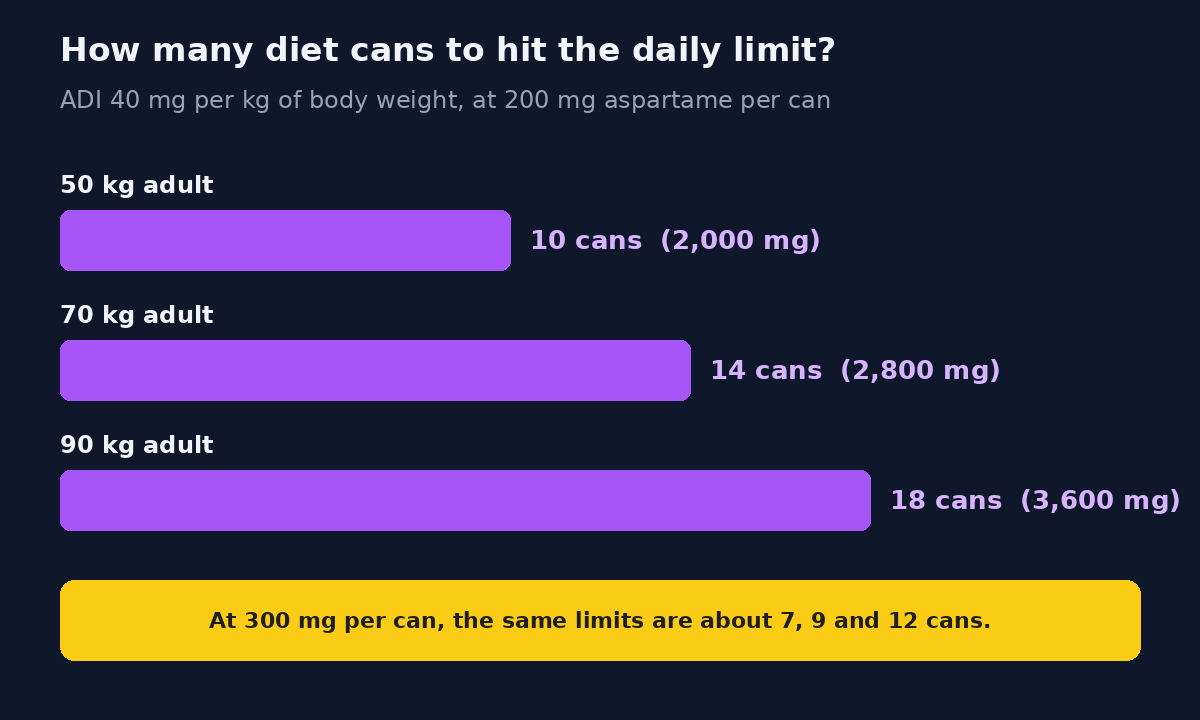
This is where the abstract debate becomes concrete, because the ADI can be turned into cans. A can of diet soft drink typically contains 200 to 300 milligrams of aspartame — the WHO's own worked example uses that range. At 200 milligrams per can, the arithmetic is simple: divide the daily limit by 200.
| Body weight | Daily limit (40 mg/kg) | Cans at 200 mg per can | Cans at 300 mg per can |
|---|---|---|---|
| 50 kg | 2,000 mg | 10 cans | About 7 cans |
| 70 kg | 2,800 mg | 14 cans | About 9 cans |
| 90 kg | 3,600 mg | 18 cans | 12 cans |
| 30 kg child | 1,200 mg | 6 cans | 4 cans |
That is the WHO's 9-to-14-can figure for a 70-kilogram adult: it is not a claim that 14 cans is healthy, it is the boundary of the safety limit, and it assumes no aspartame from any other source that day — no gum, no yoghurt, no tabletop sweetener. Most people drink one or two cans at most, which puts them at roughly a tenth of the limit. Children hit the limit sooner because they weigh less, which is a genuine reason to be more careful about children's intake, not a reason to panic about a single can.
It is also worth noting what the ADI is not. It is not a threshold where 39 milligrams is safe and 41 milligrams is dangerous. It is set far below the highest dose tested without harm in animals — in aspartame's case, JECFA's summary describes a foundational 1981 rat study at 4,000 milligrams per kilogram per day, one hundred times the ADI, in which no toxic effect was found. The factor of 100 is a deliberate safety margin, not a cliff edge. Going slightly over the ADI on one day is not a poisoning event; the limit is designed for every day over a lifetime.
What your body actually does with aspartame
Aspartame never reaches your bloodstream as aspartame. In the gut it is fully broken down into three things: phenylalanine (about 56% by weight), aspartic acid, and methanol (about 10% by weight). All three occur naturally in ordinary food. Phenylalanine and aspartic acid are amino acids, the building blocks of protein; a glass of milk or a serving of meat delivers far more phenylalanine than a diet drink. Methanol sounds alarming because it is the toxic alcohol in badly made moonshine — but dose is everything, and the dose from aspartame is small compared with the methanol your body already handles.
A can of diet drink yields roughly 3 to 20 milligrams of methanol, depending on its aspartame content, while a similar volume of fruit juice yields roughly 3 to 160 milligrams, because methanol is released from the pectin in fruit. The body itself produces an estimated 300 to 600 milligrams of methanol a day as part of normal metabolism. Methanol is converted in the liver to formaldehyde and then to formic acid, and this is the pathway behind the scariest social-media claim — "aspartame turns into formaldehyde in your body!" The claim is technically true and practically misleading: formaldehyde is an intermediate the body produces and clears constantly from many sources, and at the tiny amounts involved, blood formate levels do not measurably rise. Toxic methanol poisoning requires hundreds of milligrams per kilogram of body weight — orders of magnitude above anything a diet drink delivers. One review cited by regulators calculated that reaching a toxic methanol dose from diet drinks alone would require hundreds of cans at once, an amount no stomach can hold.
There is one population for whom this breakdown is not a footnote: people with phenylketonuria. PKU is a rare genetic condition, present from birth, in which the body cannot properly break down phenylalanine. For people with PKU, phenylalanine from any source — food or aspartame — can build up to harmful levels, which is why products containing aspartame carry a warning that they contain phenylalanine, and why aspartame is unsuitable for them. This is not a vague precaution; it is the one established, non-controversial harm in the entire aspartame story, and it is handled by labelling, not by banning the sweetener for everyone else. Pregnant women do not have a separate aspartame ban under the current limits, though anyone with PKU who is pregnant needs specialist dietary advice — a clinical matter, not a decision to make from a blog post.
The rat studies that fuel the fear
The most cited evidence against aspartame comes from the Ramazzini Institute in Bologna, Italy, led by Morando Soffritti. In studies published in 2006, 2007 and 2010, rats and mice fed aspartame from before birth and throughout their lives developed more tumours, including lymphomas, leukaemias and liver and lung tumours, with the effect increasing with dose. Critics of the official safety verdict treat these as the smoking gun that regulators ignored; defenders of the verdict treat them as flawed studies that regulators correctly set aside. Both descriptions need unpacking.
The Ramazzini studies differed from standard toxicology studies in two ways that their supporters say made them more sensitive: they used more animals and more dose groups, and they let the animals live until natural death instead of killing them at a standard age. The critics' reply is that letting animals live to old age is exactly the problem: old rats develop tumours spontaneously, the strains used are prone to liver and lung tumours, and the reported tumour rates fell within the historical range for those strains. The European Food Safety Authority (EFSA), in its full 2013 review, discounted the Ramazzini findings on those grounds and concluded there were no safety concerns at the ADI — a conclusion JECFA effectively repeated in 2023 when it judged the animal studies unusable for risk assessment because of the lifetime-exposure design.
The counter-critique is serious and should not be waved away. Researchers including Erik Millstone have argued that EFSA applied its reliability criteria asymmetrically: in a detailed appraisal of the 2013 review, Millstone counted 154 studies and found the panel deemed all 73 studies indicating possible harm unreliable, while deeming most studies indicating no harm reliable — including some earlier industry studies with, in his analysis, greater imperfections than the Ramazzini work. Whether you accept that charge or not, it identifies the real fault line in this debate: it is not that regulators never looked at the positive studies, it is that they weighed them differently from the way the studies' authors did, and reasonable toxicologists disagree about which weighing is right. What is not in doubt is that no other laboratory has replicated the Ramazzini tumour findings in the same way, and that the standard regulatory studies — the ones that set the ADI — found no such effect at doses up to 100 times the human limit.
What the human studies actually show
Human evidence is where the debate gets genuinely uncomfortable for both camps, because the largest study points one way and the regulators' verdict points the other — and both have to be reported honestly.
The largest study is the French NutriNet-Santé cohort, published by Debras and colleagues in PLOS Medicine in 2022. It followed 102,865 adults for a median of 7.8 years, recording diet through repeated 24-hour records that included brand names. Compared with non-consumers, higher consumers of aspartame had a 15% higher risk of overall cancer (hazard ratio 1.15), a 22% higher risk of breast cancer (hazard ratio 1.22), and a 15% higher risk of obesity-related cancers. The authors adjusted for a long list of confounders — age, sex, smoking, body weight, physical activity, family history of cancer, alcohol, diet quality — and concluded that the findings did not support the use of artificial sweeteners as a safe alternative to sugar. That is a real, large, peer-reviewed result, and it is the strongest human evidence the concerned camp has.
It is also an observational study, and observational nutrition studies carry weaknesses that apply here in full. Participants were volunteers, nearly four-fifths of them women, who may not represent the general population. Sweetener intake was estimated from self-reported diet records, not measured in blood. People who consume a lot of sweeteners differ from non-consumers in many ways — they are more likely to be trying to lose weight, to have diabetes in the family, to have been advised to cut sugar — and statistical adjustment cannot perfectly remove those differences. Reverse causation is a live possibility: being on the path toward illness can cause a person to switch to diet products, making diet products look like the cause. And the result has not been consistently replicated: other large cohorts and reviews have found no consistent overall cancer link, and a 2025 systematic review of epidemiological studies reported no significant association between artificial sweetener intake and overall cancer risk. JECFA's 2023 judgement — that the human evidence was "not convincing" — is a judgement about this whole, mixed picture, not a denial that the French study exists.
The older human scare stories have fared worse. A 1996 hypothesis linking aspartame's approval to a rise in brain tumours was never supported by incidence data — brain tumour rates did not track aspartame consumption. Claims linking aspartame to multiple sclerosis, lupus and Gulf War syndrome trace back to a chain email from 1998, attributed to a "Nancy Markle," that was debunked years ago and has no study behind it. Early concerns about leukaemia and lymphoma in humans have produced inconsistent results across studies, not a settled link. A reader who believes every aspartame claim they have seen online is believing several claims that the evidence has already rejected, alongside one or two that it has not.
The approval story: genuinely messy, not a proven conspiracy
No aspartame article is complete without the approval history, because it is the fuel for the most-shared version of the story: that a politically connected company forced an unsafe sweetener onto the market. The real history is messy enough without embellishment, and the embellishment is where the story goes wrong.
The documented timeline is this. Aspartame was approved by the FDA in 1974. That approval was then stayed in 1975 after objections, and a task force in 1977 identified deficiencies in the manufacturer's studies. A Public Board of Inquiry in 1980 examined the evidence and, while finding the sweetener should not be approved on the evidence then available for one question, did not find it proven unsafe. In 1981, the new FDA Commissioner, Arthur Hayes, approved aspartame for dry goods, and in 1983 for carbonated drinks; in 1996 it was approved as a general-purpose sweetener. Hayes later took a consultancy role with Searle's public-relations firm, and Donald Rumsfeld — who had been chief executive of Searle before joining the Reagan administration — is a fixture of the conspiracy version, in which his political influence supposedly forced the approval through.
What the record supports is that the approval process involved contested science, industry-funded studies, regulatory reversals, and a revolving door that looks bad and erodes trust. What it does not support is the leap from "the process was flawed" to "the product is therefore toxic": the sweetener has since been reviewed independently by EFSA, JECFA, the FDA and other regulators across four decades, including reviews that had no connection to the original approval politics, and none has found the evidence sufficient to withdraw it. A flawed birth does not prove a poisoned product — but it does explain, fairly, why many people do not trust reassurances that cite only the original approval. Trust, once spent, is not restored by repeating "regulators say it is safe" without showing the work.
The two camps, stated fairly
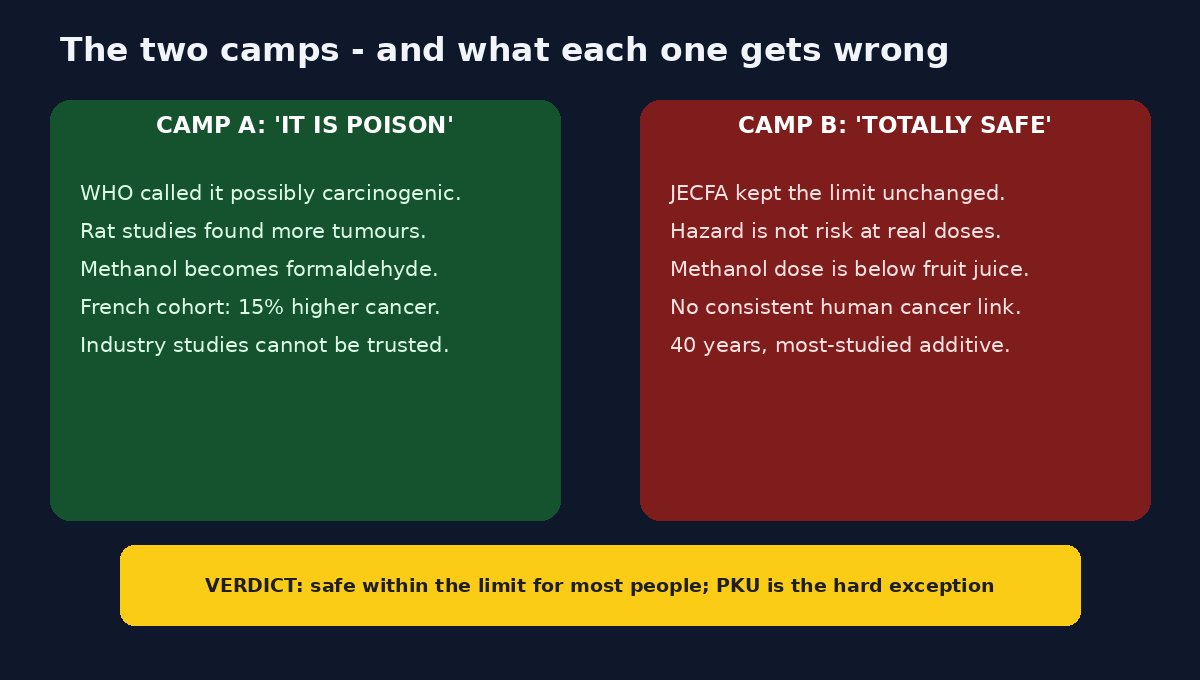
Camp A — "It is poison, and the industry bought the verdict." Its strongest argument is the combination of the IARC classification, the Ramazzini animal tumours, and the NutriNet-Santé human association: three different kinds of evidence pointing, in its reading, the same way. Its second argument is institutional: most of the early safety studies were funded by the manufacturer, regulators dismissed every positive study while accepting negative ones, and the 100-fold safety margin is built on animal data that cannot guarantee human safety. Its weakest habit is overreach: quoting the methanol-to-formaldehyde pathway without the dose, quoting the IARC group without explaining that it measures certainty rather than danger, and recycling debunked chain-email claims about multiple sclerosis and seizures as if they were studies.
Camp B — "It is totally safe, and the fear is hysteria." Its strongest argument is the dose arithmetic and the regulatory consensus: the ADI, the failure of other laboratories to replicate the rat tumours, the inconsistency of the human cancer studies, and the fact that the methanol and phenylalanine doses from a normal diet dwarf those from a diet drink. Its weakest habit is also overreach: treating "no convincing evidence of harm" as "proven harmless," dismissing the NutriNet-Santé result instead of engaging with it, and implying that anyone worried about aspartame is anti-science. "No convincing evidence" is a statement about the current state of the evidence, not a guarantee about the future — and the regulators themselves keep calling for better studies, which is not what you say about a closed question.
Where the two camps actually agree (and what is still genuinely unresolved)
Strip away the slogans, and the camps agree on more than either admits. Both accept that dose matters: nobody in the serious literature claims one diet drink causes cancer, and nobody claims drinking 20 cans a day is a good idea. Both accept that people with PKU must avoid aspartame — the labelling exists because of that agreement. Both accept that the evidence is incomplete: IARC called for more research, JECFA called for better studies with longer follow-up and repeated dietary questionnaires, and the WHO guideline authors graded their own weight recommendation as conditional. The disagreement is about what to do while the evidence is incomplete: treat the gap as a reason to avoid the sweetener, or treat the existing safety margin as a reason to keep using it.
What is genuinely unresolved is the long-term cancer question at high intakes. The human studies that exist are observational, relatively short for a cancer question, and they measure sweetener exposure imperfectly — through diet records and drink categories rather than aspartame-specific biomarkers. A definitive answer would need large cohorts with repeated, aspartame-specific exposure measurement over decades, plus mechanistic studies that pin down whether any plausible pathway operates at human doses. Neither camp has that study. Until it exists, the honest position is a split verdict by dose: confident at ordinary intakes, uncertain at very high intakes, and categorical only about PKU.
There is a second, quieter unresolved question: what diet drinks displace. If a diet drink replaces a sugary drink, the swap removes a large sugar load, and short-term trials show small weight benefits from that swap. If a diet drink becomes a licence to eat more elsewhere — the "I had a diet drink, so I can have dessert" effect — or if it keeps a sweet taste preference that drives sugar consumption later, the net effect could be worse than the drink itself. The WHO's 2023 guideline is really about this second question: sweeteners are not a weight-loss strategy, and treating them as one is a mistake even if the sweetener itself is safe. Water, unsweetened tea and sparkling water beat both sugary and diet drinks on every measure except the pleasure of sweetness itself.
At a glance: claim vs evidence
| Claim you will hear | What the evidence actually says |
|---|---|
| The WHO says aspartame causes cancer | No. IARC classified it as possibly carcinogenic (Group 2B) on limited evidence; JECFA, the WHO/FAO risk body, kept the daily limit unchanged and called the human cancer evidence not convincing. |
| Aspartame turns into formaldehyde in your body | Technically true, practically misleading. Methanol from aspartame is converted to formaldehyde and then to formic acid, but at doses far below those from fruit juice and the body's own production, with no measurable rise in blood formate. |
| Rat studies proved it causes cancer | Ramazzini Institute studies found more tumours in rats and mice, but regulators discounted them over lifetime-exposure design and strain susceptibility, and other laboratories have not replicated the findings. |
| A big French study found a 15% higher cancer risk | Yes — NutriNet-Santé (102,865 adults, 2022) found hazard ratio 1.15 for higher aspartame consumers. It is observational, so it shows association, not proof, and other studies have not consistently agreed. |
| One diet drink a day is dangerous | Not supported. One can is roughly a tenth of the daily limit for a 70-kilogram adult, and no credible study shows harm at that level. |
| People with PKU must avoid it | Yes, absolutely. PKU prevents proper breakdown of phenylalanine, so aspartame is unsuitable for people with PKU — hence the mandatory phenylalanine warning on labels. |
| It was forced through by political corruption | The approval history was genuinely contested, with stayed approvals and a revolving door, but later independent reviews across four decades reached the same safety conclusion — a flawed process does not prove a toxic product. |
| Diet drinks help you lose weight | Only as a swap, and only modestly. Short trials show small losses when diet drinks replace sugary ones; the WHO advises against relying on sweeteners for weight control, and observational links to weight gain are likely driven by reverse causation. |
| Aspartame causes multiple sclerosis and seizures | No credible evidence. The MS claim traces to a debunked 1998 chain email; seizure and headache claims rest on case reports and small, inconsistent studies, not on a settled link. |
Popular opinions: how divided people actually are
The arguments below are paraphrased from the recurring positions in forums, social media threads and comment sections — not quoted posts, and no usernames are invented or cited. They show the real shape of the divide, which is not "science versus ignorance" but different readings of the same verdicts.
"The WHO literally called it a carcinogen, and people still drink it." This camp is right that the classification happened, and wrong about what it means. Group 2B is the "possibly" category, shared with pickled vegetables and mobile-phone radiofrequency fields, and it measures certainty, not danger. Verdict: a true fact used to support a much stronger claim than it carries.
"I drink six Diet Cokes a day and I am fine, so it is all a scare." The personal-experience defence, and the most human one. Its weakness is the same as every anecdote about risk: cancer takes decades, and feeling fine now says nothing about a small long-term association. It is also worth noting that six cans a day is still below the limit for most adults — so this person is not even a counterexample to the official position. Verdict: a true story that proves less than it feels like it proves.
"Methanol is wood alcohol — you would not drink wood alcohol, so why drink this?" This is the dose fallacy in its purest form. Methanol is toxic at high doses and harmless at the trace doses in food; fruit juice delivers more of it than diet soda, and the body makes hundreds of milligrams a day on its own. Verdict: a scary word, not a scary dose.
"The rat studies were buried because the industry paid for the safety studies." Partly true about funding — many early studies were industry-funded — and genuinely important for trust. Its weakness is overreach: later reviews by EFSA and JECFA were not the original approval, the Ramazzini studies were published and debated rather than buried, and funding alone does not falsify a result. Verdict: a real trust problem, used to justify dismissing evidence that was actually examined.
"If it were dangerous, they would have banned it by now — it has been around for forty years." This sounds like common sense, but regulatory history is full of substances that stayed legal for decades before the evidence caught up, and "still legal" is not a scientific argument. Its strength is narrower: forty years of widespread use with no clear signal in population cancer data is itself evidence, and it is part of why regulators are comfortable. Verdict: weak as logic, stronger as epidemiology.
"I just drink water instead — why argue about which poison is less bad?" This is the position the evidence actually rewards, and the one neither camp wants to share, because it ends the argument. Water has no sweetener debate attached, no ADI to count, and no industry funding to distrust. Its only weakness is that it does not answer the question people asked: is the diet drink I already drink safe? Verdict: the best practical answer, and a dodge of the scientific one.
Notice the pattern, familiar from every food fight: each side reads the same July 2023 announcement as proof of its own position. One side hears "possibly carcinogenic" and stops listening. The other hears "limit unchanged" and stops listening. The announcement itself was neither a ban nor a clean bill of health. It was two agencies doing two different jobs, and the gap between their jobs is where the argument lives.
How to decide for yourself
A practical approach that follows the evidence, rather than a camp, looks like this. If you have PKU, avoid aspartame entirely and follow your clinician's dietary advice — no debate, no exception. If you do not, count roughly rather than obsessively: one or two diet drinks a day sits far inside the safety limit for an adult, and there is no credible evidence of harm at that level. If you drink many cans a day, every day, you are in the one zone where the evidence is genuinely thin — not because harm is proven there, but because the studies cannot clear it with confidence — and cutting back is a cheap, sensible precaution. Check labels for E951 and for phenylalanine warnings if anyone in your household has PKU. Be more careful with children, who reach the limit at far fewer cans because they weigh less. And do not treat a diet drink as a health product: if the goal is weight control, the evidence favours water and unsweetened drinks, and the WHO's advice on that point is the part of the 2023 story most people missed while arguing about cancer.
Aspartame is not poison, and it is not innocent. It is a sweetener with a real regulatory limit, a real exception for people with PKU, a contested animal literature, a mixed human literature, and a hazard classification that sounds far scarier than the risk assessment behind it. The 2023 verdict was not a cover-up and it was not a condemnation. It was a measurement of uncertainty: possibly carcinogenic, probably safe at ordinary doses, definitely worth better studies. The camps will keep fighting over the slogan. The numbers, read properly, point somewhere quieter: drink it if you like it, count the cans if you drink a lot of it, avoid it entirely if you have PKU, and reach for water when you can.
Frequently asked questions
Is aspartame safe?
For most people at ordinary intakes, yes, according to every major regulator that has reviewed it — the FDA, EFSA and JECFA all kept their safety limits after the 2023 reviews. The exception is people with phenylketonuria (PKU), who must avoid it because they cannot process phenylalanine. Very high, multi-can-a-day intake over many years is the one zone where the evidence is too thin for a confident all-clear.
Did the WHO say aspartame causes cancer?
No. In July 2023, IARC classified aspartame as possibly carcinogenic to humans (Group 2B) based on limited evidence for liver cancer in humans and limited evidence in animals. On the same day, JECFA reaffirmed the acceptable daily intake of 40 milligrams per kilogram of body weight, concluding the human cancer evidence was not convincing. The classification is about hazard — whether something could cause cancer — not about risk at normal intakes.
How many diet drinks can I have per day?
Using the WHO's own example, a 70-kilogram adult would need about 9 to 14 cans a day, with no aspartame from any other source, to exceed the daily limit — 14 cans at 200 milligrams per can, 9 cans at 300 milligrams. One or two cans a day is roughly a tenth of the limit. Children reach the limit sooner because they weigh less.
Is the methanol in aspartame dangerous?
Not at the doses in food. A can of diet drink yields roughly 3 to 20 milligrams of methanol, while a similar volume of fruit juice yields roughly 3 to 160 milligrams, and the body itself produces an estimated 300 to 600 milligrams a day. Methanol is converted to formaldehyde and then to formic acid, but at these amounts blood formate levels do not measurably rise, and toxic doses are hundreds of times higher.
Should children drink aspartame-sweetened drinks?
There is no ban, but caution is warranted: a child's daily limit is proportionally smaller, so a few cans can approach it, and water is the better default drink for children. Children with PKU must avoid aspartame entirely. If a child drinks diet drinks regularly, checking the total across all sweetened foods — not just drinks — is the practical step.
Is aspartame better than sugar?
For weight and teeth, swapping a sugary drink for a diet drink is modestly better in the short term, according to trial evidence. For overall health, the WHO advises against relying on non-sugar sweeteners for weight control, because the long-term observational evidence is mixed and may reflect reverse causation. Water and unsweetened drinks beat both options.
Sources and further reading
- World Health Organization, IARC and JECFA, "Aspartame hazard and risk assessment results released", 14 July 2023 — IARC Group 2B classification on limited evidence for hepatocellular carcinoma; JECFA reaffirms the acceptable daily intake of 0–40 mg/kg body weight; a 70 kg adult would need more than 9–14 cans of diet soft drink per day to exceed the limit.
- Riboli E, Beland FA, Lachenmeier DW et al., "Carcinogenicity of aspartame, methyleugenol, and isoeugenol", The Lancet Oncology, 2023 — the IARC Monographs evaluation behind the Group 2B classification.
- Debras C et al., "Artificial sweeteners and cancer risk: Results from the NutriNet-Santé population-based cohort study", PLOS Medicine, 2022 — 102,865 adults, median follow-up 7.8 years; higher aspartame consumers had a hazard ratio of 1.15 for overall cancer and 1.22 for breast cancer, with the authors noting selection bias, residual confounding and reverse causation as limitations.
- European Food Safety Authority, Panel on Food Additives and Nutrient Sources Added to Food, scientific opinion on the re-evaluation of aspartame (E951), December 2013 — no safety concerns at the ADI of 40 mg/kg body weight per day; Ramazzini findings discounted on design and strain-susceptibility grounds.
- Millstone E, "EFSA's toxicological assessment of aspartame: was it even-handedly trying to identify possible unreliable positives and unreliable negatives?" — appraisal arguing the 2013 panel deemed all 73 studies indicating possible harm unreliable while deeming most no-harm studies reliable.
- Soffritti M et al., Ramazzini Institute carcinogenicity studies of aspartame in rats and mice, 2006, 2007 and 2010 — lifetime-exposure studies reporting dose-related tumour increases; discounted by EFSA, FDA and JECFA on methodological grounds.
- World Health Organization, "Use of non-sugar sweeteners: WHO guideline", May 2023 — conditional recommendation against using non-sugar sweeteners for weight control or reducing diet-related disease risk.
- US Food and Drug Administration, "Aspartame and Other Sweeteners in Food", reviewed July 2023 — FDA disagrees with the IARC listing, cites significant shortcomings in the relied-upon studies, and states no safety concerns under approved conditions; FDA acceptable daily intake 50 mg/kg body weight per day.
This article is for general information only and is not medical advice. If you have phenylketonuria, a family history of cancer, or concerns about sweetener intake for a child, speak to a clinician about your personal situation.
Found this answer useful? This post is part of a series that takes questions many people search for but nobody has answered properly, and gives the real, detailed answer. Earlier in the series: whether sugar makes kids hyperactive, whether red meat causes cancer, whether fluoride in tap water is safe, whether seed oils are toxic, whether organic food is actually healthier, the MSG food fight and whether expired poison becomes safe. If you have a question you want answered this way, reach out through asadwebs.com.
Be the first to share a useful question or thought.