
Direct answer
No — not according to the best-controlled experiments ever run on the question. When children are given sugar or a placebo in double-blind trials, where nobody rating the behaviour knows who got what, sugar does not reliably make them hyperactive, inattentive, or harder to manage. A 1995 JAMA meta-analysis pooling 23 such trials found effect sizes effectively at zero. What parents see at birthday parties is real behaviour — but the evidence says the cause is usually the party, not the cake: excitement, late bedtimes, skipped meals, caffeine in cola and chocolate, and the simple fact that adults expect chaos once sugar appears.
Ask any room of parents and most will tell you the same story: one cupcake at a birthday party and their child turns into a different creature. Ask the researchers who spent thirty years testing that story under controlled conditions and you get a different answer: the sugar rush, as most people picture it, does not survive blinding. This post looks at both sides — the parents who swear they see it, and the trials that cannot find it — and at the one experiment that explains why the two sides can both be sincere.
At a glance
| Question | Short answer |
|---|---|
| Does sugar make most children hyperactive? | No reliable evidence in double-blind trials; pooled effect effectively zero. |
| What is the strongest evidence? | Wolraich 1995 JAMA meta-analysis: 16 reports, 23 double-blind placebo-controlled trials, 14 behaviour and cognition measures. |
| Did "sugar-sensitive" children react? | No. Trials that recruited children whose parents were sure sugar affected them still found no effect. |
| Why do parents see it then? | Party conditions (excitement, tiredness, late nights, caffeine) plus expectation: adults who believe a child had sugar rate the same behaviour as more hyperactive. |
| Are there real reasons to limit sugar? | Yes — tooth decay and excess weight gain. Those harms are well established; hyperactivity is not one of them. |
| Any honest caveats? | Very small effects, or effects in a rare subgroup, cannot be fully ruled out; and food colourings are a separate question from sugar. |
The birthday-party mystery: why the story feels so true
The sugar-rush belief did not come from nowhere. It came from the most convincing laboratory in the world: a child's birthday party. A parent watches a calm child eat cake and ice cream, then watches the same child sprint around the garden shrieking, and the cause-and-effect feels obvious. It is also, for science, the worst possible experiment — because at a party, sugar is never the only thing that changes.
Consider everything else that changes at the same time. The child is surrounded by friends and noise, often in an unfamiliar house or hall. Bedtime slides later. Lunch may have been skipped or replaced by snacks. Cola contains caffeine. Chocolate contains a small amount of caffeine too. The adults are distracted, the rules are relaxed, and the child knows it. Any one of those factors can make a child louder and faster; together, they reliably do. The cake gets the blame because it is the most visible change, not because it is the most powerful one.
There is also a quieter bias at work. Parents notice the wild behaviour after cake and remember it. They do not notice, or do not remember, the times a child ate sweets and stayed calm — because calm behaviour after sweets is not a story. Over years, the memorable cases pile up into a certainty, while the unmemorable cases vanish. That is confirmation bias, and it is powerful precisely because it feels like observation rather than reasoning.
What the blinded experiments actually found
The way to test the claim properly is to remove all of that context. In a double-blind, placebo-controlled challenge study, children are given either sugar or a placebo sweetened with an artificial sweetener so it tastes the same, and neither the children, the parents, nor the researchers rating behaviour know which is which. If sugar truly causes hyperactivity, the sugar group should be measurably wilder. Again and again, it is not.
The clearest synthesis is the meta-analysis by Wolraich, Wilson and White, published in JAMA in 1995. It pooled 16 published reports covering 23 within-subject trials that met strict criteria: a known sugar dose, a placebo condition, blinding of children, parents and staff, and enough data to compute effect sizes. Across 14 behavioural and cognitive constructs — activity level, attention, impulsivity, academic performance, mood and more — every pooled 95% confidence interval included zero. The mean effect sizes ranged from −0.14 to +0.30, none reaching statistical significance, and none close to what anyone would call a dramatic effect. In plain language: sugar did not move behaviour in any consistent direction.
A year earlier, the same research group had run an even tougher test, published in the New England Journal of Medicine in 1994. Forty-eight children — 25 preschoolers and 23 school-age children whose parents considered them sugar-sensitive — ate three consecutive three-week diets: high sucrose, aspartame, and saccharin placebo, in a double-blind crossover design. Across 39 behavioural and cognitive measures, the high-sucrose diet produced no significant difference. That last detail matters most. These were the children the theory should have caught most easily: the ones whose families were already certain. Under controlled conditions, even they did not react.
The authors of the meta-analysis were careful about the limits of their own work, and honesty requires repeating them. A meta-analysis can miss a very small effect, or an effect confined to a subgroup nobody has yet identified. What it rules out is the dramatic, reliable, every-child sugar rush of popular belief. If sugar had that kind of effect, trials of this size and quality would have found it decades ago.
The experiment that explains the argument: expectation
If sugar does not change children's behaviour, why do so many careful, observant parents insist it does? The most elegant answer came from Hoover and Milich in 1994, and it is the study that turns this debate from a stalemate into something genuinely interesting.
They recruited 35 boys aged 5 to 7 whose mothers described them as sugar-sensitive. Every boy in the study received the same drink: a placebo sweetened with aspartame. The trick was what the mothers were told. Half were told their son had received a large dose of sugar; the other half were told, correctly, that he had received the placebo. Nothing else differed — the children, the drink, and the play session were the same.
The mothers who believed their sons were "on sugar" rated them as significantly more hyperactive than the mothers who believed their sons had the placebo — even though no child had consumed any sugar at all. The effect went further than ratings: the sugar-believing mothers hovered closer, criticised more, and stayed on top of their sons throughout the session. Belief did not merely colour perception; it changed how the adults behaved, which in turn can genuinely wind a child up. The sugar rush, in this experiment, was manufactured entirely in the observer's head — and then partly acted out in the room.
That finding does not mean parents are imagining things or lying. It means human observation is not a neutral instrument. When you expect chaos, you watch for it, you notice it, you remember it, and you may even help create it by tightening control at exactly the moment a child is already excited. Both camps in this debate can be sincere: the parent who saw wild behaviour after cake, and the researcher who cannot find sugar's fingerprints on it. They are describing different parts of the same scene.
The honest caveats: what the evidence does NOT settle
Three caveats keep this verdict honest rather than triumphalist.
First, correlation is not causation — in the other direction too. Some observational studies report that children who habitually drink more sugary beverages show more attention problems. That association is real as a statistic, but it does not prove sugar causes the problems: families, routines, sleep, screen time and dozens of other factors travel with sugary-drink habits, and observational designs cannot separate them. A 2020 review of such studies reached exactly that cautious conclusion. The blinded trials, which can separate cause from company, do not find the effect.
Second, sugar is not the only food suspect. A well-known Lancet trial in 2007 tested mixtures of artificial food colours plus the preservative sodium benzoate in 3-year-olds and 8- to 9-year-olds, and found increased hyperactivity in the general population of children tested — not only those with ADHD. That is a colourings finding, not a sugar finding, and it is often wrongly folded into the sugar story. It deserves its own article; it does not rescue the sugar claim.
Third, "sugar does not cause hyperactivity" is not "sugar is harmless." Excess sugar is firmly linked to tooth decay and to weight gain, and cutting back on sugary drinks is good advice for those reasons alone. Parents who limit sweets are not being irrational — they are simply, on this one specific claim, aiming at the wrong mechanism. The practical advice survives; only the explanation changes.
What actually helps at party time
If the goal is a calmer child rather than winning an argument about cake, the evidence points away from policing sugar and toward the conditions around it:
- Protect sleep and meals. A tired, hungry child is a wild child, sugar or no sugar. A real lunch before a party beats a sugar ban after one.
- Watch the caffeine, not just the sugar. Cola and energy drinks are stimulants in their own right; chocolate has a small amount too. A child bouncing after cola may genuinely be stimulated — by caffeine.
- Expect the setting effect. New places, new friends, noise and excitement raise arousal on their own. Plan a wind-down after the party rather than a confrontation about the cake.
- Test your own expectations. If you are sure sugar affects your child, notice whether you watch them more closely, correct them more, and remember the wild moments more after sweets. The Hoover and Milich study suggests most of us do — and that noticing it is half the cure.
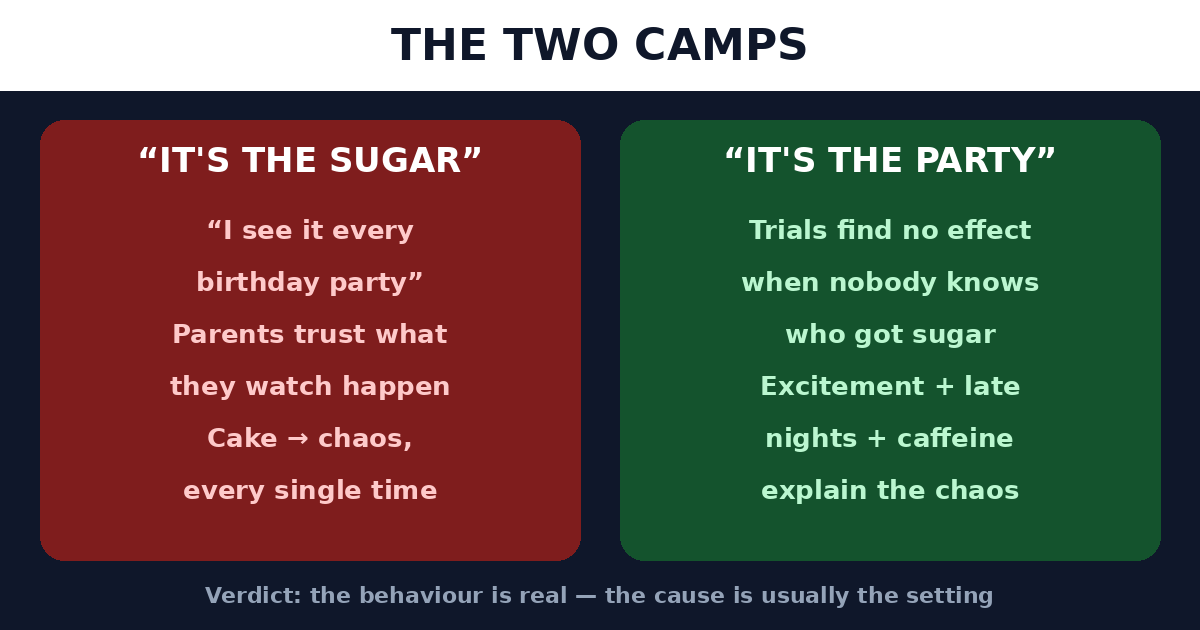
Popular opinions: how divided people actually are
Search any parenting forum for this question and the same three camps appear, often in the same thread, often furious with each other.
Camp one: "I see it with my own eyes." Parents describe a repeatable pattern — cake, then chaos — sometimes with careful detail: the same child, the same foods, the same aftermath. Their argument is experiential and, on its own terms, strong: no meta-analysis can tell a parent what happened in their own kitchen. The weakness, as the expectation research shows, is that personal observation is exactly what the blinding in these trials was designed to correct for — and the trials removed the effect along with the knowledge.
Camp two: "It is the party, not the cake." Other parents and many paediatric voices argue the setting explains everything: excitement, friends, late nights, skipped meals. Their case fits the trial evidence best, and it has a practical advantage — it suggests fixes (sleep, food, wind-down time) that work whether or not sugar is involved.
Camp three: "It is real for MY child." A smaller, more careful camp accepts the general evidence but insists on individual exceptions — food sensitivities, specific colourings, or an unidentified subgroup. This is the one position the science genuinely leaves open: the meta-analysis authors themselves said small effects or subgroup effects could not be ruled out. It is also the hardest position to test at home, because home tests are never blinded — and blinding is precisely what makes the difference.
The verdict that best fits all three camps: the dramatic, universal sugar rush is a myth; the wild behaviour at parties is real and has real causes; and a small number of individual exceptions remain possible but unproven. That is less satisfying than a clean yes or no — which is probably why the argument has run for fifty years.
Frequently Asked Questions
Does sugar make kids hyperactive?
Not according to double-blind trials. A 1995 JAMA meta-analysis of 23 placebo-controlled trials found no reliable effect of sugar on children's behaviour or cognition, including in children described as sugar-sensitive.
Why does my child go wild at birthday parties then?
Most likely the party itself: excitement, friends, noise, late bedtimes, skipped meals, and sometimes caffeine in cola or chocolate. Those factors raise arousal on their own, and adults also expect chaos once sugar appears, which changes how they watch and react.
Is there a study where parents imagined the effect?
Yes — Hoover and Milich (1994). All 35 boys received a placebo drink, but mothers told their son had sugar rated him significantly more hyperactive than mothers told he had placebo, and they hovered and criticised more during play.
Does sugar cause ADHD?
No. Controlled research has not established sugar as a cause of ADHD or hyperactivity. ADHD is a neurodevelopmental condition with genetic and developmental roots; diet is not its cause, though overall nutrition still matters for health.
Should I still limit my child's sugar?
Yes, for other reasons: tooth decay and excess weight gain are well-established harms of high sugar intake. Limiting sugary drinks is good advice — just not because of hyperactivity.
What about food colourings?
That is a separate question. A 2007 Lancet trial found mixtures of artificial food colours plus sodium benzoate increased hyperactivity in young children tested. Colourings are not sugar, and that finding does not show sugar itself causes hyperactivity.
Sources
- Wolraich ML, Wilson DB, White JW. The effect of sugar on behavior or cognition in children: a meta-analysis. JAMA. 1995;274(20):1617–1621.
- Wolraich ML, Lindgren SD, Stumbo PJ, Stegink LD, Appelbaum MI, Kiritsy MC. Effects of diets high in sucrose or aspartame on the behavior and cognitive performance of children. New England Journal of Medicine. 1994;330(5):301–307.
- Hoover DW, Milich R. Effects of sugar ingestion expectancies on mother-child interactions. Journal of Abnormal Child Psychology. 1994;22(4):501–515.
- SugarMyth — timeline and summary of the controlled sugar-behaviour literature (secondary summary; primary citations above).
- NeuroFX library — Sugar and ADHD: the persistent myth and what the evidence says (secondary summary).
Note: this article summarises published research for general information. It is not medical advice; for concerns about a child's behaviour or diet, speak to a paediatrician.
Be the first to share a useful question or thought.