
To convert an hourly wage to a salary, multiply your rate by your weekly hours, then by your weeks per year. At $28/hour, 40 hours a week, 52 weeks a year: $28 × 40 = $1,120 a week; $1,120 × 52 = $58,240 a year. The 2,080-hour figure (40 × 52) is the full-time benchmark. Divide by 12, 26 or 52 for monthly, biweekly or weekly pay. A 5% raise takes $28 to $29.40 and $58,240 to $61,152. Gross figures, before tax. The Hourly to Salary Calculator runs every variation instantly. General information only — not financial advice.
Tool Preview: The Hourly to Salary Calculator In Use
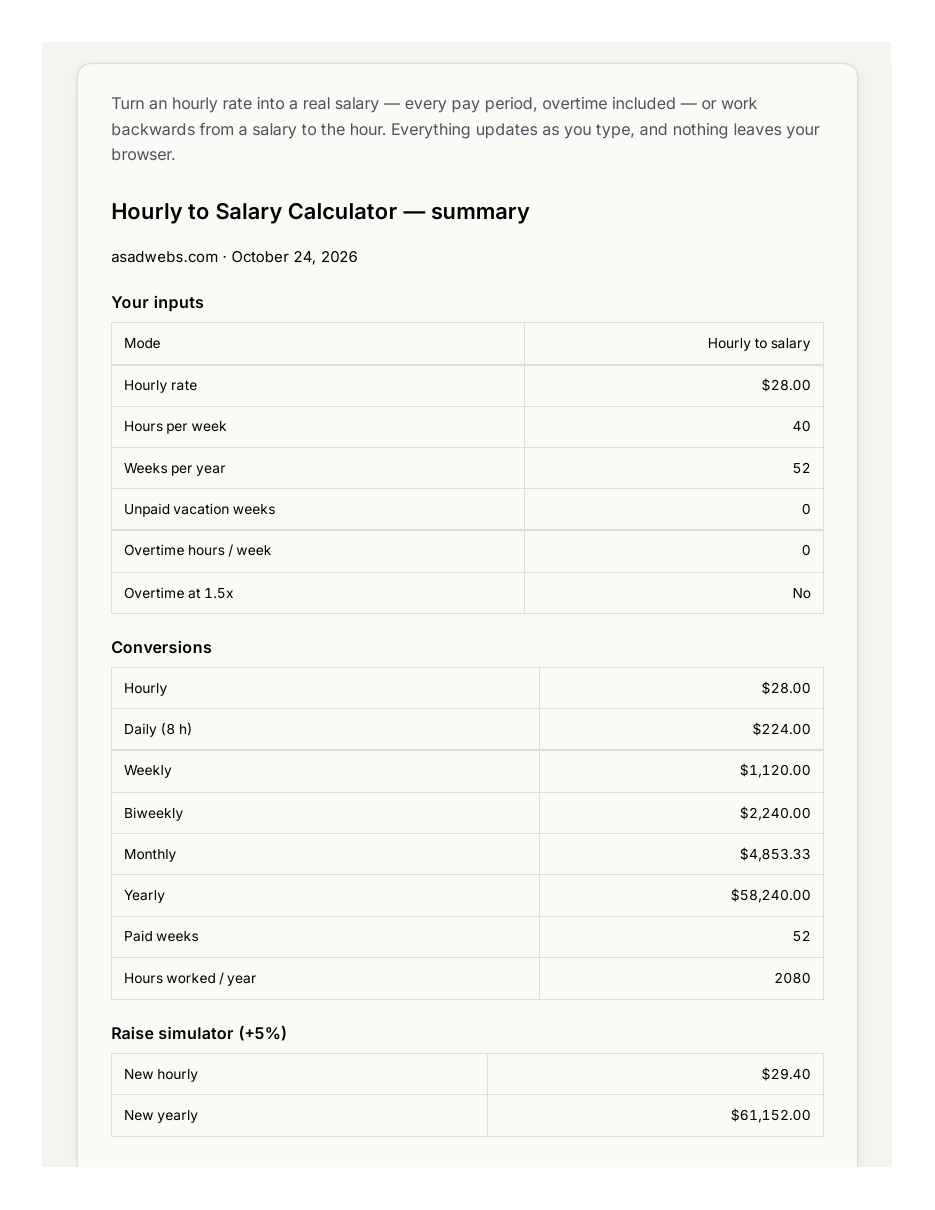
The calculator converting $28/hour at 40 hours a week, 52 weeks a year — $58,240.00 annual, $4,853.33 monthly, $1,120 weekly. Click the image to open the live tool.
The screenshot shows the tool running the exact example from this guide. It breaks the result into every pay period — annual, monthly, biweekly, weekly, daily and total hours per year — and includes an overtime toggle plus a raise simulator, so you can see what +5% on the rate does to the whole ladder. The walkthrough below follows the same steps the tool applies: weekly pay first, then annualised, then divided back into each period.
The 2,080-Hour Benchmark, Explained
Almost every salary conversion in the US and much of the world starts from one number: 2,080 hours. That is 40 hours a week × 52 weeks a year, the definition of a standard full-time year. Employers use it to translate hourly rates into the salary figures on offer letters, and salary ranges on job adverts are usually built from it in reverse.
Once you have the benchmark, the headline conversion is trivially fast: hourly rate × 2,080 = annual salary. At $28 an hour, $28 × 2,080 = $58,240. At $35 an hour, $35 × 2,080 = $72,800. Recruiters do this maths in their heads with a rougher rule of thumb — double the rate and add three zeros ($28 → $56,000) — which is close but consistently low, because the true multiplier is 2,080 rather than 2,000.
The catch is that 2,080 assumes you are paid for all 52 weeks. If you take unpaid time off, work seasonal contracts or get fewer than 40 hours some weeks, your real number is lower — which is exactly why the tool lets you set your own weeks per year instead of assuming 52. Adjust the benchmark to your reality before you make decisions on it.
Using the Hourly to Salary Calculator, Step by Step
The Hourly to Salary Calculator does the whole ladder at once. Here is how to use it well:
- Enter your hourly rate. Use the rate you actually earn. If you are comparing a job offer, enter the offered rate — not the rate you hope to negotiate.
- Set your real weekly hours. The default is 40, but part-time or variable schedules should use an honest average of the hours you actually work.
- Set the weeks you work per year. Full-time year-round is 52. If you take unpaid vacation or work a school-year schedule, reduce this — two unpaid weeks means 50, not 52.
- Add overtime if you earn it. Toggle overtime and enter the extra hours: the tool prices them at 1.5× your rate, the standard overtime premium, on top of your base pay.
- Read the pay-period ladder. Annual, monthly, biweekly, weekly, daily and total hours are all shown. Biweekly is the one to watch — most US employers pay every two weeks, so $2,240 per cheque is the number that actually lands in your routine.
- Test the raise simulator. Enter a percentage — say 5% — and watch every period move together. It turns abstract raise talk into concrete numbers: +5% on $28 is $29.40 an hour and $61,152 a year.
The Formula in Plain Language
The whole conversion is three multiplications. Weekly pay = hourly rate × hours per week (plus overtime hours × rate × 1.5 if you earn overtime). Annual salary = weekly pay × weeks per year. Then each shorter period is just the annual figure divided: ÷ 12 for monthly, ÷ 26 for biweekly, ÷ 52 for weekly, and weekly ÷ 5 for a daily figure on a five-day week.
Run the worked example through it: $28 × 40 = $1,120 a week. $1,120 × 52 = $58,240 a year. Then $58,240 ÷ 12 = $4,853.33 a month; $58,240 ÷ 26 = $2,240 biweekly; $58,240 ÷ 52 = $1,120 a week; and $1,120 ÷ 5 = $224 a day. Total hours: 40 × 52 = 2,080 a year. Every figure on the tool's ladder falls out of the same three multiplications.
The reverse direction is just as useful when you are negotiating. Hourly rate = annual salary ÷ total hours worked. A $58,240 salary offer at 2,080 hours is $58,240 ÷ 2,080 = $28 an hour. But a $58,240 salary that quietly expects 50-hour weeks is $58,240 ÷ 2,600 = $22.40 an hour — a very different deal. Always convert salary offers back to an hourly figure on the real hours before you compare.
Worked Example: $28 an Hour, Full Time
Inputs: $28.00 an hour, 40 hours a week, 52 weeks a year, no overtime. The tool's full breakdown:
| Pay period | How the tool gets it | Amount |
|---|---|---|
| Annual | $28 × 40 hrs × 52 wks | $58,240.00 |
| Monthly | Annual ÷ 12 | $4,853.33 |
| Biweekly | Annual ÷ 26 | $2,240 |
| Weekly | Annual ÷ 52 | $1,120 |
| Daily | Weekly ÷ 5 | $224 |
| Hours per year | 40 × 52 | 2,080 |
Two numbers in that table deserve extra attention. The $4,853.33 monthly figure is not what you would earn in a calendar month of actual work — months have different lengths, so the tool spreads the annual total evenly across 12. Your real monthly cheques will wobble around it. And the biweekly $2,240 is the figure most US workers should memorise, since 26 paydays a year is the most common schedule: 26 × $2,240 = $58,240, closing the loop.
Now the raise simulator. Enter +5% and the rate becomes $29.40 an hour ($28 × 1.05) and the annual salary becomes $61,152 ($58,240 × 1.05). That 5% is worth $2,912 a year, $242.67 a month and $1.40 an hour — small on the hour, meaningful on the year. When a manager says "we can do five percent," this is the translation.
Annual gross salary at $28/hour by hours worked per week — hover or tap each bar for details.
The chart shows why hours matter as much as the rate: dropping from 40 to 30 hours a week at the same $28 rate costs $14,560 a year — the same as a 25% pay cut. When you compare two offers, always convert both to the same weekly hours first.
Adjusting for Unpaid Time Off
The 2,080-hour benchmark assumes 52 paid weeks. Take two weeks of unpaid vacation and you work 50 weeks: $28 × 40 × 50 = $56,000, which is $2,240 less than the headline $58,240. Four unpaid weeks brings it to $53,760. This is the single most common reason someone's "salary" never matches their bank statements — the conversion was done on 52 weeks while the reality was 50.
Paid time off is different: if your vacation is paid, you still get 52 weeks of pay and the $58,240 stands. The adjustment only applies to unpaid time — vacation without pay, seasonal gaps, unpaid sick days. When an employer quotes an hourly rate, ask whether time off is paid; the answer changes the annual figure by thousands.
Overtime at 1.5×
Overtime is usually paid at 1.5 times the regular rate — "time and a half." At $28 an hour, an overtime hour pays $42. Five overtime hours a week add 5 × $42 = $210 to the weekly figure: $1,120 + $210 = $1,330 a week, or $69,160 a year over 52 weeks. That is $10,920 more than the base $58,240 — overtime is where hourly work can quietly out-earn an equivalent salary.
The tool's overtime toggle applies the 1.5× premium only to the overtime hours; your first 40 hours stay at the base rate. Enter your typical overtime hours honestly — a "sometimes 45, sometimes 40" week averages to 42.5, not 45 — and the ladder recalculates every period with the premium included.
The two-second estimate: double your hourly rate and add three zeros for a rough annual figure ($28 → ~$56,000). It undershoots the true number by about 4% because the real multiplier is 2,080, not 2,000 — fine for a quick comparison, but use the calculator for anything you will sign.
Why $28 an Hour Is Not $58,240 in Your Pocket
Every figure in this guide — and on the tool — is gross pay: what you earn before anything is taken out. Your actual take-home is lower, reduced by income tax, Social Security and Medicare (FICA in the US), state taxes where they apply, and any pre-tax deductions like health insurance premiums or retirement contributions. None of those are included in a rate-to-salary conversion, because they depend on your filing status, location and benefits choices.
To see the gap concretely: our worked $85,000 example in the US paycheck guide shows how federal tax, FICA and deductions shrink each biweekly cheque. Run your converted salary through that breakdown before you set a rent or car budget against it — the gross figure is for comparing offers, not for spending plans.
Benefits cut both ways, too. A $58,240 salary with paid health insurance, paid vacation and a retirement match can beat a $65,000 contractor rate with none of those. When you convert, keep a note of what sits outside the number: taxes out, benefits in. The hourly-to-salary figure is the starting point of the comparison, not the whole of it.
Common Mistakes in Hourly-to-Salary Maths
1. Using 2,000 hours instead of 2,080. The "double the rate, add three zeros" shortcut is handy but low by $2,240 on a $28 rate. Fine for interviews; wrong for offer letters.
2. Forgetting unpaid weeks. Two unpaid weeks erase $2,240 from the $58,240 headline. Set the weeks-per-year input to your reality.
3. Comparing salary offers without converting to hourly. A $58,240 salary at 40 hours a week is $28/hour; the same salary at 50 hours a week is $22.40/hour. Convert every offer to the same hours before you choose.
4. Treating gross as take-home. $58,240 a year does not mean $4,853.33 a month of spending money. Taxes and deductions come out first — always run the net figure separately.
5. Ignoring overtime in the comparison. Five overtime hours a week at 1.5× adds $10,920 a year to our example — enough to flip which of two offers is actually better.
Turning pay clarity into career clarity? If you are comparing offers, freelancing rates or the cost of going independent, talk to us — we help professionals present their value online with websites that do the explaining for them.
Frequently Asked Questions
How do you convert an hourly wage to a yearly salary?
Multiply your hourly rate by hours worked per week, then by weeks worked per year: rate × hours × weeks. At $28 an hour, 40 hours a week, 52 weeks a year: $28 × 40 × 52 = $58,240 a year. The 2,080-hour benchmark (40 × 52) is the standard full-time shortcut: rate × 2,080 = annual salary.
What is the 2,080-hour work year?
It is the standard full-time year: 40 hours a week × 52 weeks = 2,080 hours. Employers use it to convert hourly rates into salary figures and back. It assumes every week is paid — reduce it for unpaid vacation or seasonal schedules.
How do I convert a salary back into an hourly rate?
Divide the annual salary by the total hours actually worked. $58,240 ÷ 2,080 hours = $28 an hour. Use real hours, not nominal ones: if the job expects 50-hour weeks, divide by 2,600 instead — $58,240 ÷ 2,600 = $22.40 an hour.
Does the calculator include overtime?
Yes. Toggle overtime, enter your extra hours, and the tool prices them at 1.5× your rate on top of base pay. Five overtime hours a week at $28 an hour adds $210 a week — $10,920 a year over 52 weeks.
Why is my take-home pay lower than the converted salary?
The conversion gives gross pay — before income tax, Social Security and Medicare, state taxes and deductions like health insurance or retirement contributions. Your net pay depends on your filing status, location and benefits. See our US paycheck breakdown for how those deductions stack up.
Should I compare job offers by hourly rate or salary?
Convert everything to the same basis first: hourly rate on the same weekly hours, including expected overtime and whether time off is paid. Then weigh what sits outside the number — health insurance, retirement matches, paid leave — which a pure rate comparison misses.
What does the raise simulator show?
It applies a percentage raise to your rate and recalculates the whole pay ladder. A 5% raise on $28 an hour gives $29.40 an hour and $61,152 a year — $2,912 more annually, $242.67 more a month, $1.40 more an hour.
Once you know your gross salary, the next questions are what you keep and what it can do. Our guide on how to calculate your US paycheck walks through taxes and take-home line by line, and how to calculate loan payments shows what monthly payments that salary can comfortably carry. Convert any rate instantly with the free Hourly to Salary Calculator.
Be the first to share a useful question or thought.