
Short answer: APR — annual percentage rate — is the yearly cost of borrowing money, as a single percentage. Unlike the interest rate, which covers only the charge for borrowing the principal, APR also folds in certain fees, such as origination charges and points. So APR is usually higher than the interest rate — and the fairer number for comparing two loans.
Try it now: open the free Loan Calculator and enter the amount, term and rate. It works out the monthly payment and total interest, so you can see what a different APR does to the same loan — no sign-up, no download.
What APR Is and What It Includes
APR stands for annual percentage rate. The Consumer Financial Protection Bureau (CFPB) calls it a broader measure of the cost of borrowing than the interest rate, because it reflects the rate plus other charges — points and broker fees on a mortgage, origination charges on an auto or personal loan.
The legal definition sits in Regulation Z, the rule behind the Truth in Lending Act. At 12 CFR 1026.22, APR is a measure of the cost of credit, expressed as a yearly rate, relating the amount and timing of the money you receive to the payments you make. In plain terms: spread everything the loan costs over a year — what percentage of the amount borrowed is that?
Because the definition is set by federal regulation, every lender calculates APR the same way, so APRs can be compared directly. That is the whole point.
APR is a yearly price, not a total: 12% costs far more interest over seven years than over three. It also leaves some costs out — on a mortgage, title and survey fees, notary and credit report fees, escrow deposits and late fees are generally excluded.
APR vs Interest Rate
The interest rate is the cost you pay each year to borrow the money, as a percentage of the amount you owe. The CFPB puts it plainly: it does not reflect fees or any other charges you may have to pay. Together with the loan amount and the term, it sets your monthly principal and interest payment.
APR starts with that same interest rate and adds the finance charges, so it is almost always higher — identical numbers usually mean no included fees. Use the interest rate to find your monthly payment, and the APR to find which loan is cheaper overall. A wide gap means heavy fees, and heavy fees deserve a closer look at the disclosure.
Take two lenders each offering a $10,000 personal loan over 36 months at 12%. Lender A charges no fees; Lender B charges a $300 origination fee. Both loans have the same monthly payment, because the payment is set by the interest rate — but Lender B's APR is higher, because you effectively receive only $9,700 while repaying $10,000. The numbers are below: the fee lifts the effective APR from 12% to 14.13%.
| Measure | What it covers | What it is used for |
|---|---|---|
| Interest rate | The yearly charge for borrowing the principal only | Your monthly payment |
| APR | Interest rate plus certain fees, such as points and origination charges | Comparing the true yearly cost |
| APY | The yearly yield on a deposit, including compounding | Comparing savings accounts |
On credit cards, the APR and the interest rate are usually the same figure, because cards do not normally roll upfront fees into the APR. Annual, late and balance transfer fees are real costs, but they are listed separately in the card's terms.
APR vs APY: Opposite Sides of the Same Coin
APR and APY look like twins, but they measure opposite things: APR is what you pay to borrow, APY — annual percentage yield — is what you earn when you save. APR belongs to loans and credit cards, APY to savings accounts, money market accounts and certificates of deposit.
The other difference is compounding. APR is a simple yearly rate that ignores compounding; APY includes it, showing the total interest a deposit earns over 365 days. APY falls under the Truth in Savings Act and Regulation DD, while APR sits under the Truth in Lending Act and Regulation Z.
The maths shows why they diverge. A savings account paying 5% nominal, compounded monthly, has an APY of (1 + 0.05 / 12)12 − 1, or 5.116%; at 4% the APY is 4.074%. APY is always a little higher than the stated rate when interest compounds. Borrow at the lowest APR and save at the highest APY — never compare one against the other.
Fixed vs Variable APR
A fixed APR stays the same for the life of the loan, unless the contract says otherwise, so your payment is predictable. Most mortgages, auto loans and personal loans are fixed, which is why their payments never change.
A variable APR moves with a benchmark, usually the prime rate, and most credit cards work this way: the CFPB explains that the APR on most card accounts is the prime rate — what banks charge their most creditworthy customers — plus a margin the issuer sets. When the Fed moves its benchmark rate, your card APR follows within one or two billing cycles.
In November 2026: the Federal Reserve held its federal funds target range at 3.75% to 4.00% on 28 October 2026, and the prime rate stood at 7.00% at the end of October, per the Fed's H.15 release. A card with a 15-point margin over prime would therefore carry a variable APR of about 22% — the national average. A variable APR also has a floor set by your card agreement.
How APR Is Calculated
For an installment loan, the calculation runs in two steps. First, the monthly payment comes from the amortization formula: payment = P × r / (1 − (1 + r)−n), where P is the amount borrowed, r is the monthly rate (the yearly rate divided by 12) and n is the number of payments. Second, the APR is the yearly rate that makes the present value of those payments equal to the amount you actually receive — the loan minus any fees.
That second step is the key insight. With no fees, you receive the full amount and the APR equals the interest rate. If the lender keeps a fee, you receive less while repaying the same payments, so the APR rises — and the bigger the fee and the shorter the term, the bigger the gap.
For credit cards it is simpler: the monthly interest charge is the balance times the APR divided by 12. On a $3,000 balance at 24% APR, one month of interest is $3,000 × 0.24 / 12, or $60.00 — about $1.97 a day. Card interest compounds, because unpaid interest is added to the balance and charged interest the following month. Lenders must disclose the APR before you agree, and a mortgage Loan Estimate shows it beside the interest rate.
Worked Example: A $10,000 Loan at 12% APR
Take a $10,000 personal loan over 36 months at 12%, with no fees. The monthly rate is 1%, and the amortization formula gives a payment of $332.14 a month. Over 36 payments you pay $11,957.15 in total, so the interest is $1,957.15 — and with no fees, the APR is 12%.
Now add a $300 origination fee, taken out before the money reaches you. The payment stays $332.14 — it is set by the 12% rate on a $10,000 balance — but you only receive $9,700, so the yearly rate that makes 36 payments of $332.14 equal to $9,700 received is 14.13%: the APR. A fee worth 3% of the loan lifts the APR by 2.13 points. The table keeps the amount and term fixed — $10,000 over 36 months — and changes only the APR. Moving from 8% to 24% adds only $78.97 a month, but $2,842.74 in total interest — more than triple the 8% loan's interest.
| APR | Monthly payment | Total interest | Total paid |
|---|---|---|---|
| 8% | $313.36 | $1,281.09 | $11,281.09 |
| 12% | $332.14 | $1,957.15 | $11,957.15 |
| 18% | $361.52 | $3,014.86 | $13,014.86 |
| 24% | $392.33 | $4,123.83 | $14,123.83 |
Total interest on the same $10,000 loan over 36 months
Credit Card APR: A Worked Example
On a credit card, APR is usually the interest rate itself, because there is no origination fee to fold in. The cost comes from the balance and how long it stays unpaid, and card interest compounds monthly. Take a $3,000 balance at 24% APR, no new purchases, $150 a month. The first month's interest is $60.00, so $90 cuts the balance and $60 covers interest. Paying $150 a month clears the debt in 26 months, with $869.62 of total interest — $3,869.62 for $3,000 of purchases. At 18% APR the balance is gone in 24 months with $593.48 of interest. Six points of APR saves $276.14 and two months.
Paying only the minimum stretches the same balance over many more years, because the payment shrinks as the balance shrinks. Under the Credit CARD Act, issuers must disclose on the statement how long minimum payments take and what they cost. The Federal Reserve's G.19 release of 6 November 2026 put the average rate on card accounts assessed interest at 22.36% in the third quarter of 2026, up from 22.15% in the second quarter. A Bankrate survey put the average at 19.71% on 4 November 2026 — the Fed measures rates actually charged, Bankrate surveys advertised rates. Our guide to paying off credit card debt faster works through the payoff methods in detail.
Mortgage APR: A Worked Example
On a mortgage, the gap between the rate and the APR is where the fees live. Take a $300,000 loan over 30 years at 7.11% — the Freddie Mac average for the 30-year fixed mortgage in the week ending 12 November 2026. The monthly principal and interest payment is $2,018.12, and the total interest over 360 payments is $426,522.90 — more than the amount borrowed. Now suppose the lender charges one point — 1% of the loan, or $3,000 — at closing. The payment stays $2,018.12, but you effectively receive $297,000 while repaying $300,000, so the APR rises to 7.21%. The Loan Estimate shows the rate and the APR side by side on page one. And APR assumes you keep the loan for its full term: if you sell or refinance in five years, a low rate with high points can cost more than a higher rate with no points, even though its APR looks lower.
What a Good APR Is in 2026
"Good" is always relative — to the product, to your credit, and to the market that month. The benchmarks below are national averages checked in November 2026; a good APR is one at or below the average for similar borrowers, on the same product.
| Product | November 2026 benchmark | What counts as good |
|---|---|---|
| 30-year fixed mortgage | 7.11% (Freddie Mac, 12 Nov 2026) | At or below the survey average |
| Credit card | 22.36% on accounts assessed interest (Fed G.19, Q3 2026) | Well below average |
| Personal loan, 24-month | 11.90% (Fed G.19, Q3 2026) | Below the bank average |
| New auto loan | 6.35%; 4.41% super-prime (Experian, Q2 2026) | Near your tier's average |
| Used auto loan | 11.19%; 6.29% super-prime (Experian, Q2 2026) | Near your tier's average |
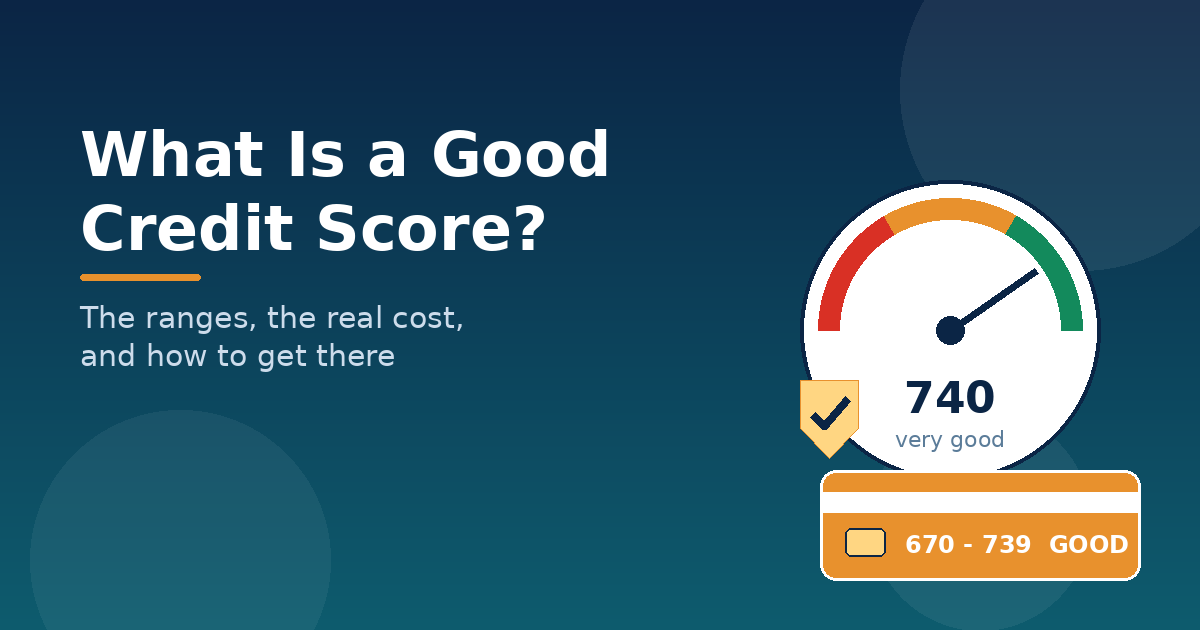
Credit tier drives the auto numbers. Experian's second-quarter 2026 data puts the average new-car APR at 4.41% for super-prime borrowers (781–850), 6.15% for prime (661–780), 9.71% for near-prime (601–660), 13.52% for subprime (501–600) and 16.11% for deep subprime (300–500); used-car APRs run higher in every tier, from 6.29% to 21.62%. A 9% APR is strong for a near-prime borrower and poor for a super-prime one. Your credit score is the biggest lever on the APR you are offered — our guide to what a good credit score is explains the bands. Treat every range here as a snapshot dated November 2026.
How to Compare APRs Properly
Comparing APRs works only when the loans are genuinely alike. Match the product, amount and term: compare a 30-year fixed mortgage with another 30-year fixed mortgage, not a 15-year loan or an adjustable-rate loan. Compare APR to APR, never APR to interest rate. Read the Loan Estimate, not just the headline. Check whether the APR is fixed or variable, and ask about the rate lock — a mortgage lock holds the quoted rate and points for 30 to 60 days; without one, the APR is a snapshot, not a promise. Finally, enter each offer into the Loan Calculator with the same amount and term, and compare total interest.
Common Mistakes With APR
Choosing by the interest rate alone. The rate sets the payment, but the APR sets the cost — a lower rate with a large fee can cost more than a higher rate with none.
Comparing a fixed APR with a variable APR. A variable rate can start low and rise — compare fixed with fixed.
Ignoring the term. The same APR costs far more over seven years than over three.
Assuming a 0% APR means free money. A 0% intro APR usually lasts 12 to 21 months; after it ends the regular APR applies, and a balance transfer may carry a fee of 3% to 5%.
Forgetting that APR is not the whole cost. Title and appraisal fees, escrow deposits and late fees sit outside the APR on many loans, so two loans with identical APRs can still differ by thousands in closing costs.
Applying everywhere at once. Every application can trigger a hard inquiry, and too many in a short window can lower your score. Rate shopping is recognized by the scoring models: multiple mortgage or auto inquiries within 14 to 45 days are generally treated as a single inquiry. Our guide to how compound interest works explains the other half of the maths.
Borrowing soon and want the numbers checked? Asad Webs builds the tools and guides behind this article. Contact Asad Webs to talk through your loan figures, or start with the free Loan Calculator and bring the result along.
Frequently Asked Questions
Is APR the same as the interest rate?
No. The interest rate is the yearly charge for borrowing the principal only. APR is broader: the interest rate plus certain fees, such as points and origination charges, as a single yearly rate. With no included fees the two are the same; on most mortgages and personal loans the APR is higher.
Why is my APR higher than my interest rate?
Because the APR includes fees the interest rate leaves out. In our example, a $300 origination fee on a $10,000 loan at 12% lifted the APR to 14.13%.
What is a good APR right now?
It depends on the product and your credit. As of November 2026, the Freddie Mac average for a 30-year fixed mortgage was 7.11%, the Fed's average on card accounts assessed interest was 22.36%, and the average 24-month personal loan rate was 11.90%. A good APR is at or below the average for similar borrowers.
Does APR include compounding?
APR itself is a simple yearly rate and ignores compounding — but the interest charged can compound: on a credit card, unpaid interest joins the balance and is charged interest the following month. APY does include compounding.
Can APR change after I take out a loan?
A fixed APR stays the same for the life of the loan. A variable APR moves with a benchmark, usually the prime rate — most credit cards work this way, so a Fed move can change your card APR within one or two billing cycles.
Is a 0% APR offer really free?
Only during the promotion, and only for what the offer covers. A 0% intro APR usually lasts 12 to 21 months; after it ends, the regular variable APR applies, and transfers may carry a fee of 3% to 5%.
Sources: Consumer Financial Protection Bureau (CFPB), consumerfinance.gov; Regulation Z, 12 CFR 1026.22 and 1026.4; Federal Reserve G.19, 6 November 2026; Federal Reserve H.15, 30 October 2026 (prime 7.00%); FOMC statement, 28 October 2026 (federal funds target 3.75%–4.00%); Freddie Mac Primary Mortgage Market Survey, 12 November 2026 (30-year fixed 7.11%); Experian State of the Automotive Finance Market, Q2 2026; Bankrate current credit card rates, 4 November 2026. Worked-example figures were computed in Python with the amortization formula. Benchmarks are dated November 2026 — check the current figure before you apply.
This article is general educational information, not financial advice for your situation. Loan terms, rates and fees change often; confirm the current terms with the lender before you apply.
Be the first to share a useful question or thought.