
To set a savings goal you will actually hit, pick a concrete amount and a date, then work backwards. Want $10,000 in 12 months with $500 already saved and 4.5% APY compounding monthly? You need to save $773.60 a month — $9,783.20 of deposits plus $216.85 of interest, finishing October 2027. The same goal at $250 a month takes 36 months, finishing October 2029, with $9,311 of deposits and $689 of interest. The Savings Goal Calculator runs both directions: monthly-needed or time-to-goal. General information only — not financial advice.
Tool Preview: The Savings Goal Calculator In Use
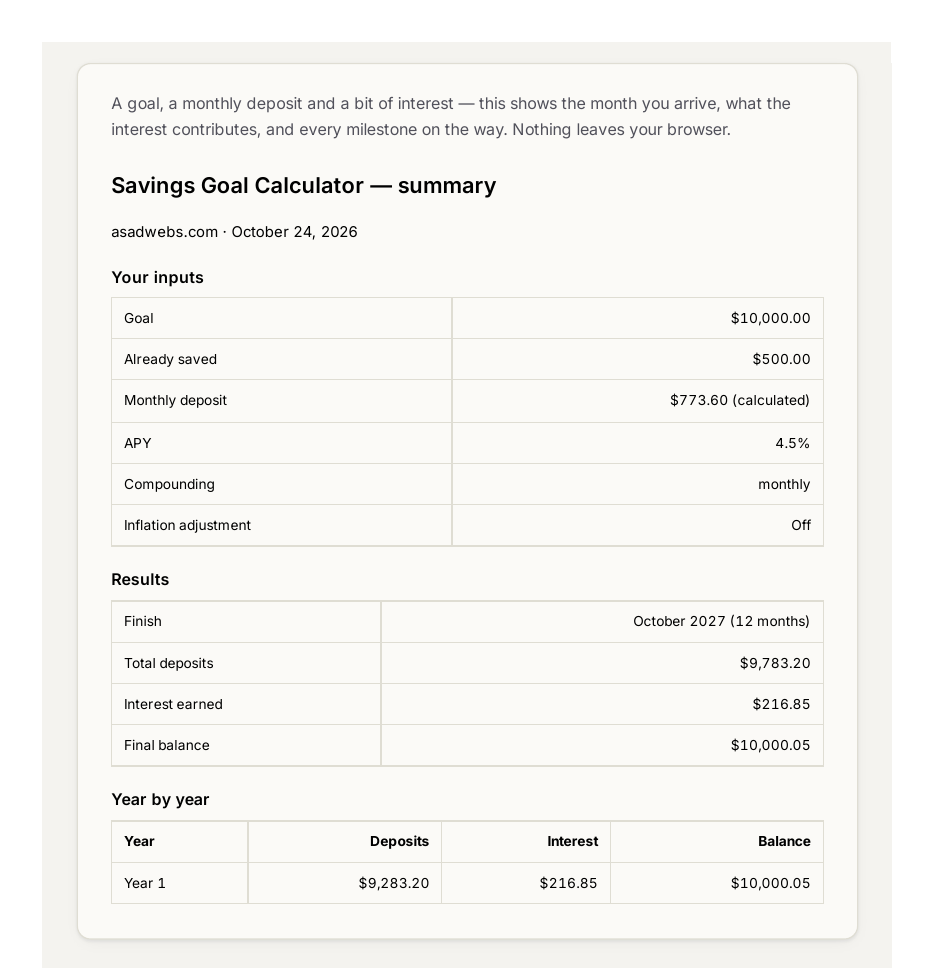
The calculator in 12-month mode on the $10,000 goal — $773.60 a month needed, $9,783.20 of deposits, $216.85 of interest, done October 2027. Click the image to open the live tool.
The screenshot shows the tool exactly as you will use it. It works in two modes: tell it your deadline and it computes the monthly amount you need; tell it your monthly amount and it computes how long the goal takes, with milestones at 25%, 50%, 75% and 100% along the way. Under the hood it grows the balance month by month — interest is credited first, then your deposit lands — at the APY and compounding frequency you choose. Although it displays dollars, the maths maps numerically onto any currency.
Picking a Goal Amount That Means Something
Vague goals produce vague saving. "Save more" has no finish line, so every month feels optional. A goal that works has three properties: a number, a date and a reason. $10,000 by October 2027 for a house deposit. $3,000 by June for the emergency fund. The reason is what stops you raiding the pot in month seven — it turns an abstract balance into a specific future you have already chosen.
Size the goal to your life, not to a round number that sounds impressive. A useful test: can you state what happens the month after you hit it? If the answer is concrete — "the deposit is paid," "the card is cleared," "six months of expenses sit untouched" — the amount is right. If the answer is "I guess I'd keep going," the goal is a wish, not a plan. Run your candidate amount through the calculator in time-to-goal mode first: if the monthly figure it returns is impossible, shrink the goal or stretch the date before you begin, not after you stall.
Monthly-Needed vs Time-to-Goal Thinking
There are two ways to frame any savings goal, and the calculator offers both because they suit different situations. Monthly-needed mode starts from a fixed deadline: "I need $10,000 by October 2027 — what must I save each month?" It answers with $773.60 a month. Use this when the date is non-negotiable — a deposit, a wedding, a course fee.
Time-to-goal mode starts from a fixed monthly amount: "I can save $250 a month — when do I reach $10,000?" It answers with 36 months, finishing in October 2029. Use this when your cash flow is the constraint and the date can flex. Neither mode is better; they are the same maths read in opposite directions. The discipline is in choosing the mode that matches your real constraint and then honouring its answer.
Notice the trade-off the two modes reveal. The 12-month path demands $773.60 a month but earns only $216.85 of interest — there is little time for compounding to work. The 36-month path asks only $250 a month and earns $689 of interest, more than triple, because the balance sits and grows for three years. Time is the ingredient that makes interest meaningful — which is why starting now beats starting perfectly later.
Using the Savings Goal Calculator, Step by Step
The Savings Goal Calculator simulates your plan month by month. Here is how to use it well:
- Enter the goal amount. The finish line — $10,000 in our example. Be specific; round numbers with no reasoning behind them are the first thing to fix.
- Enter what you have already saved. Starting from $500 instead of $0 cuts the monthly figure meaningfully, because that $500 also earns interest for the whole run.
- Set the interest rate (APY) and compounding. Use a rate you can realistically earn — 4.5% APY with monthly compounding in our example. This is an estimate for planning, not a promise of returns.
- Choose your mode. Pick monthly needed and enter your deadline, or pick time to goal and enter your affordable monthly amount.
- Read the breakdown, not just the headline. Total deposits, interest earned and the final balance tell you how much of the goal is your effort and how much is compounding. The milestone dates show when 25%, 50% and 75% arrive — the psychological fuel for the middle months.
- Stress-test one change. Drop the rate to 0% and see how much extra you must save; miss the point is that interest helps, but the deposits do the heavy lifting.
The Formula in Plain Language
The tool does not use a single closed-form equation you need to memorise — it simulates, month by month, exactly what a savings account does. Each month it takes the current balance, credits one month of interest on it, and then adds your deposit. Interest first, deposit second: that ordering matters, because your new deposit only starts earning from the following month.
In plain terms: new balance = old balance + (old balance × monthly rate) + monthly deposit. The monthly rate is the APY converted to a monthly figure. Repeat for every month until the balance reaches the goal. That loop is the whole engine — and it is why the $500 you start with matters more than it looks: it earns interest in all 12 or 36 months, while your final deposit earns almost none.
Two consequences fall out of the loop. First, earlier deposits are worth more than later ones, because they compound longer — front-loading the plan beats back-loading it. Second, the interest portion grows fastest near the end, when the balance is largest. In our 36-month example the account earns $689 of interest total, most of it in the final year when the balance is doing the heavy lifting.
Worked Example: $10,000 in 12 Months
Inputs: $10,000 goal, $500 already saved, 4.5% APY, monthly compounding, 12-month deadline. The tool's exact output:
| Figure | What it means | Amount |
|---|---|---|
| You need to save | Per month, every month | $773.60 |
| Total deposits | Your own money in | $9,783.20 |
| Interest earned | Estimate at 4.5% APY | $216.85 |
| Final balance | Goal reached | $10,000.05 |
| Finish date | 12 months on | October 2027 |
Read the split: of the $10,000.05 finish, $9,783.20 is your deposits — including the $500 head start — and only $216.85 is interest. Over 12 months, compounding barely gets going; roughly 98% of the goal is pure discipline. That is the honest message of short deadlines: the rate matters little, the monthly amount matters enormously. Miss one $773.60 deposit and you must make it up across the remaining months, because interest will not cover the gap.
The Slow Path: $250 a Month for 36 Months
Same goal, same $500 start, same 4.5% APY — but only $250 a month available. Time-to-goal mode returns 36 months, finishing in October 2029, with $9,311 of deposits and $689 of interest. The monthly burden is a third of the fast path, but the wait is three times as long and the interest earned more than triples — time doing what time does.
The tool also maps the milestones on this path, which is where the slow plan becomes bearable:
| Milestone | Balance reached | Date |
|---|---|---|
| 25% | $2,500 | June 2027 |
| 50% | $5,000 | April 2028 |
| 75% | $7,500 | January 2029 |
| 100% | $10,000 | October 2029 |
Notice the milestones are not evenly spaced: 25% arrives in about 8 months, but the final 25% takes 9. That is compounding accelerating — the bigger the balance, the harder each month's interest works. Mark these dates on a calendar. The middle of any long savings plan is where motivation dies; a milestone every 8–10 months gives you something to celebrate before the finish.
Where the $10,000 comes from: deposits vs interest on each path — hover or tap each bar for details.
The chart tells the whole story of time versus effort. On the 12-month path your deposits do essentially everything; on the 36-month path interest contributes a visible $689 — real money, earned while you slept. Neither path is free: the fast one costs effort, the slow one costs patience. The calculator lets you slide between them until the trade-off fits your life.
The Milestone Trick
A 36-month goal is psychologically brutal because the finish is invisible for two years. The milestone trick is simple: break the goal into quarters and celebrate each one. The tool gives you the dates — 25% in June 2027, 50% in April 2028, 75% in January 2029 — so put them in your calendar with a small reward attached to each. Behavioural research consistently finds that visible progress keeps people going; a plan you can see advancing is a plan you keep.
There is a second, quieter benefit. Each milestone is a checkpoint to re-run the numbers. Did the rate change? Did you miss a month? Re-enter your current balance into the calculator and get a fresh monthly figure or finish date. Plans that get recalibrated survive; plans that run on autopilot from a January spreadsheet usually do not.
The Inflation Checkbox
The tool includes an inflation option, and it is worth understanding what it does. Inflation means the $10,000 you are saving will buy less when you finally spend it. The checkbox adjusts the goal upward so that your spending power at the finish matches $10,000 in today's money — which raises the monthly amount it asks for.
Whether to tick it depends on the goal's horizon. For a 12-month plan the effect is small; for a 36-month plan it is noticeable; for multi-year goals it is the difference between hitting the number and hitting what the number was supposed to buy. Treat it as a realism setting: unticked, you hit the nominal figure; ticked, you hit the figure's meaning.
Automate the deposit: the savers who hit their goals are rarely the most disciplined — they are the most automated. Schedule the monthly transfer for the day after payday, before the money can be spent. A $773.60 plan that runs itself beats a $900 plan that depends on willpower.
Common Mistakes That Sink Savings Goals
1. Picking a round number with no date. "$10,000 someday" is a wish. "$10,000 by October 2027" is a plan with a $773.60 monthly price tag. The date is what creates the monthly figure.
2. Ignoring the interest — in both directions. Some savers assume 0% and over-save; others assume today's rate lasts forever and under-save. Use a realistic APY, label it an estimate, and re-check yearly.
3. Raiding the pot mid-plan. Every withdrawal restarts the compounding clock on that money. If the goal has a real reason attached — the deposit, the fund, the trip — the reason should win the argument in month seven.
4. Setting the monthly figure from optimism, not cash flow. $773.60 a month only works if $773.60 actually leaves your account. If it does not fit, the honest move is the 36-month path at $250 — a slower plan you keep beats a faster plan you abandon.
5. Never recalibrating. Rates change, months get missed, balances drift. Re-run your current balance through the calculator quarterly and adjust the monthly figure or the date. A plan that adapts survives.
Building the habit into something bigger? If a savings goal, a side income or a freelance leap is part of a bigger plan, talk to us — we build websites that turn skills and ideas into income.
Frequently Asked Questions
How much do I need to save each month to reach $10,000 in a year?
With $500 already saved and 4.5% APY compounding monthly, $773.60 a month for 12 months — $9,783.20 of your own deposits plus $216.85 of estimated interest, finishing with $10,000.05 in October 2027. Change any input and the monthly figure moves; the calculator shows the new number instantly.
What is APY and why does it matter?
APY — annual percentage yield — is the yearly return including the effect of compounding. A 4.5% APY with monthly compounding credits one-twelfth of the effect each month, and each month's interest starts earning its own interest. Higher APY and more frequent compounding both grow the balance faster, but over 12 months the effect is modest: $216.85 on our example. Treat any APY you enter as an estimate, not a promise.
Should I use monthly-needed or time-to-goal mode?
Use monthly-needed when the deadline is fixed — a deposit, a fee, an event — and you need to know the required monthly amount. Use time-to-goal when your monthly amount is fixed by your cash flow and the date can move. They are the same calculation read in opposite directions.
Does the calculator work in pounds, euros or other currencies?
Yes. The tool displays dollar signs, but the maths is currency-neutral — enter 10,000 in your own currency and every figure maps across numerically. The $773.60 monthly figure becomes £773.60 or €773.60 with the same inputs.
What happens if I miss a month?
The goal date moves later, or the remaining monthly amounts must rise to compensate — interest will not fill the gap for you. Re-enter your current balance and remaining months into the calculator to get the corrected figure, and consider automating the transfer so a missed month cannot happen twice.
Is the 4.5% APY used in the example guaranteed?
No. It is an illustrative estimate for planning. Real savings rates rise and fall, and no calculator can promise future returns. The useful insight from the example stands regardless of rate: over 12 months your deposits do almost all the work, so the monthly amount matters far more than the rate.
Should I save toward a goal or pay down debt first?
That depends on interest rates, the debt type and your need for a cash buffer — there is no universal answer, and this article cannot give personal advice. Many planners suggest keeping a small emergency buffer while directing extra money at high-rate debt; our debt payoff guide walks through the maths of that choice. This is general information, not financial advice.
Saving and compounding are two sides of the same coin: our guide to how to calculate compound interest shows what happens when the timeline stretches to decades, and how to pay off debt faster covers the mirror-image decision of clearing balances. Run your own numbers in the free Savings Goal Calculator.
Be the first to share a useful question or thought.