
A £52,000 salary in England or Wales for the 2026/27 tax year (6 April 2026 – 5 April 2027), on tax code 1257L with no pension contributions and no student loan, leaves £40,717.40 a year in your pocket — £3,393.12 a month, or £783.03 a week. That is after £8,232.00 of income tax and £3,050.60 of National Insurance: you keep 78.3% of the salary and 21.7% goes to tax and NI. The free UK Take-Home Pay Calculator runs the same band-by-band maths for any salary, nation, tax code and pension setup. Figures are estimates — general information, not financial advice.
Take-home pay is the number that actually matters — the salary on the job advert is a starting point, not the amount that reaches your bank account. This guide shows where the £52,000 goes, explains the band stacking that produces the £8,232.00 income tax figure, untangles the "40% cliff", and covers the pension and student loan options the calculator offers beyond our worked example.
Tool Preview: The UK Take-Home Pay Calculator In Use
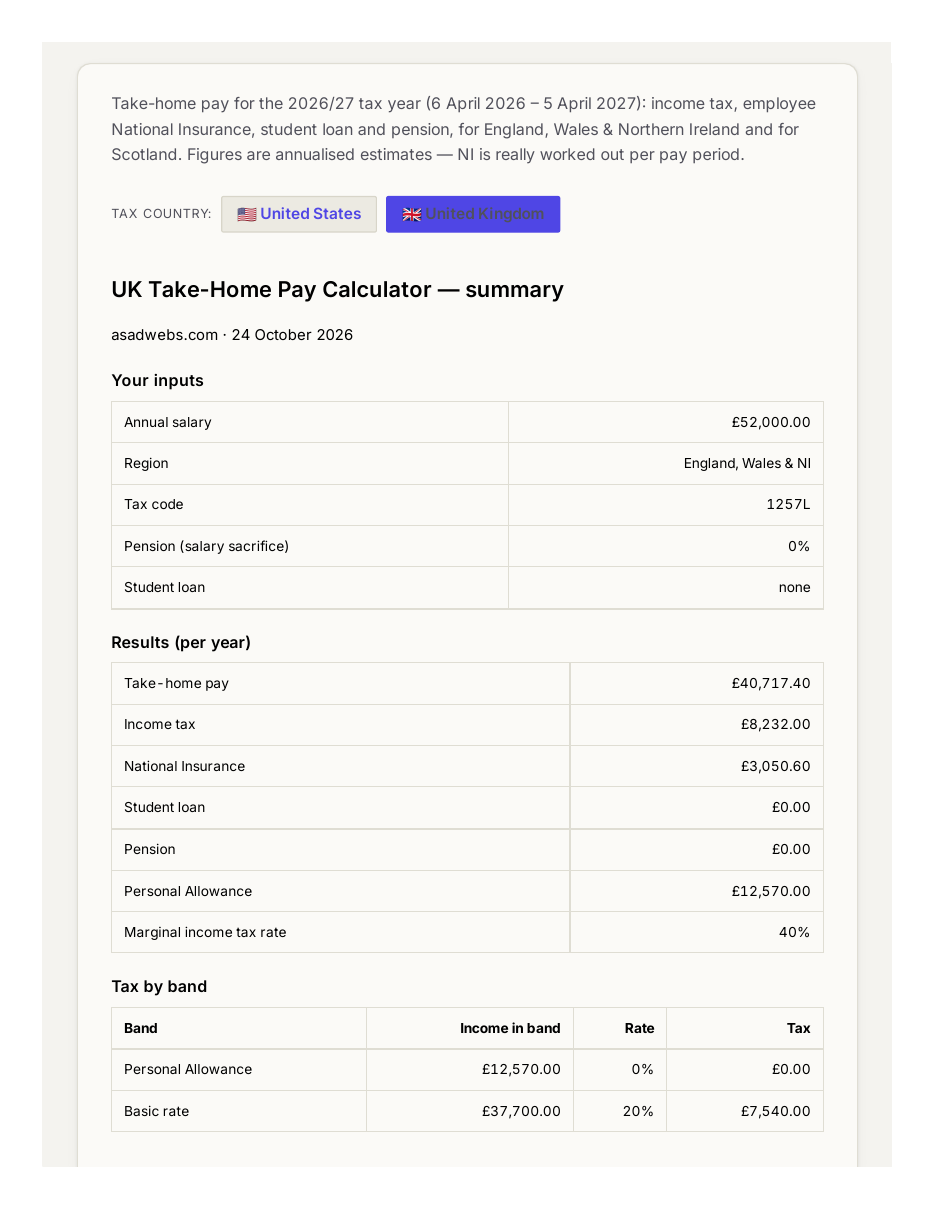
The UK Take-Home Pay Calculator in use: £52,000 salary, 2026/27, take-home £40,717.40 a year.
Using the Take-Home Pay Calculator, Step by Step
- Enter your gross annual salary. Type the headline figure — £52,000 in our example. Gross means before any tax or deductions.
- Choose the nation. Income tax bands differ in Scotland (and Wales uses the England/Northern Ireland bands), so select where you live — our example uses England, Wales & Northern Ireland.
- Set the tax code. 1257L is the standard code for most people: the L means you get the full Personal Allowance, and the 1257 encodes £12,570. Our example uses 1257L.
- Add pension contributions if you have them. The calculator supports salary-sacrifice pension contributions, which reduce both income tax and National Insurance — our example uses none, so you can see the baseline.
- Choose a student loan plan if applicable. The tool offers the loan plan options; our example has no student loan, so the deduction is £0.
- Read the result three ways. Annual (£40,717.40), monthly (£3,393.12) and weekly (£783.03) — use the monthly figure for budgeting and the weekly one for comparing with hourly-paid roles.
The Formula in Plain Language: Bands Stack Like SDLT Slices
Income tax works exactly like stamp duty's slices: the tax-free Personal Allowance (£12,570.00) first, then each taxable band at its own rate. The arithmetic for £52,000 is:
Income tax = (£37,700.00 × 20%) + (£1,730.00 × 40%) = £8,232.00
Taxable income is £52,000 − £12,570 = £39,430. The first £37,700 of that sits in the 20% basic-rate band (£7,540.00), and only the remaining £1,730 falls into the 40% higher-rate band (£692.00). Notice how small the 40% portion is: crossing the £50,270 threshold (£12,570 + £37,700) does not move your whole salary into the higher band — it taxes only the £1,730 above it at 40%. The marginal rate on the next £1 you earn is 40%, while the effective rate across the whole salary is much lower.
| Tax band | Amount in band | Rate | Tax due |
|---|---|---|---|
| Personal Allowance | £12,570.00 | 0% | £0.00 |
| Basic rate | £37,700.00 | 20% | £7,540.00 |
| Higher rate | £1,730.00 | 40% | £692.00 |
| Total | £52,000.00 | Marginal 40% | £8,232.00 |
The check that binds the whole guide: take-home £40,717.40 + income tax £8,232.00 + National Insurance £3,050.60 = £52,000.00 exactly. If your own numbers ever fail this reconciliation, something was double-counted or missed.
Where the £52,000 goes in 2026/27 (estimates) — hover or tap each bar for details.
Visually, the story is how much of the bar stays with you: £40,717.40 of £52,000 — you keep 78.3% and tax plus NI take 21.7%. That framing is healthier than "taxed at 40%": the 40% applies to one thin slice of the salary, not the salary.
The 40% Cliff — And Why It Is Not Really a Cliff
People call crossing £50,270 the "40% cliff", and the word cliff suggests a sudden drop. There is no drop. Because tax is marginal, a £52,000 salary is not taxed 40% on £52,000 — the 40% touches only the £1,730 above the threshold, costing £692. If you earned £50,269 your tax would be £7,539.80; at £52,000 it is £8,232.00. The difference is smooth and proportional, never a step.
What the threshold genuinely changes is the value of a pay rise above it. Below £50,270, each extra £1 keeps 80p (ignoring NI); above it, each extra £1 keeps 60p. Salary-sacrifice pension contributions become more attractive just over the line: each sacrificed £1 saves 40p of income tax plus the NI saving, rather than 20p. That is the real meaning of "the 40% cliff" — a change of slope, not a fall.
Salary sacrifice is the lever the calculator models. Adding pension contributions via salary sacrifice shrinks the salary that tax and NI are calculated on — so £52,000 with a 5% salary-sacrifice pension is taxed as if the salary were £49,400, which also pulls £1,530 of the higher-rate slice back into the 20% band. Use the calculator's pension option to see the before-and-after on your own figures. This is general information about the maths, not advice on your pension.
The Monthly View: Budgeting on £3,393.12
| Monthly figure | Amount | How it reconciles |
|---|---|---|
| Take-home pay | £3,393.12 | £40,717.40 ÷ 12 |
| Income tax | £686.00 | £8,232.00 ÷ 12 |
| National Insurance | £254.22 | £3,050.60 ÷ 12 |
| Gross monthly | £4,333.33 | £52,000.00 ÷ 12 (1p of rounding: the three rounded rows above sum to £4,333.34) |
Two honest caveats sit under this table. First, the 1p: monthly figures are rounded from annual ones, so the rounded rows can differ from the annual total by a penny — the annual figure is the authoritative one. Second, National Insurance is assessed per pay period in reality, not by slicing the annual salary. A monthly-paid employee's NI is computed on each month's pay against monthly thresholds; the £3,050.60 shown is the annualised estimate. For a steady monthly salary the two agree closely, which is why the calculator presents the figure this way — but irregular pay (bonuses, overtime, unpaid leave) can make actual NI differ from the estimate.
Student Loans: The Deduction Our Example Skips
Our £52,000 example has no student loan — deliberately, so the baseline is clear. If you have one, the calculator's plan options add the repayment on top of tax and NI, calculated only on income above that plan's threshold. That means two people on £52,000 can take home different amounts depending on their loan plan. When comparing a job offer with your current pay, always compare post-loan take-home, not the headline salaries.
Six Mistakes That Muddle Take-Home Pay
1. Taxing the whole salary at the top rate. At 40% on £52,000 the "tax" would be £20,800 — more than double the real £8,232.00. Only the £1,730 slice above £50,270 pays 40%.
2. Confusing marginal with effective. The marginal rate (40%) is what the next £1 costs; the effective income-tax rate (£8,232 ÷ £52,000 = 15.8%) is what you actually pay on average. Salary decisions run on the marginal rate; fairness debates run on the effective one.
3. Forgetting National Insurance. It is £3,050.60 here — 27% of the combined tax+NI deduction. Any take-home estimate that only does income tax understates the deduction by more than a quarter.
4. Budgeting on the rounded monthly figure. £3,393.12 × 12 = £40,717.44, four pence above the annual £40,717.40. Trivial, but it shows why the annual number is the source of truth.
5. Comparing headline salaries across different deductions. £52,000 with a student loan and 5% salary-sacrifice pension is a different take-home from £52,000 with neither. Normalise to take-home before comparing offers.
6. Using the wrong nation's bands. Scotland sets its own income tax bands and rates, so a £52,000 salary in Glasgow is not the same take-home as in Manchester. The calculator's nation selector exists precisely for this.
Quick sanity check for any salary: take-home + income tax + National Insurance must equal gross. For our example, £40,717.40 + £8,232.00 + £3,050.60 = £52,000.00 exactly. Run this reconciliation on the calculator's output for your own figures — it catches entry slips (wrong tax code, wrong nation) instantly.
Writing about money for your own audience? Clear, calculator-backed explainers of pay, tax and pensions earn trust — this article is the format. Book a free consultation with Asad Webs to discuss finance explainers and interactive tools for your own site.
For the percentage skills underneath all of this, our guide to how to calculate percentages covers the method from the ground up, and US readers can run the same exercise on how to calculate a US paycheck to see how different the deductions look across the Atlantic.
Frequently Asked Questions
How do I calculate my UK take-home pay?
Subtract the Personal Allowance (£12,570.00 on tax code 1257L) from gross pay, tax the remainder band by band — 20% on the first £37,700.00, 40% on what is left — then subtract National Insurance and any pension or student loan deductions. On £52,000 in 2026/27 that gives £8,232.00 income tax, £3,050.60 NI and £40,717.40 take-home. The calculator on this page does the full computation for any salary.
What is the take-home pay on a £52,000 salary in 2026/27?
£40,717.40 a year (£3,393.12 a month, £783.03 a week) for England, Wales or Northern Ireland on tax code 1257L with no pension contributions and no student loan — after £8,232.00 income tax and £3,050.60 National Insurance. Figures are estimates; confirm against your payslip and P60.
What does "marginal rate of 40%" mean?
It means each additional £1 you earn above £50,270 is taxed at 40% — 40p of each extra pound. It does not mean 40% of your whole salary: on £52,000 only the £1,730 above the threshold pays 40%, costing £692. Your effective income-tax rate is £8,232.00 ÷ £52,000 ≈ 15.8%.
Is there really a 40% cliff?
Not a cliff — a change of slope. Because tax is marginal, crossing £50,270 never reduces your take-home; it just means each extra pound above the line keeps 60p instead of 80p (before NI). The practical consequence is that salary-sacrifice pension contributions become relatively more valuable just over the line.
Does salary sacrifice change my take-home pay?
Yes — salary-sacrifice pension contributions reduce the salary that income tax and NI are calculated on, so both fall. At 5% on £52,000 (£2,600 sacrificed), the taxable salary becomes £49,400, which also pulls part of the higher-rate slice back into the 20% band. Use the calculator's pension option to model your own figures.
Is the monthly take-home exactly a twelfth of the annual?
To the penny shown, yes (£3,393.12 = £40,717.40 ÷ 12), but rounded monthly rows can differ from the annual total by a penny or two when re-added — the annual figure is authoritative. Also note National Insurance is assessed per pay period in reality, so irregular pay can make actual NI differ from this annualised estimate.
Why does the calculator ask for my nation and tax code?
Because both change the answer. Scotland has its own income tax bands and rates, and your tax code encodes your Personal Allowance — 1257L gives the full £12,570.00, but codes like BR or D0 tax everything at flat rates. Wrong nation or wrong code is the commonest source of "the calculator disagrees with my payslip". These figures are estimates for illustration, not financial advice.
Be the first to share a useful question or thought.