
A quiet room. Rows of white boxes on black racks, each with a small glowing screen. Nothing moves, and nothing hums the way a server room hums. But inside each box, something is alive: human brain cells, grown in a laboratory, kept warm and fed, firing electrical signals — and learning.
This is not science fiction. It is the CL1, built by the Australian company Cortical Labs, and it is the world's first commercially available biological computer. The two photographs in this article are real CL1 units: racks of them running in a data-centre-style installation, and a close-up of a single unit's life-support display.
The idea is simple to say and strange to sit with: instead of simulating neurons in software, use actual neurons as the computer. The cells receive electrical signals, respond, and change their behaviour with experience. They have learned to play Pong. In early 2026 they played DOOM. And that raises the question everyone asks first — the terrifying one: do they feel anything?
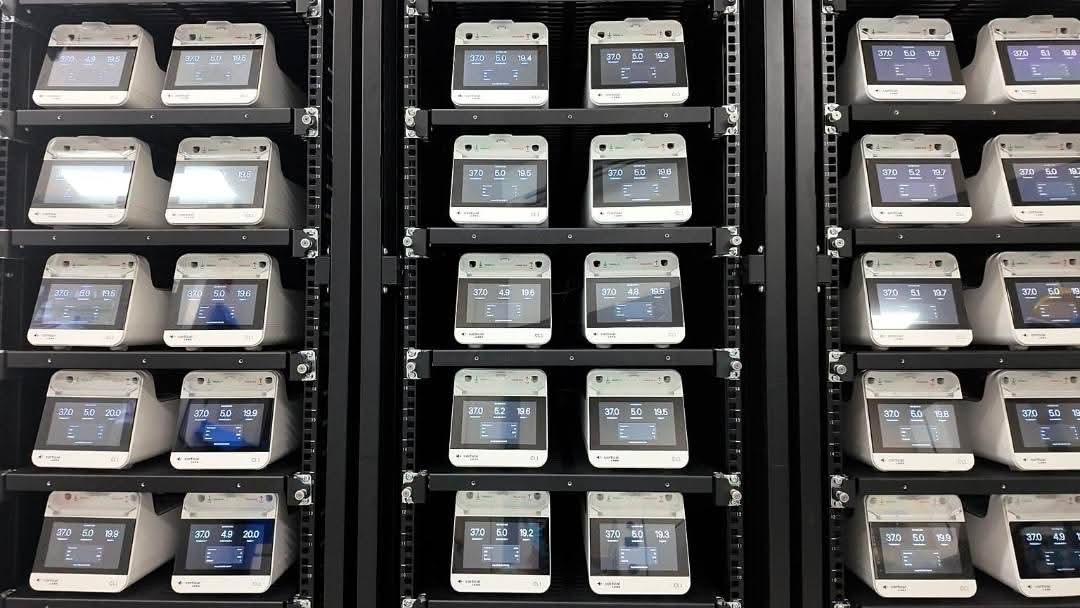
Racks of CL1 biological computers running together. (Real CL1 units.)
What the CL1 actually is
Cortical Labs calls the CL1 "the world's first code deployable biological computer." It was announced at Mobile World Congress in Barcelona in March 2025, with the first units shipping from June 2025. It is a shoebox-sized box that a researcher programs in Python — and the program runs, in part, on living cells.
| Spec | CL1 |
|---|---|
| Compute substrate | About 800,000 living human neurons, grown from donor cells and cultured flat on a silicon chip (the DOOM demonstration culture used about 200,000) |
| Chip | Silicon microelectrode array with 59 electrodes, stimulating the culture and recording its activity at sub-millisecond latency |
| Life support | Built in: nutrient fluid, gas mixing, waste filtering, temperature held at body temperature — keeps neurons alive for up to 6 months |
| Software | biOS (Biological Intelligence Operating System) creates the simulated world; Python API deploys code to the neurons; Cortical Cloud rents remote access |
| Price | About $35,000 per unit, or about $20,000 per unit in 30-unit racks; cloud access from $300 per week |
| Power | Roughly 850–1,000 watts for a 30-unit rack, per coverage of company figures |
| Buyer | Universities, startups, government labs and pharma — a research platform, not a consumer device |
How it works — and what the display in the photo is showing
The close-up photograph shows the unit's own touchscreen, and every number on it is life support. Temperature 36.8°C. Carbon dioxide 4.7%. Oxygen 5.8%. Pump speeds for the circulating fluid: MEA 190, Gas 1000, Reservoir 2000 microlitres per minute. Media in at the top, waste out at the top. That is the whole bargain of biological computing: the computer must be kept alive, every minute, the way a patient is kept alive — fed, warmed, and cleaned — or the processor dies.
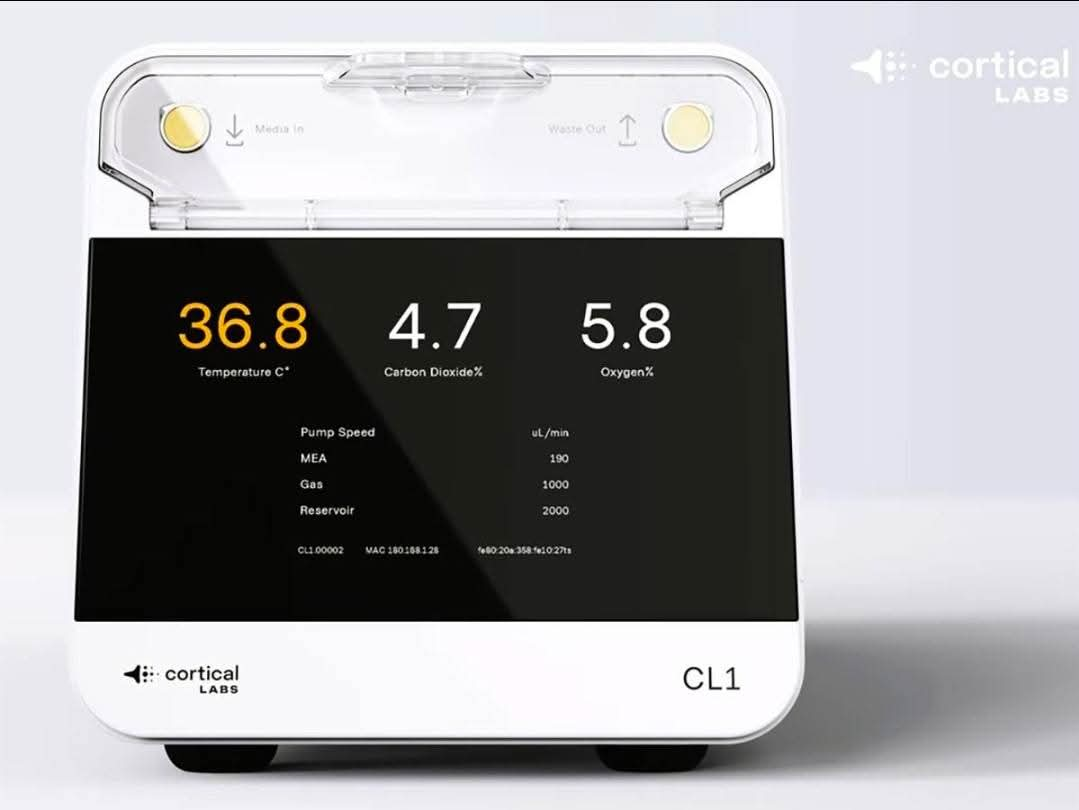
A single CL1 unit's life-support display: 36.8°C, 4.7% carbon dioxide, 5.8% oxygen. (Real CL1 unit.)
The world the neurons live in is created by biOS. It runs a simulated environment and turns events in that environment into patterns of electrical stimulation delivered through the 59 electrodes. The neurons fire in response. Their firing patterns are recorded, decoded, and turned back into actions in the simulated world. Then the loop repeats — and because the feedback is structured, the culture's behaviour changes over time. That closed loop is the entire trick.
The CL1 loop: a simulated world is translated into stimulation, living neurons respond, and their firing is decoded back into action — with feedback closing the loop.
The neurons themselves come from real people. A donated blood or skin sample is reprogrammed into induced pluripotent stem cells — the technique that won the 2012 Nobel Prize in Physiology or Medicine — and those stem cells are differentiated into cortical neurons. Growing a culture takes months before a unit ships, and Cortical Labs' founder has said his own blood is among the donor sources, according to coverage. Nobody extracts neurons from a living brain for this; the cells are grown, not taken.
What it is capable of — the tests it has actually passed
| When and what | What happened | What it proves |
|---|---|---|
| 2022 — Pong (DishBrain) | About 800,000 human and mouse neurons on an electrode array learned Pong in a simulated game-world, with apparent learning within five minutes of real-time play, longer rallies than controls, and human cultures outperforming mouse cultures. Published in Neuron (Kagan et al.). | Closed-loop feedback is essential: cultures given stimulation without feedback did not learn. The result is peer-reviewed, not a demo video. |
| 2025 — CL1 launch | The predecessor became a product: code-deployable biology, Python API, cloud rental. Researchers anywhere can run experiments on living neurons without building a biology lab. | The interface problem is solved well enough to sell. That is a platform milestone, not a scientific result. |
| 2025 — Epilepsy model | In a company-reported, accepted paper, cultures modelling epilepsy learned poorly — but antiepileptic drugs restored learning-like performance and other previously inaccessible measures. | The drug-discovery use case: reading behaviour, not just electrical activity, as a new way to test compounds. Company-reported, so treat it as promising, not proven. |
| Early 2026 — DOOM | About 200,000 neurons on a CL1 played DOOM: a 3D world with enemies, exploration and shooting. Independent developer Sean Cole wired it up in about a week using the Python API — against 18 months for DishBrain's Pong. Play was beginner-level and clumsy, and the culture died frequently. | Real-time, goal-directed learning in a far harder environment — and proof that a software developer with no biology background can now build on living neurons. |
| 2026 — Data centres | Melbourne hosts what Cortical Labs describes as the world's first Biological Data Centre prototype: 120 internet-connected CL1 units. A separate 20-unit system runs at the National University of Singapore with NUS Medicine and DayOne — 16 million neurons in one installation. | Biological computing has left the single bench and entered rack-scale infrastructure, even if the workloads are still research. |
From a lab experiment to a product to rack-scale installations: the invention of biological computing in five milestones.
What it cannot do — the honest limits
Three corrections to the viral version of this story. First, the CL1 cannot run ChatGPT, large language models, or general software, and it is not competitive with silicon on any conventional benchmark. It is a research platform for neuroscience and drug discovery, not a PC. Second, it plays games badly: the DOOM culture was a beginner that died a lot, and Scientific American's coverage described the performance as clumsy. Third, the power story is real but smaller than the hype. A 30-unit rack draws roughly 850–1,000 watts, which is far less than a GPU data-centre rack — but the neurons are only one component: game rendering, stimulation mapping, decoding, cooling and life support all run on conventional computers around them, and nothing has yet run at a scale where a fair comparison with GPU training exists. The viral "20 watts replaces a data centre" claim is misleading, and this article will not repeat it.
There are practical limits too. A culture lives up to about six months on the unit, then it must be replaced — and growing a replacement takes months. Cultures vary: different neuron cultures behave almost like individuals, some more active than others. And the system is fragile in the way living things are fragile: temperature, gases, nutrients and waste all have to stay in range, or the processor dies.
Does it have feelings?
The short answer is: there is no evidence that it does, and scientists do not consider current systems capable of feelings or consciousness.
Much of the confusion comes from one word. The 2022 DishBrain paper's title says the neurons "exhibit sentience." The authors clarified that they meant something narrow: the system responds to its environment in a goal-directed way. They did not mean it feels, suffers, or has conscious experience. The word choice drew a formal critique in Neuron in 2023, and a multi-author consensus paper in 2024 revisited the terminology.
Scale puts the question in perspective. A CL1 culture holds roughly 800,000 neurons. A human brain holds roughly 86 billion — the culture is under 0.001% of a brain. There are no senses, no body, no brain regions for emotion or pain, no memory of a life. Nothing in the system corresponds to pain processing: the electrical stimulation it receives is information, not injury in any demonstrated sense. Cortical Labs itself says today's neurons are far simpler than a human brain and are not conscious. Theoretical neuroscientist Karl Friston, a co-author on the DishBrain paper, has described the technology's real gift as a "little synthetic brain" for experiments — an enabling tool for science, not a mind.
The open question — and it is a real one — is about the future. If systems grow far more complex, with millions or billions of neurons, sensory input and richer structure, the question of experience becomes genuinely hard. There is no agreed test for consciousness in a dish, which is exactly why ethicists want rules written before systems get more complex, not after. And the most unsettling version of the question is the one in the draft that started this article: what if, one day, we build something that can suffer but has no way to tell us — and we do not notice? That is a scientific and ethical concern, not a proven fact. But for the first time, it is not only science fiction.
Who is behind it, and how you can get one
Cortical Labs was founded in Melbourne in 2019 by Hon Weng Chong — a medical doctor and software engineer who previously co-founded CliniCloud — with neuroscientist Brett Kagan, first author of the DishBrain paper and now the company's CEO, and computer scientist Andy Kitchen. It raised a $1.62 million seed round in 2019 and a $10 million Series A in 2023 led by Horizons Ventures. If you are a researcher, you can buy a unit for about $35,000, buy a 30-unit rack at about $20,000 per unit, or rent time on Cortical Cloud from $300 per week. If you are a consumer, this is not for you — and it is not trying to be.
Watch it for real
The DOOM demonstration video, posted in February 2026, shows the culture navigating corridors, spinning, firing at demons, and dying — repeatedly — while adapting over the session: watch living human neurons play DOOM on a CL1. The two photographs in this article are real CL1 units, not renders: racks of units running together, and the life-support display of a single unit reading 36.8°C, 4.7% carbon dioxide and 5.8% oxygen.
Does the CL1 have feelings?
No evidence says so, and scientists do not consider current systems capable of feelings or consciousness. The 2022 paper's word "sentience" meant goal-directed responsiveness to the environment, not experience — the authors clarified this themselves.
Can it feel pain?
Nothing in the system corresponds to pain processing: no senses, no body, no brain regions for pain, and only about 800,000 neurons against roughly 86 billion in a human brain. The stimulation it receives is information, not injury in any demonstrated sense.
Can it run ChatGPT or replace my GPU?
No. The CL1 is a research platform for neuroscience and drug discovery, not a general-purpose computer, and it is not competitive with silicon on any conventional benchmark.
Can I buy a CL1?
If you are a researcher or a lab, yes: about $35,000 per unit, about $20,000 per unit in a 30-unit rack, or from $300 per week on Cortical Cloud. It is not a consumer device.
How long do the cells live, and where do they come from?
A culture lives up to about six months on the unit, then it must be replaced — and growing a replacement takes months. The neurons come from donated blood or skin cells, reprogrammed into stem cells and differentiated into cortical neurons. They are grown, not taken from a brain.
Sources
- Cortical Labs, CL1 official page: https://corticallabs.com/cl1
- Kagan et al., "In vitro neurons learn and exhibit sentience when embodied in a simulated game-world", Neuron (2022): https://doi.org/10.1016/j.neuron.2022.09.001
- Cortical Labs DOOM demonstration video (February 2026): https://www.youtube.com/watch?v=yRV8fSw6HaE
- Inside BCI, Cortical Labs CEO transition and deployments (Melbourne 120-unit prototype; Singapore 20-unit system): https://insidebci.com/market/2026-09-01-cortical-labs-brett-kagan-ceo-hon-weng-chong-transition-melbourne-sbi/
- Wetware World, biological computing hardware landscape (honest limits): https://wetwareworld.com/biohybrid/biological-computing-hardware-landscape/
- Singapore biological data centre coverage: https://www.rathbiotaclan.com/biological-computers-living-human-neurons/
Be the first to share a useful question or thought.