
Short answer: Fidelity's widely used guideline is to have 1× your salary saved by 30, 3× by 40, 6× by 50, 8× by 60 and 10× by 67. On an $80,000 salary that means $80,000 at 30, $240,000 at 40, $480,000 at 50, $640,000 at 60 and $800,000 at 67. When you start matters more than how much you earn: at an illustrative 7% annual return, $329 a month from 25 reaches $1,000,000 by 67, but starting at 45 takes $1,601 a month. Save 15% of your pay including any employer match, and let time do the heavy lifting.
Try it now: open the free 401(k) Calculator and enter your age, salary, contribution rate and employer match to see how your balance grows. Aiming for financial independence instead? The FIRE Number Calculator works out the portfolio size your spending needs.
The Benchmarks: How Much to Have Saved by Age
Fidelity publishes the most widely cited retirement savings benchmarks, expressed as multiples of your annual salary rather than fixed dollar amounts, so the same rule works at any income level: 1× your salary by 30, 3× by 40, 6× by 50, 8× by 60 and 10× by 67. They assume you start saving at 25, put away 15% of pre-tax income a year from 25, including any employer match, keep more than half in stocks on average, and retire at 67 with Social Security covering part of your income. Fidelity's modelling assumes your own savings replace about 45% of your pre-retirement income.
| Age | Fidelity multiple | On a $60,000 salary | On an $80,000 salary | On a $100,000 salary |
|---|---|---|---|---|
| 30 | 1× salary | $60,000 | $80,000 | $100,000 |
| 40 | 3× salary | $180,000 | $240,000 | $300,000 |
| 50 | 6× salary | $360,000 | $480,000 | $600,000 |
| 60 | 8× salary | $480,000 | $640,000 | $800,000 |
| 67 | 10× salary | $600,000 | $800,000 | $1,000,000 |
Two things matter more than the exact numbers. First, the multiple is applied to your current salary, so the dollar figure rises as your pay rises — a promotion moves the goalposts, which is how it should work, because your retirement lifestyle is priced off your final salary, not your first one. Second, Fidelity calls these milestones aspirational goalposts, not a pass-or-fail test. Most savers miss at least one. What matters is knowing roughly where you stand and which lever — your savings rate, your time horizon or your investment mix — would move you closest to the next milestone. Your own figure may differ: a modest retirement or working past 67 can mean closer to 8×, while retiring early or a pricier lifestyle can push it toward 12×.
What Counts Toward the Multiple?
The benchmark counts money held in retirement accounts: your 401(k) and 403(b) balances, your traditional and Roth IRA balances, and any vested pension value. It does not count your emergency fund, your house, or education savings — separate goals, and folding them in would flatter the number without funding the retirement. A $50,000 emergency fund is real wealth, but you will spend it on the next roof repair or job gap, not on groceries at 72. Home equity only becomes retirement income if you sell or downsize, which most people do not plan to do.
One thing that does count is the employer match. Fidelity's 15% guideline includes it: on $80,000, contributing 10% yourself with a 5% employer match means you are saving 15% — $1,000 a month in total.
How Much to Save Each Month at 25, 35 and 45
The table shows the monthly saving needed to reach $1,000,000 by 67, starting from zero, at an illustrative 7% annual return with monthly compounding. The 7% figure is an assumption used to show the maths — it is not a promise, and real returns vary year to year.
| Start age | Years to 67 | Monthly saving to reach $1,000,000 | Total paid in |
|---|---|---|---|
| 25 | 42 | $329 | $165,816 |
| 35 | 32 | $700 | $268,800 |
| 45 | 22 | $1,601 | $422,664 |
The 25-year-old pays in $165,816 and growth supplies the other $834,184. The 45-year-old pays in $422,664 — more than two and a half times as much — for the same $1,000,000. Every decade you wait roughly doubles the monthly cost, because you lose the years when compounding does its heaviest work. It works the other way too: $500 a month from 25 grows to about $1,521,854 by 67 at the same illustrative 7% return, while the same $500 a month from 35 reaches only about $714,206.
Monthly saving needed to reach $1,000,000 by age 67, at an illustrative 7% annual return — hover or tap each bar for details.
How does the 15% guideline translate into a monthly figure? On a $60,000 salary, 15% is $9,000 a year, or $750 a month. On $80,000 it is $1,000 a month; on $100,000 it is $1,250 a month. Those figures include the employer match, so your own paycheque deduction is smaller wherever your employer contributes. If 15% feels out of reach today, start at whatever you can — even 5% — and raise it by one percentage point each year, or with each pay rise.
What the Average Saver Actually Has
Benchmarks are the goal; the averages show where people really stand. Vanguard's How America Saves 2026 report, covering about 4.6 million participants in the plans it runs, puts the average 401(k) balance at $167,970 at the end of 2025, with a median of $44,115. The gap is the story: a small number of very large accounts lifts the average far above the typical saver. The median — the balance half of participants sit above and half below — is the fairer comparison for most people.
| Age group | Average 401(k) balance | Median 401(k) balance |
|---|---|---|
| Under 25 | $7,259 | $2,234 |
| 25–34 | $50,261 | $18,732 |
| 35–44 | $120,742 | $46,919 |
| 45–54 | $214,991 | $78,730 |
| 55–64 | $305,006 | $107,269 |
| 65 and older | $330,186 | $103,202 |
Two cautions: these figures count 401(k) money only, so many households hold more in total. And the medians reflect real careers with interruptions and late starts, not the steady 15%-from-25 path Fidelity models. Being behind is normal; the fix is a higher savings rate from today.
The 2026 Contribution Limits
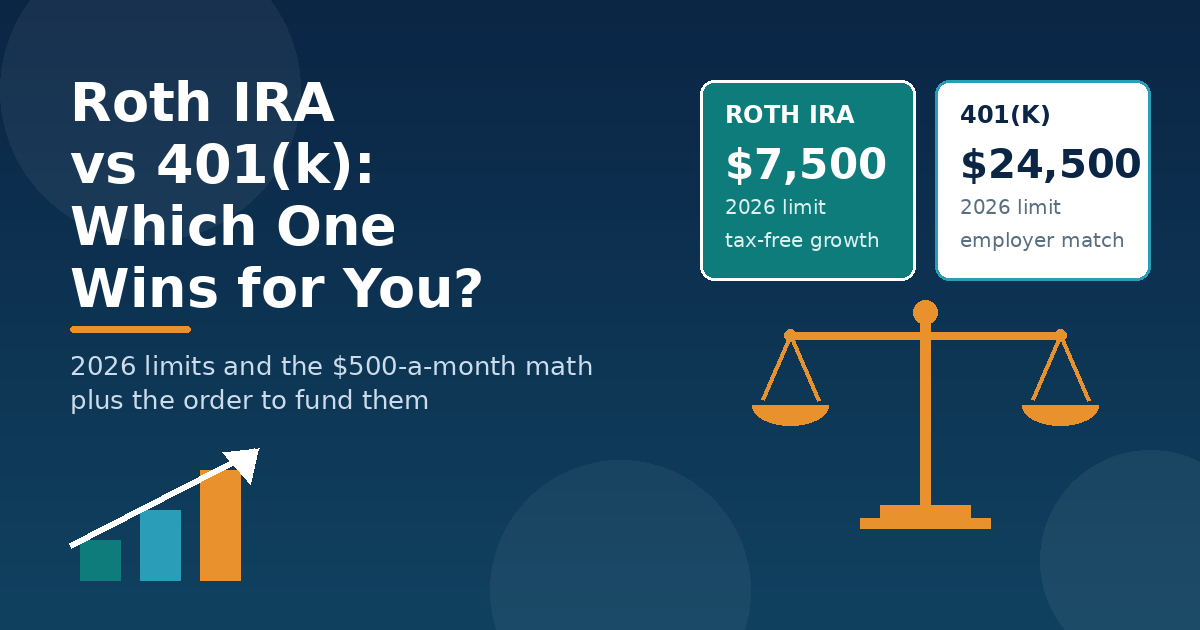
The IRS sets the caps each year; the 2026 figures (IR-2025-111 and Notice 2025-67, November 13, 2025) rose again. For 2026 you can put up to $24,500 of your own pay into a 401(k), 403(b), governmental 457 plan or the federal Thrift Savings Plan, up from $23,500 in 2025. Workers aged 50 or older can add an $8,000 catch-up, for a total of $32,500. Workers who turn 60, 61, 62 or 63 during 2026 get a higher catch-up of $11,250 instead, for $35,750. From 2026, catch-up contributions must go into a Roth account for certain higher earners — those whose prior-year wages from their current employer exceed $150,000.
The IRA limit rose too: $7,500 for 2026, up from $7,000, across all your traditional and Roth IRAs combined — not $7,500 in each. The catch-up at 50 or older is $1,100, up from $1,000, for $8,600 in total. IRA contributions cannot exceed your taxable compensation for the year, and you have until April 15, 2027 to make a 2026 contribution. The 401(k) and IRA limits are separate. Most savers will never hit these caps — they are ceilings, not expectations — but the room is there when you need it: a 55-year-old can shelter $32,500 a year in a 401(k) plus $8,600 in an IRA.
The Employer Match Comes First
If your employer offers a 401(k) match, capturing the full match is the first move, before anything else. A common formula is 50 cents per dollar up to 6% of pay, or a dollar for dollar up to 3% plus 50 cents up to 5%. Either way the match is an instant, guaranteed return — 50% or 100% the moment the money lands — and no investment beats a guaranteed return of that size. Leaving part of the match unclaimed is the closest thing to refusing a pay rise. Work out your plan's formula, set your contribution high enough to earn the whole match, then raise the rate toward 15% of pay including the match.
What to Do If You Are Behind
Being behind at 45 or 55 is common — the Vanguard medians above prove it — and it is fixable, because the levers get stronger with age. First, use the catch-up room: from 50, add $8,000 a year to a 401(k) and $1,100 to an IRA; from 60 to 63 the 401(k) catch-up rises to $11,250. Second, raise your savings rate in steps: one extra percentage point a year, or half of every pay rise, compounds into a large change over a decade. Third, consider working a little longer: each extra year adds contributions, adds growth, and shortens the retirement your savings must fund. Finally, look at the spending side: a retirement that costs 20% less needs roughly 20% less saved.
A note on the 7% return: every projection here uses 7% a year as an illustrative assumption, with monthly compounding and no fees, taxes or inflation taken out. Real returns vary widely and no return is guaranteed — treat the monthly figures as a way to compare starting ages, not as a promise.
Frequently Asked Questions
How much should I have saved for retirement by 30?
About 1× your annual salary — $60,000 on a $60,000 salary. It assumes you started saving around 25 at roughly 15% of pay including any employer match. If you are short, fix the savings rate: the gap at 30 is the cheapest you will ever close.
How much should I have saved by 50?
About 6× your salary — $360,000 on $60,000, $480,000 on $80,000, $600,000 on $100,000. By 50, growth on the balance starts doing as much work as new contributions. From 50, catch-ups add $8,000 to a 401(k) and $1,100 to an IRA for 2026.
How much do I need to save per month to retire with $1 million?
At an illustrative 7% annual return with monthly compounding, starting from zero: $329 a month from age 25, $700 a month from 35, or $1,601 a month from 45 — all reaching $1,000,000 by 67. The 7% figure is an assumption, not a promise.
Is saving 15% of my income enough for retirement?
Fidelity's modelling says 15% of pre-tax income a year, including any employer match, from 25 should reach about 10× salary by 67, with Social Security covering part of retirement income. Your own figure depends on when you start, when you retire, and the lifestyle you want.
What is the 401(k) contribution limit for 2026?
$24,500, up from $23,500 in 2025. At 50 or older add an $8,000 catch-up, for $32,500; at 60–63 add $11,250 instead, for $35,750. The IRA limit is $7,500, or $8,600 at 50 or older. Source: IRS Notice 2025-67.
What if I am 50 and have almost nothing saved?
Start with the employer match, then use the catch-up room — $8,000 extra into a 401(k) and $1,100 into an IRA for 2026 — and raise your savings rate by a point a year. Consider working a year or two longer: each extra year adds contributions and growth, and shortens the retirement your savings must fund.
Sources: Fidelity — "How much do I need to retire?" (savings milestones 1× by 30, 3× by 40, 6× by 50, 8× by 60, 10× by 67; 15% savings rate from age 25; savings replacing about 45% of pre-retirement income); IRS news release IR-2025-111 and Notice 2025-67 (2026 limits: 401(k) $24,500, catch-up $8,000, ages 60–63 catch-up $11,250, IRA $7,500, IRA catch-up $1,100, Roth catch-up wage threshold $150,000); Vanguard — How America Saves 2026 (average and median 401(k) balances by age, balances as of December 31, 2025; overall average $167,970, median $44,115). Monthly-saving and growth figures were calculated independently at an illustrative 7% annual return with monthly compounding, starting from zero. This article explains the maths and is not financial advice.
Related reading: How to Calculate Your FIRE Number · How to Calculate 401(k) Growth · Should You Invest or Pay Off Debt First?
Planning your retirement? If you want help working out your savings rate, your pension options or a debt payoff plan, book a free consultation with Asad Webs — we will help you work out the numbers before you commit.

Be the first to share a useful question or thought.