
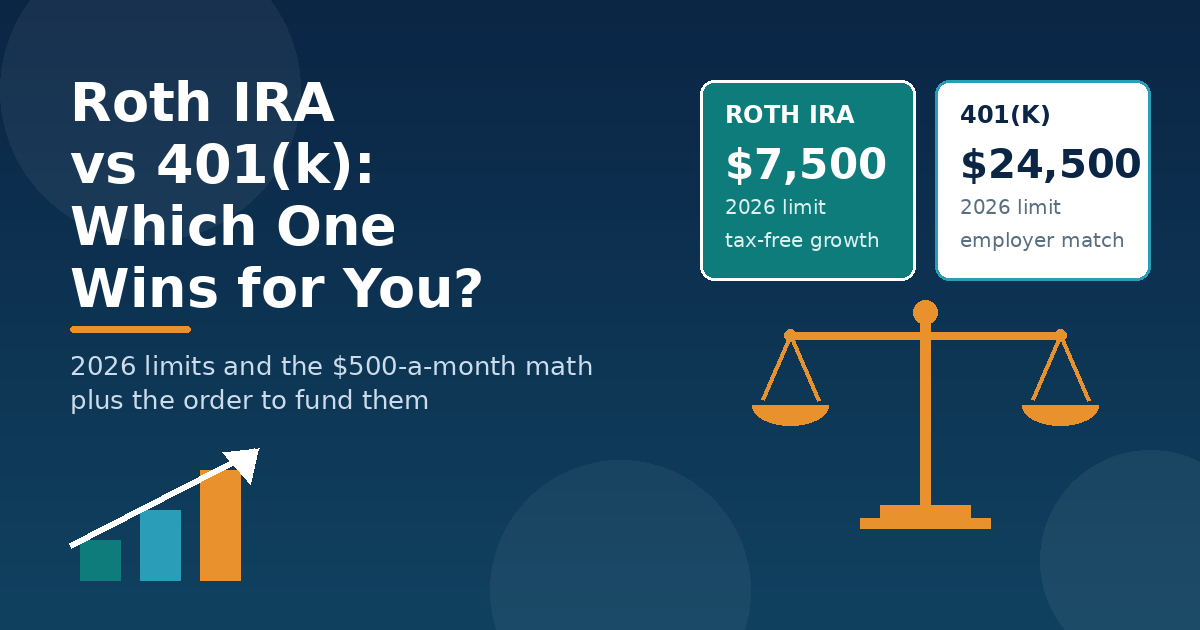
Short answer: neither IRA wins in every case — the winner is your tax rate now versus your tax rate in retirement. With a Roth IRA you pay tax now and all growth comes out tax-free. With a traditional IRA you take the tax break now and pay tax on every dollar withdrawn. Lower rate later? The traditional wins. Higher rate? The Roth wins. Same rate? A tie. For 2026 the limit is $7,500 for either type ($8,600 if 50 or older). Below, $7,000 a year for 30 years at an illustrative 7% grows to $661,226 either way — only the tax bill differs.
Try it now: open the free Roth IRA Calculator and enter your contribution, expected return and tax rate. It projects your tax-free growth against the same money in a traditional IRA — no sign-up, no download.
How Each IRA Taxes You
The two accounts hold the same investments; only the timing of the tax differs. A Roth IRA is funded with money you have already paid tax on: no deduction when you contribute, but qualified withdrawals in retirement, including all growth, are completely tax-free. A traditional IRA works the other way round: contributions are often tax-deductible, growth is tax-deferred, and every dollar withdrawn is taxed as income.
Both accounts share the same limit and deadline: for 2026 the combined limit is $7,500 under 50, or $8,600 if 50 or older — the catch-up rose from $1,000 to $1,100. Contributions cannot exceed your taxable compensation; 2026 contributions can be made up to April 15, 2027. Early withdrawals differ too: money taken from a traditional IRA before 59½ is taxed as income plus a 10% penalty. A Roth is more forgiving — original contributions can come out at any age, tax-free and penalty-free. Earnings are stricter: tax-free only after five tax years and age 59½ (or another qualifying event, such as disability or a first home purchase).
Roth IRA vs Traditional IRA: Side by Side
| Feature | Roth IRA | Traditional IRA |
|---|---|---|
| Tax when you contribute | None — after-tax money | Often deductible |
| Tax when you withdraw | $0 on qualified withdrawals | Every dollar taxed as income |
| 2026 contribution limit | $7,500 ($8,600 at 50+) | $7,500 ($8,600 at 50+), shared |
| Income limit | Yes — phases out above $153,000 single / $242,000 joint | None; the deduction phases out with a workplace plan |
| Required minimum distributions | None during the owner's lifetime | Must start at 73 (75 from 2033) |
| Early access to contributions | Anytime, tax-free and penalty-free | Taxed plus 10% penalty before 59½ |
| Best when | Your tax rate now is lower than in retirement | Your tax rate now is higher than in retirement |
That last row is the whole decision: each account is a bet on the direction of your tax rate. Young workers in a low bracket, and anyone expecting a pension or rental income in retirement, usually do better with the Roth. Peak earners expecting a lower income in retirement usually do better with the traditional IRA.
The 2026 Limits That Decide It for You
Check whether the income limits have already decided for you: above the Roth ceiling, you cannot contribute directly. The traditional IRA has no ceiling on contributing, but the deduction phases out with a workplace plan such as a 401(k).
| Rule for 2026 | Single / head of household | Married filing jointly |
|---|---|---|
| Roth IRA — full contribution | Modified AGI below $153,000 | Modified AGI below $242,000 |
| Roth IRA — reduced contribution | $153,000 to $168,000 | $242,000 to $252,000 |
| Roth IRA — no direct contribution | $168,000 or more | $252,000 or more |
| Traditional deduction (covered) — full | Modified AGI $81,000 or less | Modified AGI $129,000 or less |
| Traditional deduction (covered) — partial | $81,000 to $91,000 | $129,000 to $149,000 |
| Traditional deduction (covered) — none | $91,000 or more | $149,000 or more |
Two details catch people out: if neither spouse is covered by a workplace plan, your traditional contribution is fully deductible at any income. If only your spouse is covered, your joint-return deduction phases out over $242,000 to $252,000. Above the Roth ceiling, the workaround is a backdoor Roth IRA, but the pro-rata rule can tax part of the conversion — check with a tax professional first. Figures: IRS Notice 2025-67 and Publication 590-A.
The Break-Even Maths: $7,000 a Year for 30 Years
A saver puts $7,000 into an IRA each year-end for 30 years at an illustrative 7%. The future value is $7,000 × 94.4608, the 30-year annuity factor at 7% — $661,226. Total contributions are $210,000; $451,226 is growth. The 7% is an assumption, not a promise — real returns vary.
Compare equal out-of-pocket cost, not equal contributions. A $7,000 Roth contribution costs $7,000 after tax. To spend the same $7,000 after tax on a traditional IRA at a 22% marginal rate, contribute $7,000 ÷ (1 − 0.22) = $8,974 before tax — the $1,540 saved is part of the deal. On that basis the traditional IRA grows to $847,725 before tax; what you keep depends on your retirement rate:
| Scenario (22% today) | Roth IRA after tax | Traditional IRA after tax | Winner |
|---|---|---|---|
| Retirement rate 12% | $661,226 | $745,998 | Traditional, by $84,773 |
| Retirement rate 22% | $661,226 | $661,226 | Exact tie |
| Retirement rate 32% | $661,226 | $576,453 | Roth, by $84,773 |
Where the Roth wins. Maya is 30, earns $65,000 in the 22% bracket, and expects a pension and higher income in retirement — the 32% bracket then. She puts $7,000 after tax into a Roth each year and ends with $661,226, all hers. The same cost in a traditional IRA would grow to $847,725 but lose 32% ($271,272), keeping $576,453. The Roth leaves her $84,773 ahead.
Where the traditional wins. David is 52, earns $140,000 in the 22% bracket and expects retirement income taxed at 12%. He puts $8,974 before tax in each year — the same $7,000 after-tax cost — saving $1,540 a year. After 30 years he holds $847,725, pays 12% ($101,727) and keeps $745,998 — $84,773 more than the Roth. On an equal-cost basis only the gap between the two rates matters; forgetting the $1,540 a year of tax saving makes the traditional IRA look $79,347 worse than it is.
After-tax value after 30 years — hover or tap each bar for details.
Who Should Pick Which
Pick the Roth IRA if you are early in your career, in the 10% or 12% bracket, or expecting raises, a pension or rental income that will push your retirement rate above today's. The Roth also wins on flexibility: no required minimum distributions during your lifetime, and contributions can come out at any time without tax or penalty — useful as an emergency backstop, though raiding retirement savings should be a last resort.
Pick the traditional IRA if you are in your peak earning years, in the 22% bracket or above, expecting your income to fall in retirement. The deduction is worth real money now — $1,540 a year on $7,000 at 22% — and at a 12% retirement rate you keep $84,773 more than the Roth. It is also the right call when the Roth limits shut you out but you still qualify for the full deduction. Under SECURE 2.0, traditional owners must start annual withdrawals at 73 (born 1951–1959) or 75 (born 1960 or later). Those withdrawals are taxed whether you need the money or not; missing one costs a 25% penalty, cut to 10% if corrected promptly. Roth owners never face lifetime RMDs.
The Split Strategy: Why Many Savers Use Both
If you cannot predict your retirement tax rate — and nobody can thirty years out — splitting is the honest answer. The $7,500 limit for 2026 is combined across both accounts, so you might put $4,000 in a traditional IRA and $3,500 in a Roth, then adjust as your income changes: weight the Roth early on, the traditional in peak earning years, and the Roth again near retirement. Splitting also hedges against tax law itself — the RMD age has already moved twice in five years.
Frequently Asked Questions
Can I contribute to both a Roth IRA and a traditional IRA in the same year?
Yes. The 2026 limit of $7,500 ($8,600 at 50+) covers all your IRAs combined, not each account. Split it as you like — say $4,000 traditional and $3,500 Roth — within the limit and your taxable compensation.
What happens if I earn too much for a Roth IRA?
For 2026, direct Roth contributions phase out at $153,000–$168,000 of modified AGI for single filers, and $242,000–$252,000 for joint filers. Above that you cannot contribute directly, but you can still contribute to a traditional IRA. Some high earners use a backdoor Roth instead, but the pro-rata rule can tax the conversion.
Is a traditional IRA still worth it if I cannot deduct the contribution?
Usually not as a first choice. A nondeductible contribution still grows tax-deferred, but withdrawals are taxed and the account carries RMDs, while a Roth offers tax-free growth and no lifetime RMDs. Track nondeductible basis on IRS Form 8606 to avoid being taxed twice.
Do Roth IRAs really have no required minimum distributions?
For the original owner, yes — a Roth owner never takes lifetime RMDs. Traditional owners must start at 73 or 75 (born 1951–1959, or 1960 and later). Beneficiaries must generally empty an inherited Roth within 10 years, though withdrawals stay tax-free if the five-year rule was met.
Can I withdraw my Roth IRA contributions before retirement?
Yes. Original Roth contributions can be withdrawn at any age, for any reason, tax-free and penalty-free. Only earnings are restricted: tax-free after five tax years and age 59½. Withdraw earnings early and they are taxed as income, usually plus a 10% penalty.
What is the deadline for 2026 IRA contributions?
April 15, 2027, for the 2026 tax year; you can contribute any time from January 1, 2026. The limit is $7,500, or $8,600 at 50 or older.
Sources: IRS, "401(k) limit increases to $24,500 for 2026, IRA limit increases to $7,500" (Nov 13, 2025); IRS Notice 2025-67; IRS Publications 590-A and 590-B (2025); SECURE 2.0 Act of 2022. The 7% return is illustrative, not a forecast; all figures were verified by calculation. Not financial advice — confirm your situation with a qualified tax professional.
Related reading: How to Calculate Roth IRA Growth · How Much Tax Do You Pay on Capital Gains · How to Calculate Your FIRE Number
Planning your retirement savings? If you are working out which account fits your income and tax rate, book a free consultation with Asad Webs — we will help you run the numbers before you commit.


Be the first to share a useful question or thought.