
A £425,000 first-time buyer purchase in England or Northern Ireland costs £6,250 in Stamp Duty Land Tax (SDLT) — an effective rate of 1.47%. The tax is marginal, slice by slice: 0% on the first £300,000, then 5% on the £125,000 slice from £300,001 to £425,000, so only that slice is taxed. The free UK Stamp Duty Calculator takes your price, buyer type and nation and returns the exact slice-by-slice breakdown. Rates are as checked in October 2026 — confirm the current figures at gov.uk before exchange. General information only — not financial advice.
Stamp duty is the tax many buyers only meet for the first time at the point of purchase, and it is the tax most commonly misunderstood, because people apply the headline rate to the whole price. That single error can misstate the bill by thousands of pounds. This guide explains how the marginal bands work, walks through the calculator step by step, shows a fully worked example at £425,000 for all three buyer types, and flags the devolved nations where different taxes apply.
Tool Preview: The UK Stamp Duty Calculator In Use
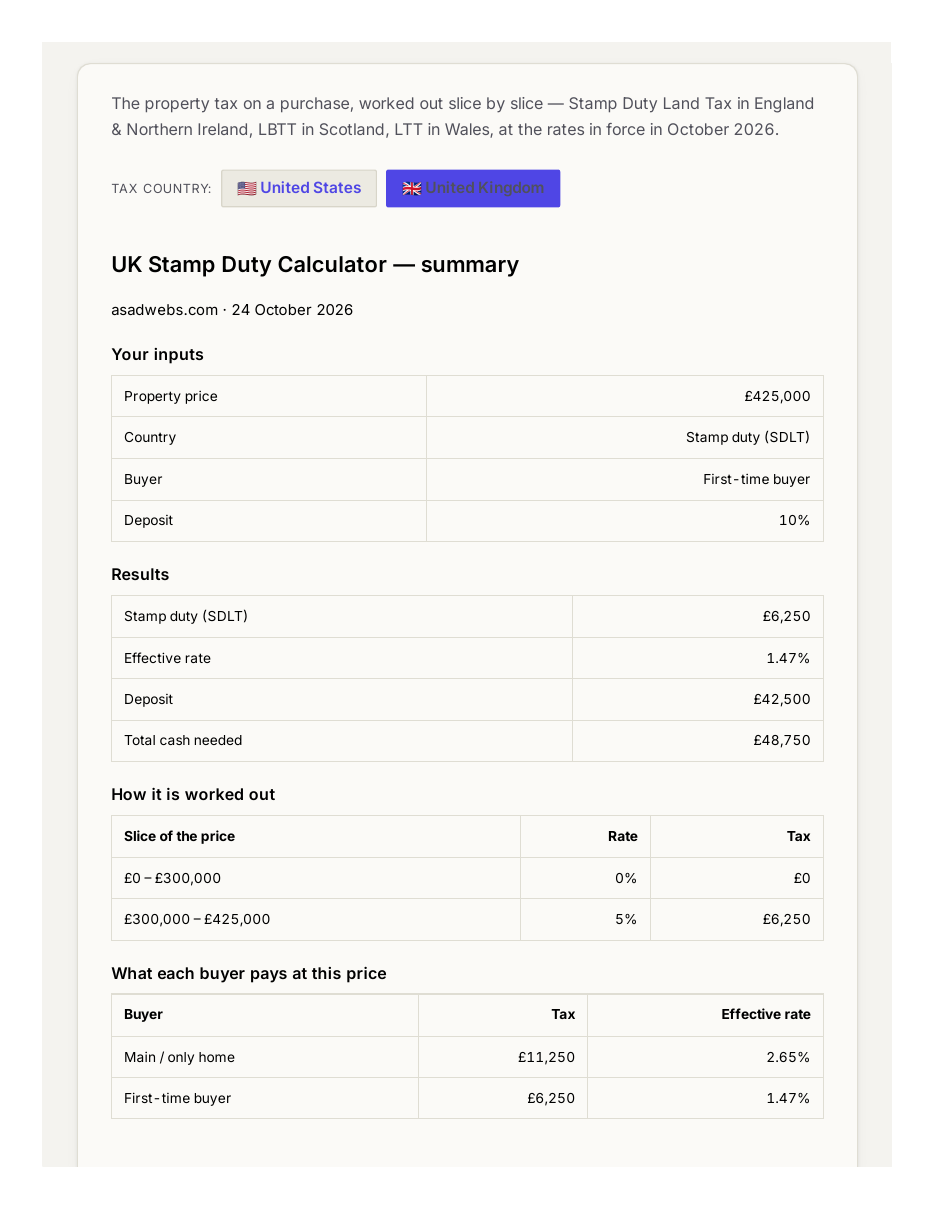
The UK Stamp Duty Calculator in use: a £425,000 first-time buyer purchase in England & Northern Ireland, SDLT £6,250.
Using the UK Stamp Duty Calculator, Step by Step
- Enter the purchase price. Type the full agreed price — £425,000 in our example. The calculator applies the bands to this figure, not to your deposit or mortgage amount.
- Choose the buyer type. Select first-time buyer, main or only home, or additional property. The rate structure changes completely between these — at £425,000 the answers range from £6,250 to £32,500, so this choice matters enormously.
- Choose the nation. Stamp Duty Land Tax applies in England and Northern Ireland. Scotland charges Land and Buildings Transaction Tax (LBTT) and Wales charges Land Transaction Tax (LTT), each with its own bands — the guide covers these below.
- Read the slice breakdown. The result shows each band as its own slice with the rate, the taxable portion and the tax on that slice, then the total and the effective rate. Our example returns SDLT of £6,250, an effective rate of 1.47% and a top band rate of 5%.
- Record the deposit alongside it. A 10% deposit on £425,000 is £42,500; with the £6,250 SDLT the total cash needed on top of the mortgage is £48,750. Keeping the deposit and the tax in one place stops the classic mistake of budgeting for the deposit and discovering the duty later.
The Formula in Plain Language: Slices, Not Flat Rates
SDLT is not a percentage of the price. It is a stack of slices, each taxed at its own rate, like a tiered wedding cake where only each new layer pays the higher rate. For a first-time buyer in England and Northern Ireland, the tool states the relief exactly:
"First-time buyer relief: 0% up to £300,000, then 5% from £300,001 to £500,000. Above £500,000 the relief is lost entirely."
In plain arithmetic: SDLT = (slice 1 × its rate) + (slice 2 × its rate) + …. For the £425,000 example there are two slices: £0–£300,000 at 0% contributes £0, and £300,001–£425,000 at 5% contributes £125,000 × 0.05 = £6,250. The relief's cliff edge at £500,000 is worth memorising: go £1 above it and the first-time buyer relief disappears entirely, which is why a price just under the threshold can be dramatically cheaper overall than a price just over it.
Rates move — always check before exchange. Stamp duty bands and reliefs change at Budgets and fiscal events. The figures in this guide are as checked in October 2026; before you exchange contracts, confirm the current bands on gov.uk (England & Northern Ireland), the Revenue Scotland site (LBTT) or the Welsh Revenue Authority site (LTT). A last-minute rate change between your calculation and completion can alter the bill.
Worked Example: £425,000 First-Time Buyer, England & Northern Ireland
Every figure below is exactly as the calculator returns it:
| Slice of price | Rate | Taxable slice | SDLT due |
|---|---|---|---|
| £0 – £300,000 | 0% | £300,000 | £0 |
| £300,001 – £425,000 | 5% | £125,000 | £6,250 |
| Total | Top band 5% | £425,000 | £6,250 |
Check the effective rate: £6,250 ÷ £425,000 = 0.0147, i.e. 1.47%. The effective rate is always lower than the top band rate when lower slices are taxed at lower rates — this is precisely why "the rate is 5%" and "you pay 5%" are two different statements. And notice the flat-rate fallacy destroyed by the table: applying 5% to the whole £425,000 would claim £21,250, more than triple the true £6,250. That is the mistake the marginal system exists to avoid, and the mistake the calculator exists to prevent.
SDLT on a £425,000 purchase by buyer type — hover or tap each bar for details.
The chart makes the buyer-type choice visible at a glance: the same £425,000 price produces a £26,250 spread between a first-time buyer and an additional-property buyer. The lesson is that "how much stamp duty" is the wrong question on its own — the right question is "how much stamp duty for a buyer like me".
Same Price, Three Bills: The Comparison Table
| Buyer type | SDLT on £425,000 | Effective rate | Vs first-time buyer |
|---|---|---|---|
| First-time buyer | £6,250 | 1.47% | — |
| Main / only home | £11,250 | 2.65% | Pays £5,000 more |
| Additional property | £32,500 | 7.65% | Pays £26,250 more |
The comparison is the relief's value in cash: a first-time buyer saves £5,000 against a main-home purchase at this price (£11,250 − £6,250). The additional-property figure includes the higher-rate surcharge that applies when the property is not the buyer's only home — a reminder that "buying a second property" is a tax category with real consequences, not just a lifestyle choice. The surcharge alone (£32,500 − £11,250 = £21,250) is more than the entire first-time buyer bill.
Deposit Plus Duty: The Full Cash Picture
Stamp duty is paid in cash alongside the deposit, so the two must be planned together. On the £425,000 example with a 10% deposit:
- Deposit: 10% × £425,000 = £42,500
- SDLT (first-time buyer): £6,250
- Total cash needed: £42,500 + £6,250 = £48,750
That £48,750 is the honest answer to "how much cash do I need to buy?" on these terms — before fees, survey and moving costs. A 5% deposit would cut the deposit to £21,250, but the £6,250 duty does not shrink with it, and smaller deposits usually mean higher mortgage rates. Run the calculator's SDLT figure through the Mortgage Calculator thinking alongside our guide to how to calculate a mortgage payment to see the monthly side of the same purchase.
The £500,000 relief cliff. Quoting the calculator: "First-time buyer relief: 0% up to £300,000, then 5% from £300,001 to £500,000. Above £500,000 the relief is lost entirely." Buying at £500,001 instead of £500,000 does not just add tax on the extra £1 — it removes the relief from the whole price. If your agreed price is near the threshold, negotiate the price, not just the tax.
Scotland and Wales Use Different Taxes
SDLT stops at the border. Scotland charges Land and Buildings Transaction Tax (LBTT), administered by Revenue Scotland, and Wales charges Land Transaction Tax (LTT), administered by the Welsh Revenue Authority. Each has its own bands, its own first-time buyer treatment and its own surcharges. A £425,000 purchase in Edinburgh or Cardiff produces a different bill from the same price in England or Belfast. Do not apply the figures in this guide across the border — use the relevant revenue authority's own calculator for the nation where the property sits.
Six Mistakes That Inflate (or Understate) the Bill
1. Applying the headline rate to the whole price. The classic error: 5% of £425,000 is £21,250, but the real bill is £6,250 because only the slice above £300,000 pays 5%. Always slice first, then rate.
2. Quoting the effective rate as the rate. "I pay 1.47%" is the average across slices, not the rate that applies to the next £1. The next £1 of price costs 5p of duty — the top band rate — which is what matters when negotiating a price change.
3. Forgetting the relief vanishes above £500,000. The tool's own note warns of this: relief applies to £300,001–£500,000, and above £500,000 it is lost entirely. A £501,000 purchase is taxed as a standard transaction.
4. Mixing nations' rules. LBTT and LTT are separate taxes with separate bands. English SDLT figures applied to a Scottish purchase are simply wrong.
5. Ignoring the additional-property surcharge. Buyers acquiring a second property while keeping the first sometimes assume the "main home" bill — the surcharge more than doubles it at £425,000 (£11,250 → £32,500).
6. Forgetting duty in the cash plan. The duty is cash, due on completion alongside the deposit. A plan that funds the £42,500 deposit but not the £6,250 duty is £6,250 short on moving day.
Building a property website? Estate agents, brokers and conveyancers who answer buyer questions with honest calculator-backed guides earn the enquiries — this article is an example of the format. Book a free consultation with Asad Webs to discuss finance explainers and interactive tools for your own property audience.
For the tax-on-a-price maths behind invoices and receipts, our guide to how to calculate sales tax walks through adding tax and extracting it from a tax-inclusive total in both directions.
Frequently Asked Questions
How is UK stamp duty actually calculated?
Marginally, slice by slice. Each portion of the price falls into a band with its own rate, and you pay that rate only on that portion. A first-time buyer at £425,000 pays 0% on £0–£300,000 (£0) and 5% on £300,001–£425,000 (£6,250), for a total of £6,250. The calculator on this page performs the same slice breakdown for any price, buyer type and nation.
What stamp duty does a first-time buyer pay on £425,000?
£6,250 in England or Northern Ireland — 0% on the first £300,000 and 5% on the remaining £125,000, an effective rate of 1.47%. With a 10% deposit of £42,500, the total cash needed is £48,750.
How much does a first-time buyer save compared with a main-home purchase?
At £425,000 the saving is £5,000: the first-time buyer pays £6,250 while a main/only home purchase pays £11,250 (2.65%). An additional property at the same price pays £32,500 (7.65%) including the higher-rate surcharge.
What happens if the price is above £500,000?
The first-time buyer relief is lost entirely above £500,000, so the purchase is taxed at standard rates on the full price. Near the threshold, the tax difference between just under and just over £500,000 can be very large — confirm the current position at gov.uk before exchange.
Does stamp duty apply in Scotland and Wales?
No — Scotland charges Land and Buildings Transaction Tax (LBTT) and Wales charges Land Transaction Tax (LTT), each with their own bands and rules administered by their own revenue authorities. This guide's figures are for England and Northern Ireland only.
Is the effective rate the same as the tax rate?
No. The effective rate (1.47% at £425,000 for a first-time buyer) is the total tax divided by the price — an average across the slices. The top band rate (5%) is what applies to the next £1 of price, and it is the figure that matters when the price changes during negotiation.
Do I pay stamp duty on the deposit or the full price?
The full price. SDLT is calculated on the purchase price of the property, not on your deposit or mortgage amount. That is why the duty and the deposit must be planned together as one cash figure — £48,750 in our worked example. This guide is general information, not financial advice; confirm current rates at gov.uk before exchange.
Be the first to share a useful question or thought.